


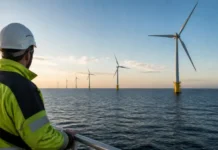
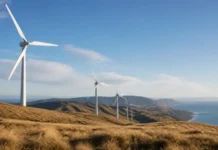
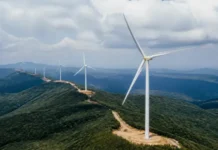




















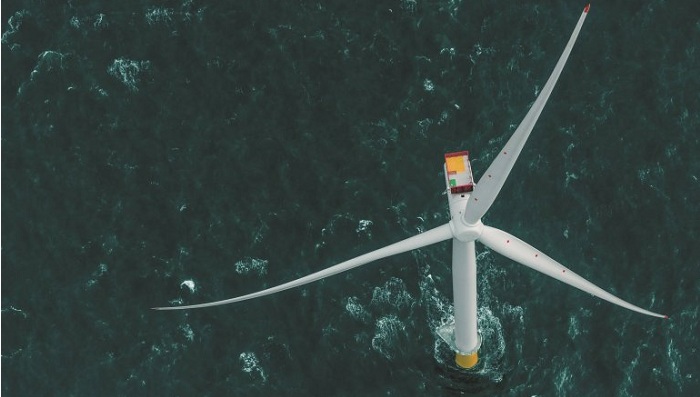

The wind off the U.S. coasts could be used to generate more than double the combined electricity capacity of all the nation’s electric power plants, reports have suggested. But building wind turbines offshore is expensive, requiring parts to be transported at least 30 miles off land.
Purdue University engineers are conducting research on a way to make these parts out of 3D-printed concrete, a less expensive material that would also allow parts to float to a site from an onshore plant.
“One of the current materials used to manufacture anchors for floating wind turbines is steel,” said Pablo Zavattieri, a professor in Purdue’s Lyles School of Civil Engineering. “However, finished steel structures are much more expensive than concrete.”
Conventional concrete manufacturing methods also require a mold to shape the concrete into the desired structure, which adds to costs and limits design possibilities. Using 3D-printing would eliminate the expenses of this mold.
The university researchers are working in collaboration with RCAM Technologies, a startup founded to develop concrete additive manufacturing for onshore and offshore wind energy technology.
“Purdue’s world-class capabilities and facilities will help us develop these products for offshore products for the U.S. Great Lakes, coastal and international markets,” said Jason Cotrell, CEO of RCAM Technologies. “Our industry also needs universities such as Purdue to provide the top-quality university students for our workforce needs for these cutting-edge technologies.”
The work also is funded by the National Science Foundation INTERN program. The team is developing a method that would involve integrating a robot arm with a concrete pump to fabricate wind turbine substructures and anchors.
The group’s current research involves scaling up their 3D printing by using a mixture of cement, sand, aggregates and chemical admixtures to control shape stability when concrete is still in a fresh state.
“Offshore wind power is a nearly perfect platform for testing 3D printing,” said Jeffrey Youngblood, a Purdue professor of materials engineering.
The goal is to understand the feasibility and structural behavior of 3D-printed concrete produced on a larger scale than what the team has previously studied in the lab. The researchers will determine how gravity affects the durability of the larger-scale 3D-printed structure.
“The idea we have for this project is to scale up some of the bioinspired design concepts we have proven on a smaller scale with the 3D printing of cement paste and to examine them on a larger scale,” said Mohamadreza “Reza” Moini, a Ph.D. candidate in civil engineering at Purdue.
“Printing geometric patterns within the structure and being able to arrange the filaments through or playing around with distribution of the steel are both possibilities we have considered for optimizing and reinforcing the structures,” said Jan Olek, Purdue’s James H. and Carol H. Cure Professor of Civil Engineering.