































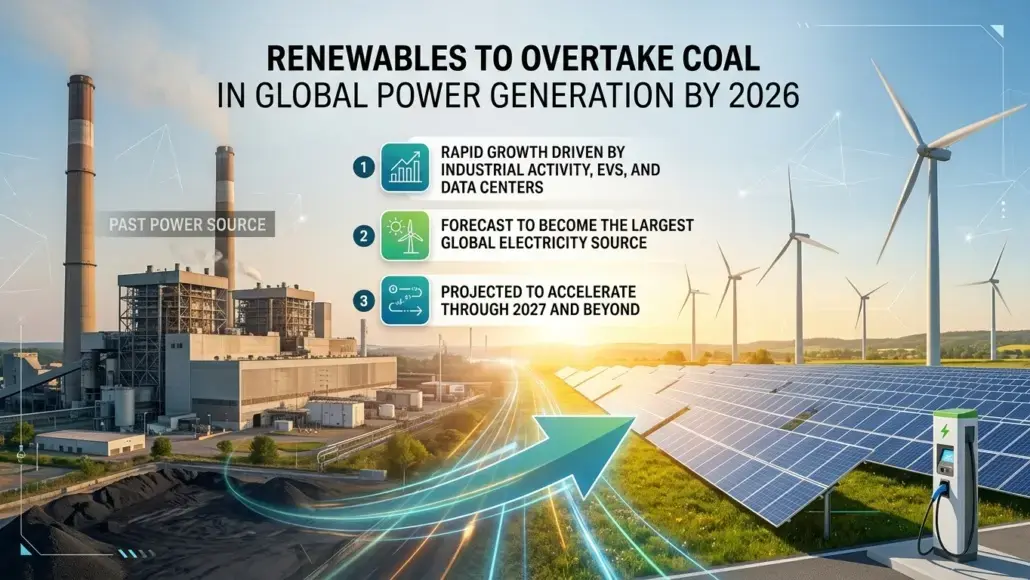

The International Energy Agency (IEA) reports that global renewable electricity generation is forecast to accelerate through 2027, driven by expanding industrial activity, electric vehicle adoption, cooling systems, household appliances, and data centers. According to the IEA’s Electricity Mid-Year Update 2026, renewable energy will become the world’s largest source of electricity generation in 2026, overtaking coal after almost matching its output in 2025. Renewable electricity generation is projected to grow by more than 8% in 2026, boosting its share of global power generation from 33% in 2025 to 37% by 2027.
Solar PV to Become Second-Largest Renewable Source
Solar PV is expected to account for the largest share of new electricity supply expansion. The IEA projects global solar PV generation to rise by around 600 TWh in 2026, matching the record growth achieved in 2025. This milestone will allow solar PV to overtake wind power and become the world’s second-largest renewable electricity source behind hydropower in 2026, with similar growth projected for 2027.
Regional Growth Trends and Energy Security
The growing share of renewable energy generation has helped diversify electricity supplies and significantly improved energy security, even as global markets faced higher generation costs linked to Middle East tensions early this year. Although additional LNG supplies, particularly from North America, helped ease market pressures, higher gas prices prompted several countries in Asia and Europe to switch part of their generation from natural gas to coal.
Overall global electricity consumption is projected to increase from 28,600 TWh in 2025 to 30,700 TWh by 2027. Global electricity demand is expected to grow by 3.6% in 2026 and 3.8% in 2027, up from the 3% growth recorded in 2025. Consumption across major global power markets shows steady expansion:
- China’s demand is projected to grow by 5.5% in 2026, supported by manufacturing and EV charging.
- India’s demand is expected to rebound by 7% after a subdued 1.6% in 2025.
- US and European Union electricity demand is forecast to grow by around 2%, driven by electrification, cooling needs, and data centers.
Grid Flexibility and System Reliability
Weather conditions remain a key uncertainty for electricity markets. A stronger-than-expected El Niño event could increase electricity consumption through higher cooling needs while reducing hydropower and wind generation in some regions, temporarily raising dependence on fossil fuel generation. At the same time, the ongoing expansion of renewable energy is making negative wholesale electricity prices more frequent in certain markets, highlighting the growing need for grid flexibility, battery energy storage, and demand response to maintain energy security and reliable electricity systems.