
























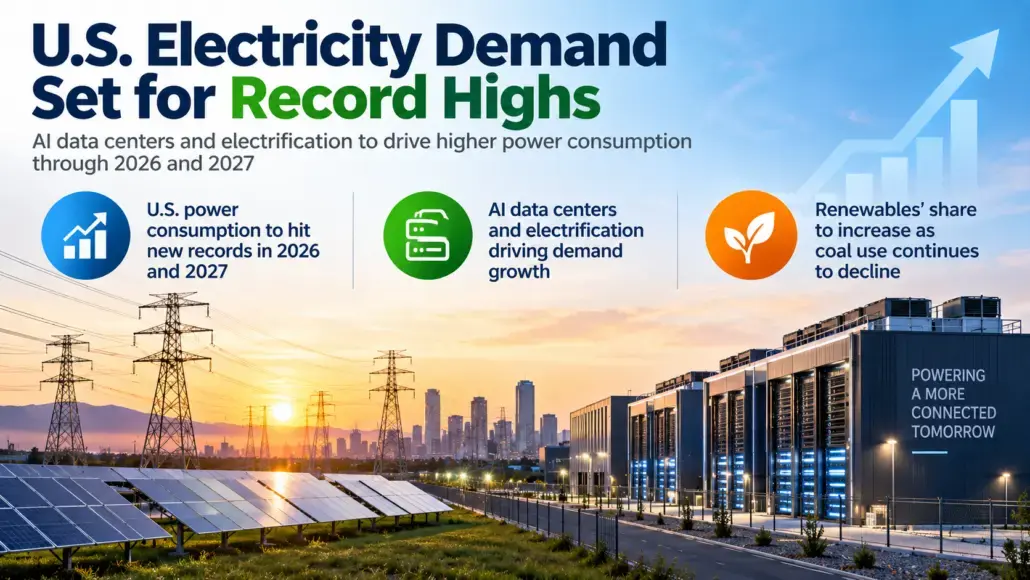

The United States is on course to set consecutive records in electricity consumption through 2026 and 2027, driven largely by the rapid expansion of artificial intelligence infrastructure and the broader electrification of homes, businesses, and transportation, according to the U.S. Energy Information Administration’s latest Short-Term Energy Outlook (STEO), released on Wednesday.
EIA Projects Sustained Growth in Electricity Demand
The EIA forecast that total U.S. power consumption will climb from a record 4,195 billion kilowatt-hours (kWh) in 2025 to 4,270 billion kWh in 2026, and further to 4,349 billion kWh in 2027. The agency attributes this sustained upward trajectory to data centers serving artificial intelligence and cryptocurrency operations, alongside a growing shift away from fossil fuels for heating and transport across both residential and commercial sectors.
U.S. power demand, according to the outlook, is being shaped by structural changes in how energy is consumed nationwide, with technology infrastructure playing an increasingly central role.
West South Central Region Leads Electricity Sales Growth
Despite a temporary pause on connecting new data center projects to the grid in Texas, the West South Central region has emerged as the largest contributor to electricity sales growth in the EIA’s forecast period. This underscores the region’s continued significance as a hub for large-scale power-intensive facilities, even as grid interconnection challenges create short-term friction.
Sector-by-Sector Electricity Sales Breakdown for 2026
The EIA provided detailed projections for electricity sales by customer category in 2026. Commercial customers are expected to account for 1,542 billion kWh, surpassing residential consumers at 1,527 billion kWh and industrial customers at 1,059 billion kWh.
These figures represent notable milestones when placed against historical benchmarks. Residential electricity consumption reached an all-time high of 1,515 billion kWh in 2025, while commercial customers set their record at 1,493 billion kWh in the same year. Industrial electricity consumption peaked at 1,064 billion kWh back in 2000. The 2026 projections are set to exceed all prior records across residential and commercial categories.
Renewable Energy Share Rising as Coal Continues to Decline
The EIA outlook also highlights a continuing shift in the fuel mix used for power generation. The share of electricity generated from coal is projected to fall from 17% in 2025 to 16% in 2026, and further to 14% in 2027. Natural gas is expected to maintain a steady 40% share across both 2026 and 2027, unchanged from 2025.
Renewable energy’s share of total power generation is forecast to grow from approximately 24% in 2025 to 25% in 2026, reaching 27% by 2027. Nuclear power is expected to hold a consistent 18% share in both 2026 and 2027, matching its 2025 contribution.
Natural Gas Consumption Trends Across Key Sectors
On the natural gas side, the EIA projected that residential consumption will ease to 12.5 billion cubic feet per day (bcfd) in 2026, while commercial usage is expected to dip to 9.5 bcfd. Industrial consumption, however, is forecast to rise to 23.9 bcfd, and natural gas use for power generation is expected to reach 36.8 bcfd.
These projections sit alongside historically significant reference points. Residential natural gas consumption peaked at 14.3 bcfd in 1996, while commercial customers reached their all-time high of 9.9 bcfd in 2025. Industrial natural gas use hit its record of 23.8 bcfd in 1973, and power generation consumption matched its 2024 peak of 36.8 bcfd.
AI Data Centers and Electrification Driving the Outlook
The convergence of AI data center expansion and widespread electrification continues to define the trajectory of U.S. power demand through the remainder of the decade. The EIA’s forecast reflects a market in which commercial electricity sales are on pace to exceed residential demand for the first time in 2026, a threshold that underscores the growing weight of technology-driven consumption in the national energy profile.