
































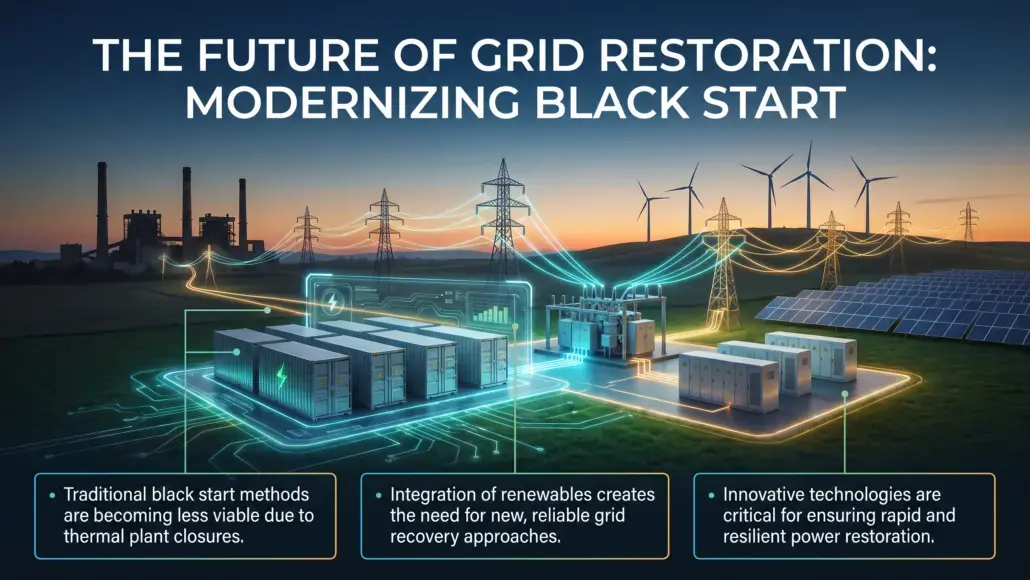

The ability to restore a power grid from a state of total collapse is one of the most critical functions of any utility. Historically, this process, known as a black start, relied on large hydro plants or small diesel generators that could start without an external power supply to provide the initial cranking power for larger thermal units. However, the closure of traditional coal and gas plants, combined with the rise of inverter-based renewable energy, has created a need for new approaches to restoration. Modern black start technologies improving power system recovery capability are now incorporating advanced battery energy storage systems and grid-forming inverters to provide the fast, precise, and reliable power injection needed to re-energize transmission networks. These technologies offer a cleaner and more flexible alternative to traditional fossil-fueled start-up units, ensuring that the grid can be brought back online quickly even in an environment with high levels of decentralized generation. The strategic importance of these restoration assets cannot be overstated, as they form the final line of defense against prolonged societal disruption following a catastrophic failure.
Evolution of Restoration Strategies in Modern Grids
The traditional black start procedure is a bottom-up approach where small “islands” of power are created and then carefully synchronized and merged until the entire system is restored. This process is time-consuming and fraught with technical challenges, particularly regarding the management of reactive power and frequency stability during the initial stages of restoration. The introduction of black start technologies improving power system recovery capability has shifted the focus toward more automated and responsive solutions. Battery energy storage systems, for instance, can provide instantaneous power to energize transformers and transmission lines, overcoming the initial surge currents that often trip traditional mechanical generators. This rapid response is critical for maintaining the momentum of the restoration process and preventing secondary failures.
Additionally, the geographic distribution of restoration assets is changing. In the past, black start capability was concentrated at a few large, strategic sites. Today, the integration of energy storage at the substation level allows for a more distributed restoration strategy. This decentralization reduces the reliance on long, vulnerable transmission paths during the early stages of a restart, significantly improving the overall resilience of the network. The ability of batteries to maintain a constant voltage and frequency independently of the rest of the grid makes them the ideal foundation for building these initial power islands. As more renewable energy is integrated at the distribution level, these localized restoration hubs will become the primary nodes for re-energizing the broader transmission system, providing a more strong and flexible recovery path.
Grid Forming Inverters and Virtual Synchronous Machines
The technical foundation of modern black start capability in renewable-heavy grids is the grid-forming inverter. Unlike standard grid-following inverters, which require a stable external voltage and frequency signal to operate, grid-forming inverters can establish their own reference signal. This capability allows them to act as a virtual synchronous machine, providing the necessary strength to the grid to allow other, less sophisticated units to synchronize and connect. The deployment of black start technologies improving power system recovery capability relies heavily on these inverters to manage the delicate balance of the system as more loads and generators are added during the restoration sequence. The ability to provide this “reference voltage” is the essential difference between a grid that can recover autonomously and one that remains dependent on a shrinking fleet of thermal plants.
Grid-forming technology also provides essential ancillary services such as synthetic inertia and fault current contribution. Inertia is traditionally provided by the rotating mass of large turbines, but as these are decommissioned, the grid becomes more susceptible to rapid frequency deviations. Grid-forming inverters can mimic this inertial response using the energy stored in batteries or capacitors, providing a vital buffer during the highly unstable initial phases of a grid restart. By stabilizing the frequency, these inverters prevent the cascading trips that can occur when bringing large industrial loads back online, thereby speeding up the total recovery time. The sophistication of these inverter control algorithms is a major area of ongoing research, with a focus on ensuring they can handle the complex interactions between multiple grid-forming units operating in close proximity.
Integration of Energy Storage and Synchronous Condensers
While batteries provide the active power needed for start-up, maintaining voltage stability across long transmission lines requires significant amounts of reactive power. In a black start scenario, the capacitance of energized high-voltage lines can cause voltage levels to spike, potentially damaging equipment. To manage this, black start technologies improving power system recovery capability often combine battery storage with synchronous condensers. These are essentially large motors that spin without a load, providing the reactive power support and physical inertia needed to stabilize the voltage and frequency of the emerging grid islands. This combination of digital energy storage and physical rotating mass creates a hybrid system that offers the best of both worlds.
The synergy between batteries and synchronous condensers creates a strong restoration package that can handle the complex electrical dynamics of a modern transmission system. The battery provides the initial energy to spin up the condenser, which then takes over the task of voltage regulation. This combination is particularly effective for re-energizing large wind farms or solar plants, which often require a significant amount of reactive support to begin exporting power. By providing a stable electrical environment, these technologies enable renewable assets to contribute to the restoration process much earlier than was previously possible, reducing the reliance on fossil-fueled backup units. The use of refurbished generators as synchronous condensers is an economically attractive way to repurpose existing assets for these new grid-balancing roles.
Digitalization and Automated Restoration Sequences
The complexity of restoring a modern grid requires a high degree of coordination and precision. Manual restoration procedures are increasingly inadequate for handling the fast-moving dynamics of a system with many small, decentralized nodes. Consequently, the advancement of black start technologies improving power system recovery capability is closely linked to the development of sophisticated Grid Management Systems and automated restoration sequences. These digital platforms use real-time data from sensors across the network to calculate the optimal path for re-energization, automatically adjusting the output of black start units to maintain stability. The automation of these processes reduces the potential for human error during the high-stress environment of a system recovery operation.
Automated sequences can perform hundreds of switching operations in the time it would take a human operator to perform one, drastically reducing the duration of an outage. These systems also include advanced simulation capabilities, allowing operators to run what-if scenarios to ensure that the chosen restoration path is safe and effective. The integration of machine learning algorithms further enhances these systems by identifying patterns in grid behavior during previous outages, allowing the restoration logic to evolve and improve over time. This digital layer ensures that the physical hardware of the black start system is used to its full potential, providing a seamless transition from a total blackout to a fully operational grid. The use of standardized communication protocols is essential for ensuring that these digital tools can interact with equipment from multiple different vendors.
Regulatory Frameworks and Market Incentives
Ensuring that sufficient black start capability is available in a deregulated electricity market requires clear regulatory frameworks and financial incentives. Historically, black start was treated as a mandatory service provided by large generators as part of their connection agreements. In the modern market, however, black start is increasingly treated as a separate ancillary service that must be procured through competitive auctions or long-term contracts. The implementation of black start technologies improving power system recovery capability is often driven by these market signals, which provide the necessary return on investment for high-tech solutions like grid-forming batteries. The development of clear performance metrics for black start providers is essential for ensuring that the grid remains resilient in a competitive environment.
Regulators are also updating the technical requirements for black start providers to reflect the changing nature of the grid. For instance, new standards may require restoration assets to be capable of multiple restarts in quick succession or to provide a minimum amount of reactive support. These stringent requirements favor advanced, versatile technologies over traditional mechanical systems. By creating a transparent and predictable market for black start services, regulators can ensure that the grid remains resilient in the face of increasing environmental and cyber threats. The investment in these recovery technologies is a small price to pay for the security of the power system, which serves as the foundation for all other critical infrastructure, including communication and transportation networks.
Future Resilience and Hardening Strategies
As the threat of extreme weather events and cyberattacks continues to grow, the importance of strong restoration capabilities will only increase. Future developments in black start technologies improving power system recovery capability will likely focus on enhancing the autonomous capabilities of local grid segments, such as microgrids. These small, self-contained systems can provide critical services to local communities during a wide-scale outage and then assist in the re-energization of the broader transmission network once conditions stabilize. The ability of these microgrids to act as local black start hubs will be a key component of the next generation of resilient power systems. This localized approach to recovery ensures that the most critical societal functions can be maintained even during the most severe disturbances.
Additionally, the development of hydrogen-based black start solutions offers a path toward completely carbon-free restoration. Fuel cells or hydrogen-fueled turbines can provide the same long-duration energy supply as diesel generators without the associated emissions. When combined with onsite hydrogen production from renewable sources, these systems create a truly sustainable and self-reliant recovery capability. The ongoing evolution of black start technology is not just about bringing the lights back on; it is about building a power system that is fundamentally more resilient, flexible, and sustainable for the challenges of the twenty-first century. The integration of these advanced recovery tools into the broader grid planning process will ensure that the transition to a low-carbon future does not come at the expense of energy security.