






























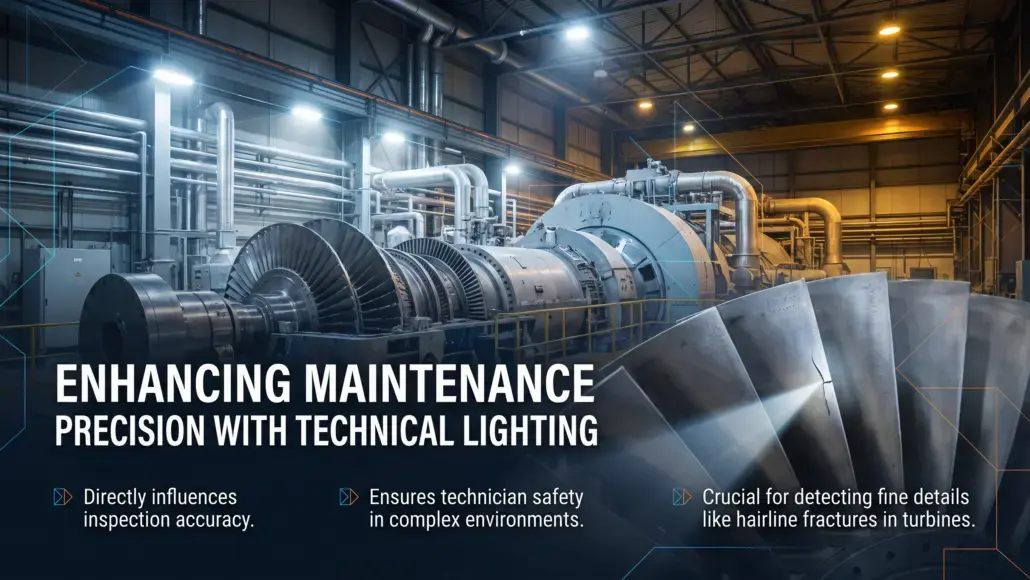

The operational integrity of power generation facilities depends heavily on the precision of maintenance activities performed within complex architectural environments. Technical lighting systems serve as a foundational element in these environments, directly influencing the accuracy of inspections and the safety of technicians. High-intensity discharge lamps and older fluorescent fixtures often struggle to provide the uniform illumination required for detecting hairline fractures in turbine components or identifying subtle insulation degradation in high-voltage switchgear. Modern power plant lighting solutions prioritize high color rendering index values and directional precision to eliminate shadows that can obscure critical diagnostic indicators during routine service intervals. By adopting solid-state technology, facility operators can achieve a level of visual clarity that was previously unattainable with traditional mercury vapor or high-pressure sodium sources. This clarity is not merely a matter of convenience; it is a vital component of the risk mitigation strategy for aging infrastructure.
Improving visibility in these environments requires a departure from generic industrial illumination strategies. The integration of site-specific optics allows for the concentration of light on specific task areas, such as boiler tubes or cooling water pumps, without creating glare that might impede the vision of personnel operating heavy machinery. By utilizing advanced LED arrays with customized beam angles, facility managers can ensure that every square inch of the production floor is adequately illuminated. This level of visual clarity is essential for identifying leaks in high-pressure steam lines early, preventing catastrophic failures that lead to unplanned outages. Power plant lighting must also account for the vertical nature of many power generation sites, providing multi-layered illumination that reaches elevated walkways and basement level auxiliary equipment with equal intensity. The transition to precision optics reduces the wasted light that often spills into unoccupied areas, focusing energy resources exactly where technicians need to perform their most critical work.
Enhancing Diagnostic Accuracy through High Color Fidelity Optics
The selection of lighting fixtures for power generation environments involves rigorous evaluation of spectral output and its impact on human perception. Accurate color identification is a safety requirement when working with multi-colored wiring harnesses and pressure-sensitive instrumentation. Technical lighting systems with a high Color Rendering Index (CRI) ensure that technicians can distinguish between similar shades of electrical insulation or identify oxidation patterns on metallic surfaces that signify impending corrosion. When power plant lighting delivers a spectral distribution close to natural daylight, the cognitive load on maintenance staff decreases, allowing for longer periods of focused inspection without the onset of visual fatigue. This accuracy is particularly vital during major overhauls when time-sensitive tasks require absolute precision to maintain the tight schedules of a planned outage. The ability to differentiate between a copper busbar that is merely tarnished and one that is exhibiting signs of severe overheating can be the difference between a successful inspection and a missed hazard.
Advanced optical designs also contribute to better depth perception within the dense geometry of a power plant. The ability to clearly see into the recesses of a steam turbine or the interior of a generator housing reduces the risk of tools being left behind or components being misaligned during reassembly. By reducing the reliance on portable handheld torches, which often create harsh contrasts and localized glare, fixed technical lighting systems provide a stable and predictable visual field. This stability allows for the use of high-resolution thermographic cameras and other diagnostic tools that require consistent ambient light levels to produce reliable data for predictive maintenance reports. The transition to these sophisticated optical systems represents a strategic shift toward data-driven maintenance where visual confirmation remains the primary gatekeeper for operational safety. Technicians can now rely on ambient illumination to provide the necessary detail for digital documentation, ensuring that inspection logs are accurate and comprehensive.
Mitigating Human Error with Uniform Distribution Strategies
Shadow reduction is a critical objective in the design of illumination for power generation facilities. Conventional lighting often leaves dark zones around large pieces of equipment like transformers or fuel handling systems, creating hazards for personnel moving through the site. By implementing uniform distribution strategies, facility engineers can eliminate these visual gaps, ensuring that obstacles are visible from a distance. The use of wide-angle reflectors and secondary optics in modern power plant lighting fixtures helps to diffuse light evenly across large open areas while maintaining high lux levels at the floor. This uniformity is especially important in emergency situations where personnel must quickly find exit routes or locate manual override controls under stressful conditions. When light levels are consistent, the brain can process environmental information more quickly, reducing the delay in human response during critical incidents.
Consistent light levels across different zones of the plant also improve the efficiency of shift handovers. When maintenance crews move from a brightly lit control room to a dimly lit boiler deck, their eyes require time to adjust to the change in luminance. During this adaptation period, the risk of missing a warning sign or tripping over a structural element increases significantly. Technical lighting systems designed for power generation address this by creating gradual transitions between high and low intensity zones, minimizing the physiological impact on the workforce. This holistic approach to light distribution supports a continuous culture of safety, where the physical environment actively assists the technician in maintaining focus on the task at hand. The reduction of glare also plays a significant role in long-term worker health, as it prevents the chronic eye strain often associated with legacy lighting systems that utilize high-intensity point sources without proper diffusion.
Thermal Management and Longevity in High Temperature Environments
Power generation facilities present unique thermal challenges for electronic lighting components. The areas surrounding boilers and steam pipes often experience ambient temperatures far exceeding standard industrial limits. Technical lighting systems designed for these zones must incorporate sophisticated thermal management features, such as extruded aluminum heat sinks and specialized thermal interface materials, to prevent the premature failure of LED drivers. When power plant lighting is subjected to constant heat, the degradation of internal components can lead to color shifting or a rapid reduction in light output, both of which compromise visibility. Selecting fixtures with high thermal tolerances ensures that the maintenance team has reliable illumination regardless of the plant’s operational state. This reliability is paramount during start-up and shut-down sequences, when temperature fluctuations are most extreme and the demand for visual monitoring is highest.
The longevity of these systems is a direct contributor to the overall serviceability of the facility. Frequent light fixture replacements in hard-to-reach areas, such as the upper tiers of a flue gas desulfurization unit, require the use of scaffolding or specialized lift equipment, increasing both cost and risk. By deploying technical lighting systems with extended life cycles and high-temperature ratings, power plants can synchronize lighting maintenance with major equipment outages. This synchronization reduces the frequency of localized maintenance interventions, allowing the facility staff to concentrate resources on core power generation assets. The durability of the housing materials, often comprising copper-free aluminum or stainless steel, further protects the internal electronics from the vibratory and chemical stresses common in coal-fired or gas-turbine environments. The implementation of impact-resistant glass or polycarbonate lenses further ensures that the fixtures remain operational even in areas where physical contact with debris or maintenance tools is a possibility.
Strategic Placement for Specialized Power Generation Tasks
The layout of a power plant requires a specialized approach to fixture placement that accounts for the specific needs of different operational zones. In the switchyard, lighting must be positioned to avoid creating silhouettes of high-voltage insulators, which could lead to errors during remote visual inspections. In contrast, the lighting in a lubrication oil room must be explosion-proof and positioned to provide high horizontal illuminance for checking fluid levels and detecting leaks. Technical lighting systems offer the flexibility to tailor the illumination profile to these diverse requirements through the use of modular mounting options and adjustable aiming mechanisms. This customization ensures that the light is always directed where it is needed most, rather than being wasted on unoccupied spaces. The use of motion sensors and dimming protocols in secondary areas further optimizes energy consumption without compromising the availability of light for mobile maintenance crews.
Optimizing light placement also involves considering the needs of automated monitoring systems. Many modern power plants utilize fixed-position cameras for 24-hour surveillance of critical gauges and valves. The efficiency of these cameras is highly dependent on the quality of the local illumination. By integrating power plant lighting with the site’s security and monitoring infrastructure, facility managers can ensure that remote operators have a clear view of the facility at all times. This synergy between human-centric lighting and machine vision supports a comprehensive management strategy that prioritizes early detection of anomalies. The result is a more resilient power generation infrastructure where every component, from the largest turbine to the smallest LED, works in concert to maintain reliable energy production for the grid. The continuous evolution of lighting technology ensures that even as power plants become more complex, the ability to see and maintain them will continue to improve.