




















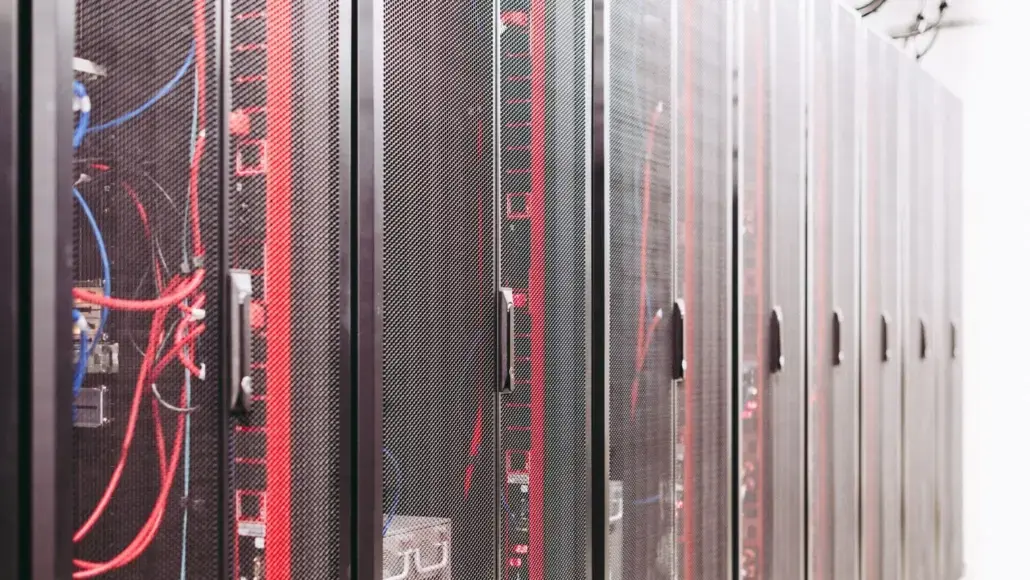

Utility planners who evaluate a new data center start with megawatts. Water belongs in the same conversation.
Most large facilities still reject heat through cooling systems that consume water, and the power plants that supply them consume far more.
The load is growing fast. U.S. data centers used 176 terawatt-hours (TWh) of electricity in 2023, about 4.4% of national consumption, according to the 2024 United States Data Center Energy Usage Report from Lawrence Berkeley National Laboratory (LBNL).
The report projects 325 to 580 TWh by 2028, or 6.7% to 12% of U.S. electricity use.
Why Cooling Connects Power and Water
Servers turn nearly all the electricity they draw into heat, and that heat has to leave the building. The most common way to move it at scale is evaporative cooling.
Warm water from the facility flows through a cooling tower, a portion of it evaporates, and the evaporation carries heat away. The water that evaporates is gone for good, so the system needs a steady supply of makeup water to replace it.
Evaporation also leaves dissolved minerals behind. As their concentration climbs, operators bleed off a portion of the circulating flow, a stream called blowdown, and replace it with fresh supply to keep scale and corrosion in check.
Blowdown adds to the makeup demand and sends a wastewater stream to the sewer, so a single cooling tower draws on both the supply and discharge sides of the local system.
Moving Cooling Off the Drinking Water Supply
Makeup water has traditionally come from municipal drinking water. To ease the pressure on local systems, operators are moving cooling demand to reclaimed and non-potable sources, such as treated municipal wastewater and recycled process water.
Reclaimed water needs its own treatment program, since it carries more dissolved solids and nutrients than drinking water, but it keeps a fast-growing industrial user off the potable supply.
Getting it to the site takes infrastructure: a separate purple-pipe distribution line from the treatment plant, storage on site and backup connections for times when reclaimed flow runs short.
Those pieces take years to permit and build, which is why the decision belongs early in project planning.
LBNL puts direct water consumption by U.S. data centers at 66 billion liters in 2023, roughly 17.4 billion gallons. Hyperscale and colocation facilities accounted for 84% of that total.
The Larger Water Footprint Sits at the Power Plant
For power producers, the more important figure is indirect water use. Thermoelectric power plants consume water for their own cooling, so every kilowatt-hour a data center buys carries a water cost at the generating station.
LBNL estimates that indirect footprint at nearly 800 billion liters in 2023, more than 12 times the water consumed on site. Based on the grid mix where data centers operate, that works out to 4.52 liters of water per kilowatt-hour (kWh) of electricity.
This matters for siting. A large campus in a water-stressed region draws on local water twice: once through its cooling system and again through the plants that serve its load.
As Power Info Today has reported, the rise in data center development across the U.S. is already reshaping the country’s energy path, and water availability now shapes where that development can go.
Cooling Choices and Their Tradeoffs
Cooling design sets how much water a facility consumes on site and how much electricity it needs to stay within operating temperatures. The two are linked, so lowering one can raise the other.
Evaporative Cooling
Evaporative systems use the least energy of the common options, which keeps indirect water use down. They consume the most water on site, and their demand peaks on the hottest days, when local supplies are tightest.
Closed-Loop and Liquid Cooling
A closed-loop cooling system circulates the same water or coolant through a sealed circuit and rejects heat through dry coolers or chillers rather than evaporation. On-site water consumption drops sharply.
Liquid cooling, which brings coolant directly to the chip or rack, extends the same approach to the high-density racks used for artificial intelligence (AI) workloads.
The tradeoff is energy: mechanical chillers use more electricity in hot weather, and that added load moves part of the water footprint back to the power plant.
Free Air Cooling
Free air cooling uses outside air when temperatures and humidity allow.
It cuts both water and energy use, but its value depends on climate. Facilities in hot or humid regions can only use it for part of the year.
Measuring the Tradeoff
Two metrics help compare designs. Power Usage Effectiveness (PUE) divides total facility energy by the energy used by IT equipment, so a lower number means less overhead.
Water Usage Effectiveness (WUE) measures liters of water consumed on site per kWh of IT energy. Reading the two together shows whether a facility saved water by spending more power, or the reverse.
What Utilities and Developers Should Plan For
Data center load forecasts and water planning have been handled by different teams at most utilities. Large new campuses make the case for bringing them together.
Practical steps include:
- Add water to siting studies. Screen candidate sites for water stress alongside transmission capacity and land.
- Ask for the cooling design early. A developer’s choice of evaporative, closed-loop or liquid cooling changes both peak electric demand and water demand.
- Line up reclaimed water. Supply agreements with municipal wastewater treatment plants can serve cooling demand without drawing on drinking water.
- Request PUE and WUE targets. Published targets make it easier to forecast both loads and to hold projects to them.
- Coordinate with water utilities. Shared planning avoids approving a campus that the local water system can’t serve in a drought year.
Conclusion
Data center growth is now a water planning issue as much as a power one. On-site cooling consumes billions of gallons a year, and the electricity behind it consumes many times more at the generating station.
Utilities and developers that weigh both resources from the start will site projects where supply can keep up, choose cooling designs that fit local conditions, and avoid trading a power problem for a water problem.