



























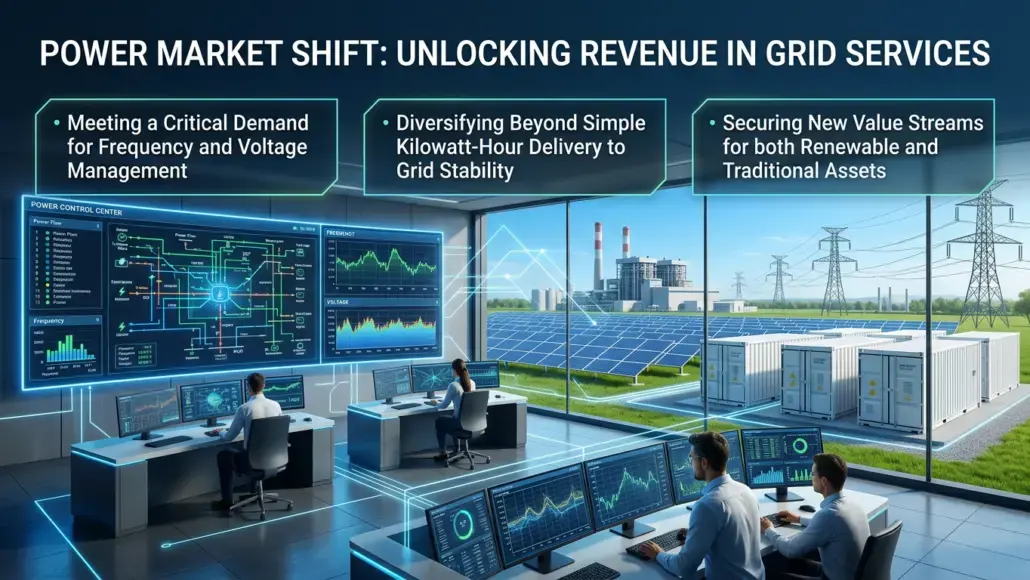

The global shift toward intermittent renewable energy sources has created a critical demand for services that maintain grid frequency and voltage levels. Traditionally, power generation focused almost exclusively on the bulk delivery of kilowatt-hours to the transmission network. However, the operational environment has shifted significantly in recent years. Ancillary service markets now represent a significant and growing portion of the total economic potential for traditional and renewable assets alike. These specialized markets compensate generators for providing the essential technical support required to keep the transmission system in a state of equilibrium. As coal and gas plants are retired or repurposed, the remaining fleet must step up to provide the inertia and fast-response frequency services that wind and solar cannot always guarantee.
Operational flexibility is becoming the primary currency in the modern power sector. Generators that can modulate their output rapidly or maintain standby capacity are finding themselves in a unique position to capitalize on price volatility within these secondary markets. Ancillary service markets provide a critical buffer against the declining margins observed in primary energy-only markets where prices are often depressed by zero-marginal-cost wind and solar production. By participating in frequency response, operating reserves, and black start capabilities, asset owners can ensure a more stable financial outlook even when wholesale electricity prices are low or negative. This strategic shift requires a deep understanding of technical specifications and the regulatory frameworks that govern how these services are auctioned and settled by regional transmission organizations.
The technical requirements for participation are becoming more stringent as grid complexity increases. High-speed telemetry and advanced control systems are now necessary to meet the sub-second response times required for enhanced frequency control. Asset owners are investing in control upgrades to ensure their hardware can respond accurately to the automated signals sent by grid operators. This investment is not merely a cost of doing business; it is a strategic repositioning of the power plant from a simple energy provider to a versatile grid service hub. The integration of ancillary service markets into the long-term planning of a utility is no longer optional for those seeking to maximize the life cycle value of their thermal or hydro facilities.

The Economic Impact of Frequency Regulation and Spinning Reserves
Frequency regulation is arguably the most lucrative of the services provided within the broader ancillary framework. When the balance between supply and demand is disrupted, grid frequency fluctuates. If it deviates too far from the standard 50Hz or 60Hz, equipment damage and widespread outages can occur. Power assets that provide primary and secondary frequency control are paid a premium for their ability to react within seconds. This technical capability is particularly valuable during the evening ramp when solar production drops off and consumer demand spikes across residential and industrial sectors. The revenue from these specialized services often exceeds the profit margins of standard baseload generation, making it a priority for plant managers to optimize their participation.
Spinning reserves provide another layer of security and income for power generators. These are units already connected to the grid and ready to increase power output immediately if a large generator trips offline unexpectedly. The payments for being on standby can be substantial, especially in regions with high penetration of variable renewables where the risk of sudden imbalances is higher. Asset owners must balance the mechanical wear and tear of frequent cycling against the high payments offered in these markets. Predictive maintenance and advanced analytics are being used to manage this trade-off, ensuring that the asset remains available for peak periods without sacrificing its long-term integrity or increasing maintenance costs.
- Frequency Response: Fast-acting adjustments to balance supply and demand in real-time, often requiring sub-second accuracy.
- Voltage Support: Maintaining stable voltage levels across the transmission network by injecting or absorbing reactive power.
- Black Start: The critical ability to restart a power plant without external power after a major grid failure or blackout.
- Operating Reserves: Standby capacity used to cover unforeseen imbalances, equipment failures, or sudden changes in demand.
- Regulation Up and Down: The capacity to increase or decrease generation in response to signals from the system operator.
Regulatory Evolution and Market Access for Diverse Power Technologies
The rules governing who can participate in ancillary service markets are undergoing a massive overhaul globally. Historically, these markets were designed for large, centralized thermal power plants with massive rotating turbines. Today, new rules are allowing battery storage systems, demand-response aggregators, and even virtual power plants to compete on a level playing field. This increased competition is driving down the costs for grid operators while forcing traditional generators to become more efficient in their operations. The regulatory environment is shifting toward pay-for-performance models, where assets that provide faster and more accurate responses are paid more than those that are slower to react to system needs.
Market transparency is also improving through the adoption of digital platforms. Real-time data feeds and automated auction platforms are making it easier for smaller power assets to bid their capacity into these markets. This democratization of grid services is essential for a decentralized energy future where flexibility is distributed across the network. Asset managers must now act as sophisticated traders, constantly monitoring market signals and adjusting their operational stance to capture the best pricing windows. The ability to switch between energy-only delivery and high-value ancillary services is what defines a modern, competitive power company in the current economic climate.
Effective management of these assets often involves complex software that integrates directly with market platforms to automate bidding strategies. For example, hydro reservoir optimization allows plant operators to time their generation and ancillary bids to coincide with the most profitable windows while managing water conservation needs. This level of technical and economic coordination ensures that every drop of water or every cubic foot of gas is used to its maximum potential. The synergy between different power generation technologies is creating a more resilient grid that can handle the challenges of the energy transition while providing sustainable returns for investors and stakeholders.
Technological Integration and Digital Asset Management
The role of digitalization in maximizing ancillary revenue cannot be overstated. Power plants are no longer just mechanical systems; they are data-driven entities that require sophisticated monitoring. Modern sensors and industrial internet of things (IIoT) devices allow operators to track the health of their equipment in real-time. This data is fed into digital twins that can simulate various operating scenarios. By understanding the exact limits of their hardware, plant managers can bid more aggressively into ancillary service markets without risking catastrophic failure. This data-driven approach allows for the optimization of maintenance schedules, reducing downtime and ensuring that the plant is available when market prices for frequency regulation are at their highest.
Cybersecurity is also a critical component of technological integration in grid services. As power assets become more connected to external market platforms and grid operator signals, the potential for cyber threats increases. Advanced security protocols must be implemented to protect the integrity of the control systems. This includes everything from encrypted communication channels to rigorous access controls for plant personnel. Ensuring the security of the power asset is not just a regulatory requirement; it is a prerequisite for participating in the high-stakes world of ancillary services where reliability is the most important factor for the system operator.
Additionally, the use of artificial intelligence and machine learning is becoming standard practice for market participation. These tools can analyze historical market data to predict future price movements with high accuracy. They can also account for weather patterns, which have a direct impact on renewable generation and subsequent demand for ancillary services. By utilizing these advanced tools, power generation companies can stay ahead of the competition and secure the most profitable contracts. The combination of human expertise and machine intelligence is the key to thriving in the complex and rapidly evolving energy sector.
Long-Term Strategy for Grid-Scale Revenue Diversification
As we look toward the 2030s, the importance of ancillary service markets will only grow in significance. The electrification of heating and transport will add new layers of complexity to grid management, requiring even more sophisticated balancing services. Power assets will need to be even more responsive to a wider variety of stresses, from sudden spikes in electric vehicle charging to prolonged periods of low wind and solar output. Revenue diversification is no longer just a hedge against market volatility; it is the foundation of a viable business model in the power generation sector. Companies that fail to adapt their technical and commercial strategies to include these services risk becoming stranded assets.
The transition requires a cultural shift within utility companies and independent power producers. Engineering teams and trading desks must work more closely to align technical capabilities with market opportunities. Decisions about when to run a plant are based on a multi-variable analysis of grid needs. This holistic approach to asset management is the hallmark of the next generation of power industry leaders. By embracing the complexity of modern grid services, these leaders are ensuring that their assets remain profitable for decades to come.
Ultimately, the goal is to create a power system that is both reliable and economically efficient for all participants. Ancillary service markets are the mechanism that makes this possible by providing the financial incentives for generators to invest in the technologies and practices that keep the lights on. For power asset owners, the message is clear: the future of revenue lies in the flexibility and reliability of the services they provide to the transmission system. Continuous investment in both physical hardware and digital capabilities will be necessary to stay competitive and contribute to a stable energy future.