





























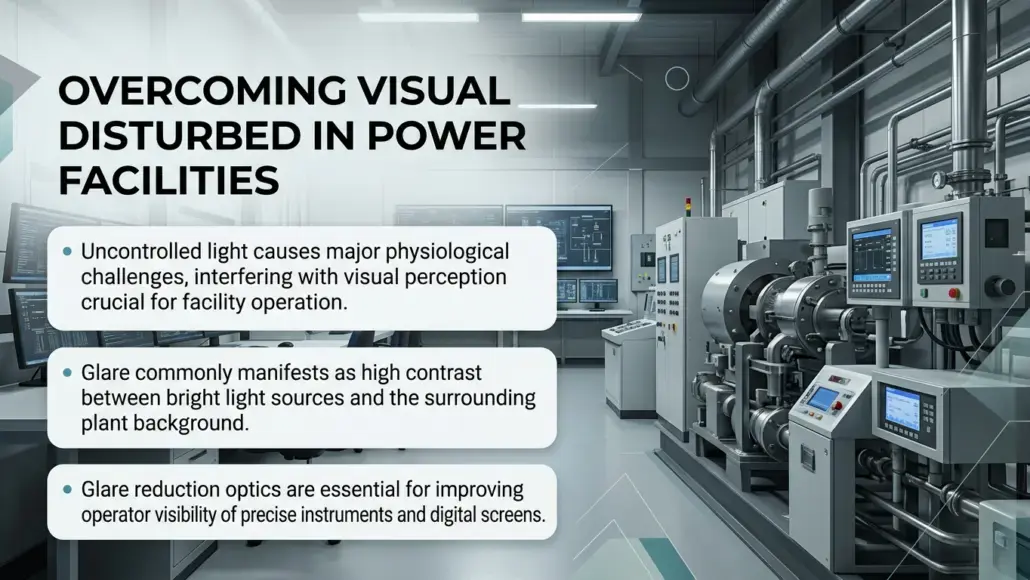

The operation of a power generation facility involves the continuous monitoring of high-precision instruments, digital displays, and complex mechanical assemblies. In such an environment, the presence of uncontrolled light can lead to significant physiological challenges for the operating staff. Glare is fundamentally an interference with visual perception caused by a high contrast between the light source and the surrounding background. In power plants, this often manifests as direct glare from unshielded luminaires or reflected glare from polished metal surfaces and glass-fronted gauges. The implementation of glare-control optics is a primary intervention aimed at mitigating these effects and ensuring that operators can maintain visual focus over extended shifts.
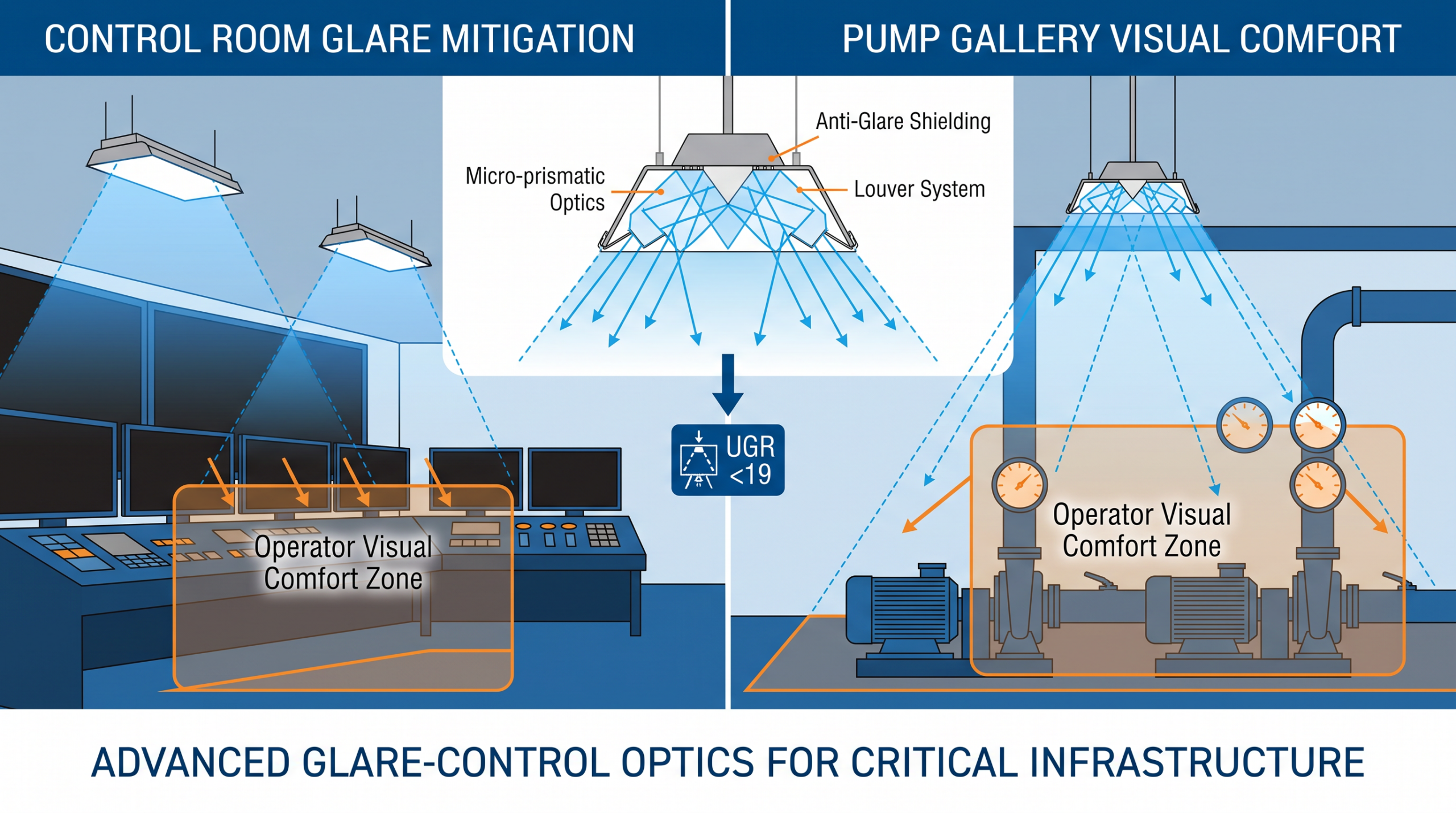
Prolonged exposure to glare leads to asthenopia, commonly known as eye strain, which can manifest as headaches, blurred vision, and general cognitive fatigue. For a power plant operator responsible for managing a multi-gigawatt load, any reduction in cognitive performance is a potential safety risk. The use of glare-control optics work by redistributing the luminous intensity of a fixture, ensuring that the light is directed toward the task area rather than into the field of vision of the worker. By using micro-prismatic lenses or specialized louvers, these systems can achieve a Unified Glare Rating of less than nineteen, which is the international benchmark for high-comfort industrial environments. This reduction in visual noise allows the eye to relax, maintaining the acuity required to spot subtle changes in pressure readings or temperature trends.
The impact of glare is particularly acute during nighttime operations or in windowless sections of the plant. Without the balancing effect of natural daylight, artificial light sources can appear much harsher. Integrated glare-control optics help to soften the transition between light and shadow, creating a more uniform visual environment. This uniformity is essential for depth perception, which is critical when navigating the tight corridors and multi-level platforms of a boiler house or pump gallery. When glare is effectively managed, the likelihood of misreading a gauge or tripping over an obstruction is significantly reduced. This makes the selection of optics a central component of any facility’s ergonomic and safety strategy.
Optical Engineering and Light Distribution Strategies
Modern lighting design for power plants has moved beyond simple illumination toward the precise engineering of light distribution. These specialized systems utilize a variety of technical strategies to manage how light leaves the luminaire. One of the most common methods involves the use of prismatic lenses that refract light at specific angles. These prisms are designed to “cutoff” the light at an angle that prevents it from entering the human eye at typical viewing heights. This ensures that while the floor and equipment are brightly lit, the light source itself remains relatively unobtrusive. This is a critical feature in areas with low ceilings or where operators must look upward to inspect valves and piping.
Another approach involves the use of diffuse materials that scatter light in multiple directions, reducing the intensity of any single point source. While this can sometimes reduce the overall efficiency of the fixture, advanced polymers have been developed that provide high diffusion with minimal light loss. These materials are often used in control rooms where the primary challenge is reflected glare on computer monitors. By creating a larger, softer light source, these optical elements eliminate the “hot spots” that cause screen reflections and obscured data. In some cases, indirect lighting strategies are also employed, where light is bounced off a white ceiling or wall to provide a gentle, shadow-free environment that is naturally low in glare.
- Utilization of micro-prismatic lenses for precise beam control.
- Implementation of deep-cell louvers to provide a physical cutoff of light rays.
- Use of frosted or opal diffusers to minimize high-intensity point sources.
- Integration of asymmetric optics to redirect light away from operator sightlines.
- Adoption of matte finishes on luminaire housings to prevent secondary reflections.
The integration of technical lighting systems improving maintenance visibility in power plants often works in tandem with these comfortable lighting strategies. While the primary goal is comfort for the operator, the lighting must also be functional for the technician. Balancing these two needs requires a nuanced approach to fixture selection. For instance, a luminaire might use a high-performance optic for general illumination but include an adjustable component for localized tasks. This versatility ensures that the lighting environment can adapt to the diverse needs of a power generation facility without compromising on visual comfort or safety.
Enhancing Safety Through Improved Visual Contrast
Visual contrast is the ability of the eye to distinguish an object from its background, a capability that is severely hampered by the presence of glare. In a power plant, contrast is essential for identifying small cracks in machinery, spotting steam leaks, or reading fine print on a label. High-quality glare-control optics improve contrast by eliminating the “veiling” effect that occurs when light scatters within the eye or reflects off the surface being viewed. When glare is minimized, the edges of objects become sharper, and subtle variations in texture and color become more apparent. This improvement in visual clarity is a key factor in the early detection of mechanical failures and operational anomalies.
The relationship between glare and contrast is particularly important in hazardous areas where quick identification of warnings is necessary. Safety signs, emergency shut-off valves, and high-voltage warnings must be instantly recognizable from a distance. If an operator is blinded by a poorly positioned light fixture, their ability to process this visual information is delayed. Advanced optical systems ensure that these critical markers are illuminated clearly without being washed out by excessive brightness. This is also relevant for the identification of fluid levels in sight glasses, where the reflection of a light bulb can make it nearly impossible to determine the actual level of oil or coolant.
Additionally, improved contrast assists in the navigation of complex three-dimensional spaces. Power plants are filled with vertical obstructions, hanging pipes, and varying floor levels. Directional lighting components help to define the shadows and highlights of these structures, providing the brain with the spatial cues needed for safe movement. When an environment is overly bright or filled with glare, the world can appear “flat,” making it difficult to judge distances or depths. By providing high-quality, directional light with minimal glare, these systems enhance the operator’s spatial awareness, leading to a safer and more efficient workplace.
Long-Term Operational Benefits and Operator Well-Being
The focus on operator well-being has become a significant trend in industrial management, with companies recognizing that a healthy workforce is more productive and less prone to accidents. The implementation of high-comfort lighting is a proactive step in supporting the long-term health of the eyes. Constant exposure to high-intensity glare can contribute to permanent changes in visual health over decades of service. By providing a comfortable visual environment, power plant owners can demonstrate a commitment to the welfare of their employees, which can improve morale and reduce staff turnover in these highly specialized roles.
Operational benefits also manifest in the form of reduced human error. Studies have shown that workers in well-lit, low-glare environments are better at performing repetitive tasks and are more likely to notice errors in their work. In the context of a power plant, where a single mistake can lead to a multi-million-dollar outage or a catastrophic safety incident, the value of this error reduction cannot be overstated. Optimized optical systems contribute to a state of “visual comfort” that allows operators to remain alert and engaged with their tasks for longer periods. This is especially important during the twelve-hour shifts that are common in the industry, where fatigue typically sets in during the final hours of the rotation.
The maintenance of these optical systems is also relatively straightforward. High-quality industrial lenses are typically housed within sealed units that protect them from the dust and moisture prevalent in power generation environments. Unlike traditional louvers that can accumulate grime and become less effective over time, modern internal prisms remain clean and functional for the life of the fixture. This ensures that the performance does not degrade, providing a consistent visual environment for the operators year after year. The investment in superior optics therefore pays for itself through improved safety, better operator health, and long-term reliability.
Implementation Challenges and Future Trends in Industrial Optics
While the benefits of glare control are clear, implementing these systems in an existing power plant can be challenging. Retrofitting older facilities often involves dealing with fixed mounting points and limited electrical infrastructure. Engineers must carefully select components that can work within these constraints while still achieving the desired visual outcomes. This often requires a detailed site audit and the use of photometric simulations to predict the impact of new lighting. In some cases, the installation of shields or baffles on existing fixtures can provide a temporary improvement, but a full upgrade to modern luminaires is usually the most effective long-term solution.
Looking toward the future, the field of industrial optics is seeing the emergence of smart lighting systems that can adjust their distribution based on the position of the operator. Using integrated sensors and digital addressable lighting interfaces, these systems could theoretically dim or redirect light that is in the direct line of sight of a worker while maintaining high levels of illumination in other areas. This dynamic approach to comfort management represents the next frontier in industrial safety and comfort. Additionally, the development of new materials with even higher refractive indices will allow for thinner, more efficient lenses that provide even better control over light distribution.
The ongoing evolution of these technologies ensures that power plant operators will continue to benefit from improvements in visual clarity and comfort. As the industry moves toward more complex and automated systems, the role of the human operator remains central, and their ability to see and process information remains a critical link in the safety chain. Professional optics are not merely a luxury but a fundamental requirement for the modern power generation facility. By prioritizing visual health and clarity, the industry can continue to meet the twin goals of operational excellence and personnel safety.