

















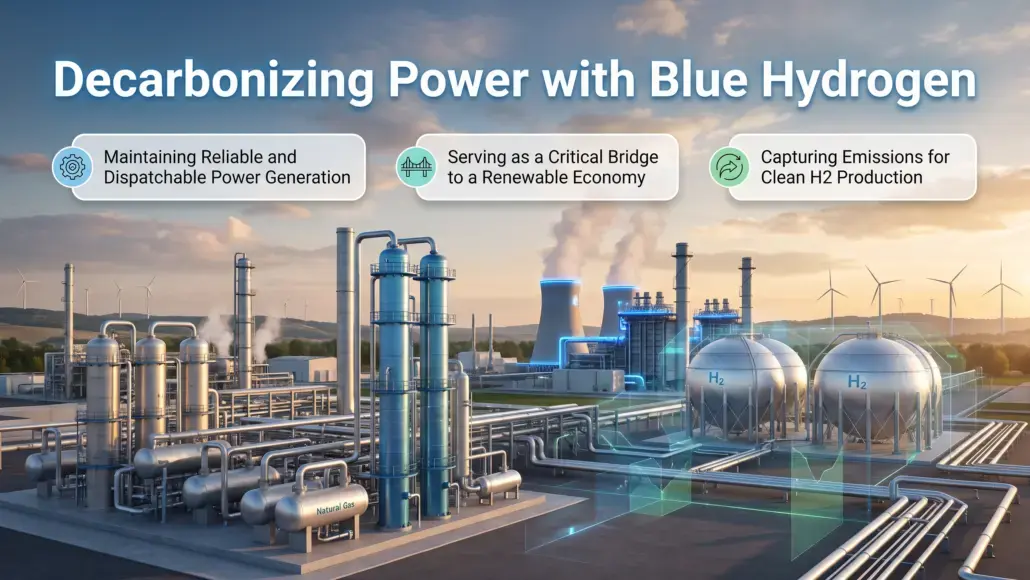

The global power generation sector faces an urgent requirement to decarbonize while maintaining the reliability and dispatchability provided by gas-fired assets. Blue hydrogen emerges as a critical transitional fuel, offering a bridge between conventional natural gas and a fully renewable hydrogen economy. The integration of blue hydrogen carbon capture systems improving emissions performance of h2 production is central to this transition, ensuring that the process of converting natural gas into hydrogen does not merely shift emissions from the power plant to the production facility. By capturing carbon dioxide at the point of creation, these systems allow utilities to utilize existing infrastructure while significantly reducing their overall environmental footprint.
The effectiveness of these capture technologies depends heavily on the specific reforming process employed, with steam methane reforming and autothermal reforming offering different profiles for carbon sequestration. As the industry scales, the focus shifts toward maximizing the percentage of CO2 captured, often targeting rates exceeding ninety-five percent. This high level of capture is necessary for blue hydrogen to meet the stringent low-carbon definitions required by international regulators and investors. Implementing these systems involves complex engineering challenges, including the management of pressure drops, heat integration, and the selection of appropriate solvents or membranes for separation.
Optimization of Reforming Technologies for High Carbon Capture Rates
The choice between steam methane reforming and autothermal reforming represents a fundamental decision in the design of blue hydrogen facilities. Steam methane reforming remains the most common method, utilizing external heat to drive the reaction between steam and natural gas. However, because a portion of the natural gas is burned to provide this heat, the resulting CO2 is diluted in the flue gas, making capture more energy-intensive. To improve the efficiency of capture, operators are increasingly looking at advanced solvents and cryo-separation methods that can handle these dilute streams effectively.
Autothermal reforming, by contrast, uses oxygen rather than external combustion to provide the heat for reforming. This results in a more concentrated CO2 stream within the high-pressure process gas, which is inherently easier and cheaper to capture. Many new large-scale projects are opting for autothermal reforming because it allows for capture rates of ninety-nine percent or higher with lower capital expenditure per unit of hydrogen produced. The synergy between autothermal reforming and carbon capture technology represents a significant advancement in the ability to produce hydrogen at scale with minimal atmospheric impact.
Beyond the reforming method itself, the optimization of catalysts plays a vital role in emissions performance. Advanced catalysts can operate at lower temperatures or higher pressures, reducing the total energy input required for the process. This reduction in energy demand directly translates to lower indirect emissions, assuming the electricity used for pumps and compressors is also decarbonized. The industry is currently investigating the use of electrified reforming, which replaces fossil-fired heat with renewable electricity, further pushing the boundaries of what blue hydrogen can achieve in terms of carbon intensity.
Post-Combustion and Pre-Combustion Capture Integration in Power Assets
In the context of power generation, carbon capture can be applied either during the hydrogen production phase or at the power plant itself when burning a blend of fuels. Pre-combustion capture, which occurs at the hydrogen production site, is generally more efficient because it deals with concentrated CO2 streams. By deploying blue hydrogen carbon capture systems improving emissions performance of h2 production, power producers can receive a fuel that is already decarbonized, simplifying the operation of the turbines and boilers at the generation site. This approach avoids the high cost and parasitic load associated with post-combustion capture at the stack of a gas power plant.
However, for facilities that choose to produce hydrogen on-site, the integration of pre-combustion capture requires a sophisticated balance of thermal energy. The heat generated during the carbon capture process, particularly when using amine-based solvents, can often be recovered and used to pre-heat the feed gases for the reformer. This thermal integration is essential for maintaining the overall efficiency of the power generation cycle. When hydrogen is produced and captured effectively, the resulting fuel burns with zero CO2 emissions at the point of use, effectively turning a natural gas asset into a zero-carbon power source.
The logistical aspects of CO2 transport and storage also influence the integration strategy. Power plants located near depleted oil and gas fields or saline aquifers have a distinct advantage, as they can directly inject the captured carbon. For plants further afield, the development of CO2 pipeline networks is necessary. The reliability of these capture systems is paramount, as any downtime in the carbon sequestration unit would result in the venting of CO2, negating the environmental benefits of the hydrogen fuel. Consequently, redundant systems and advanced monitoring sensors are being standardized across new installations.
Minimizing Methane Slip and Indirect Emissions in the Production Chain
A common critique of blue hydrogen is the potential for methane leakage throughout the natural gas supply chain. If methane, which has a much higher global warming potential than CO2, leaks during extraction or transport, the lifecycle benefits of the hydrogen produced are diminished. Therefore, blue hydrogen carbon capture systems improving emissions performance of h2 production must be accompanied by rigorous upstream monitoring and leak detection. Technologies such as satellite imaging and ground-based optical gas imaging are being deployed to ensure that the natural gas feedstock is as clean as possible.
Within the production facility itself, methane slip (the small percentage of methane that passes through the reformer unreacted) must also be addressed. If this methane is not captured or recycled, it eventually reaches the atmosphere. Modern plant designs include secondary reforming stages or advanced purification units to ensure that nearly all methane is converted into hydrogen and CO2. This attention to detail in the process chemistry is what differentiates high-quality blue hydrogen from less efficient alternatives. The goal is to achieve a carbon intensity that rivals green hydrogen, particularly in regions where renewable electricity remains expensive or scarce.
Indirect emissions from the electricity used to power the capture units and oxygen plants also contribute to the final carbon footprint. Power generators are increasingly sourcing renewable energy or using a portion of the produced hydrogen to generate the power needed for the production process. This circular approach ensures that the entire lifecycle of the fuel remains within acceptable low-carbon limits. As carbon pricing mechanisms become more prevalent globally, the economic incentive to eliminate every gram of CO2 and methane from the production chain continues to grow.
Economic Viability and Lifecycle Assessment of Low-Carbon Blue Hydrogen
The cost of blue hydrogen is heavily influenced by the capital cost of the carbon capture equipment and the ongoing expense of CO2 transport and storage. While blue hydrogen is currently cheaper to produce than green hydrogen in most markets, the margin is narrowing as electrolyzer costs fall. To remain competitive, blue hydrogen producers must demonstrate superior reliability and the ability to scale rapidly. The deployment of blue hydrogen carbon capture systems improving emissions performance of h2 production provides a pathway for existing gas assets to avoid becoming stranded, offering a clear economic benefit to utilities with significant investments in thermal generation.
Lifecycle assessment models are now being used to verify the emission claims of blue hydrogen producers. These assessments take into account everything from the energy used to drill the gas well to the final combustion of the hydrogen in a turbine. For power generators, these reports are essential for securing green financing and meeting corporate sustainability targets. The transparency provided by these assessments helps build trust with regulators and the public, who are often skeptical of fossil-derived fuels. By proving that capture rates can consistently exceed ninety-five percent, the industry can justify the role of blue hydrogen in the long-term energy mix.
Investment in blue hydrogen also serves as a catalyst for the broader carbon capture and storage industry. The large volumes of CO2 generated by hydrogen production provide the scale necessary to justify the construction of shared transport and storage infrastructure. This infrastructure can then be used by other industrial emitters, such as cement and steel plants, further accelerating regional decarbonization. In this way, the power sector’s adoption of blue hydrogen acts as a cornerstone for a wider carbon-neutral economy.
Regulatory Compliance and Emission Benchmarking for Global Power Markets
Regulatory frameworks are evolving to provide clearer definitions of what constitutes low-carbon hydrogen. In Europe, the Delegated Acts under the Renewable Energy Directive set strict thresholds for carbon intensity, while in the United States, the Inflation Reduction Act provides tax credits based on the amount of CO2 sequestered. For power generators, staying ahead of these regulations is a matter of both compliance and financial strategy. The implementation of blue hydrogen carbon capture systems improving emissions performance of h2 production is the most effective way to ensure that hydrogen production meets these evolving benchmarks.
Benchmarking emissions against international standards allows power producers to participate in global hydrogen markets. As hydrogen becomes a traded commodity, the carbon intensity of the fuel will be as important as its energy content. Facilities that can guarantee ultra-low emissions will command a premium price and enjoy more favorable access to capital. This market-driven approach encourages continuous innovation in capture technology, pushing the industry toward the goal of net-zero emissions.
Standardization of measurement and reporting is also crucial. The industry is moving toward real-time monitoring of carbon capture efficiency, with data being verified by independent third parties. This level of rigor ensures that the environmental benefits of blue hydrogen are real and quantifiable. For the power generation sector, this means that every megawatt-hour produced using blue hydrogen can be accurately labeled as low-carbon, providing a clear path forward in a world that is increasingly demanding accountability for carbon emissions.