


























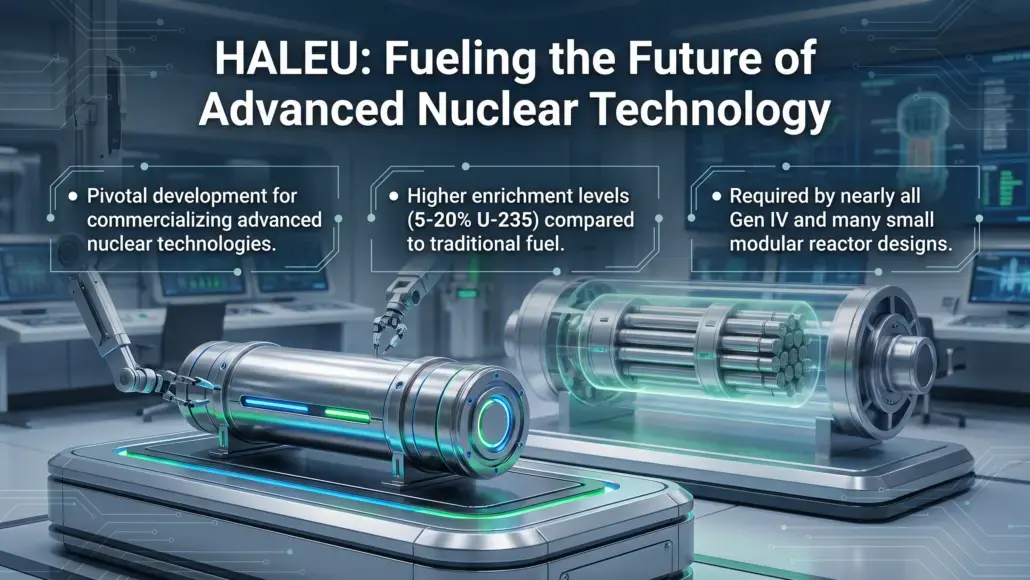

The emergence of High-Assay Low-Enriched Uranium, commonly referred to as HALEU fuel, represents a pivotal development in the effort to commercialize advanced nuclear technologies. For decades, the commercial nuclear industry has relied on uranium enriched to between three and five percent of the isotope U-235. However, nearly all generation IV reactors and many small modular designs require fuel with enrichment levels between five and twenty percent. This higher concentration of fissile material is not merely a preference but a fundamental requirement for the physics of advanced reactor cores, which are designed to be more compact, efficient, and versatile than the current light water fleet.
The transition to HALEU fuel is a strategic necessity for the power generation sector as it seeks to deploy reactors that can operate for longer periods, produce less waste, and provide high temperature heat for industrial processes. Without a reliable and affordable supply of this material, the transition to advanced nuclear power could be significantly delayed. Consequently, the development of enrichment capacity and the establishment of a secure supply chain for HALEU have become top priorities for governments and industry stakeholders worldwide. The following examination details the technical drivers and strategic implications of this critical fuel form for the future of nuclear energy.
Strategic Importance of Enrichment Capacities for Modern Power Systems
Enrichment capacity is the foundation upon which the entire nuclear fuel cycle is built. For the power generation industry to move beyond its reliance on legacy technologies, it must have the ability to produce fuel at the specific enrichment levels required by modern designs. HALEU fuel provides the higher neutron flux and reactivity needed to sustain a chain reaction in smaller reactor cores or in systems that use non water coolants. This capability is essential for the development of microreactors and small modular reactors, which prioritize a reduced physical footprint and simplified cooling architectures. By enabling these designs, HALEU fuel facilitates a more distributed and resilient energy infrastructure.
The strategic importance of developing domestic enrichment capacity for HALEU cannot be overstated. Currently, the global supply of commercial HALEU is extremely limited, with a significant portion of the production capacity concentrated in a few nations. This creates a potential bottleneck for utilities and reactor developers who are ready to deploy new systems but face uncertainty regarding fuel availability. By investing in new enrichment facilities, such as those utilizing advanced centrifuge technology or laser based separation methods, nations can ensure that their transition to carbon free energy is not compromised by external supply disruptions. This investment in infrastructure is a prerequisite for achieving long term energy independence and security.
Additionally, the expansion of enrichment capabilities encourages competition and innovation within the fuel cycle. As more companies enter the HALEU market, the costs associated with enrichment are expected to decrease, improving the overall economic competitiveness of advanced reactors. This market evolution is critical for attracting private investment and for making advanced nuclear power a viable option for a wider range of utilities and industrial users. The ability to produce high assay uranium at scale is therefore a central pillar of the global strategy for meeting rising energy demand while simultaneously achieving deep reductions in greenhouse gas emissions.
Compatibility with High Temperature Gas and Liquid Metal Reactors
One of the primary technical drivers for high assay uranium is its compatibility with advanced reactor designs that operate at much higher temperatures than conventional plants. High Temperature Gas-cooled Reactors (HTGRs) and various liquid metal cooled designs rely on the superior energy density of HALEU to achieve their performance targets. In an HTGR, for example, the use of high assay uranium allows for a very high burnup rate, which means the reactor can extract more energy from a smaller volume of fuel. This high burnup is essential for producing the 700 to 900 degree Celsius heat required for industrial applications such as thermochemical hydrogen production and large scale desalination.
Liquid metal reactors, such as those cooled by sodium or lead, also benefit significantly from the use of high assay uranium. These reactors operate in the fast neutron spectrum, which allows them to utilize uranium more efficiently and to transmute long lived radioactive waste. The higher enrichment of HALEU provides the necessary reactivity to maintain a stable fast neutron population in a compact core. This enables the design of reactors that are both smaller and more sustainable than traditional thermal reactors. The synergy between HALEU and fast reactor technology is a key component of the vision for a closed nuclear fuel cycle, where waste is recycled into new fuel.
In addition, the physical properties of high assay uranium assemblies are tailored to the unique environments of advanced reactors. The use of metallic fuels, advanced ceramics, and specialized cladding materials ensures that the fuel can maintain its structural integrity under extreme thermal and radiological stress. This durability is vital for ensuring the safety and reliability of advanced power plants, particularly those designed for autonomous or remote operation. By providing a fuel form that is optimized for high performance environments, high assay uranium enables the full potential of advanced reactor physics to be realized in commercial applications.
Supply Chain Security and Domestic Production Infrastructure
The establishment of a secure and resilient supply chain for high assay uranium is a complex task that involves multiple stages, from uranium mining and conversion to enrichment and final fuel fabrication. Historically, the supply chain for commercial nuclear fuel has been well established for low enriched uranium (LEU), but the infrastructure for HALEU is still in its infancy. For power generation companies, the risk of a supply chain disruption is a major concern that can impact the financing and deployment of new projects. To mitigate this risk, industry stakeholders are working to develop a diverse and geographically distributed production infrastructure that reduces reliance on any single source.
Domestic production of HALEU is becoming a central theme in energy policy for many industrialized nations. By building enrichment and fabrication facilities within their own borders, countries can protect their energy systems from geopolitical volatility and trade disputes. This movement toward localized production is also creating new economic opportunities, as the construction and operation of these advanced facilities require a highly skilled workforce and specialized engineering services. The development of a domestic HALEU infrastructure is thus not only an energy security measure but also a driver of industrial growth and technological innovation.
In addition to enrichment, the supply chain must also address the challenges of HALEU deconversion and fabrication. Once the uranium is enriched, it must be converted from a gas into a solid form, such as an oxide or metal, and then manufactured into the specific fuel elements required by different reactor designs. This process requires specialized facilities that can handle higher enrichment levels while maintaining strict safety and security protocols. The integration of these different stages into a seamless and efficient supply chain is essential for providing utilities with a predictable and cost effective source of high assay uranium. By addressing every link in the chain, the industry is building the foundation for a sustainable and secure nuclear future.
Improving Operational Flexibility and Fuel Utilization Efficiency
The use of high assay uranium leads to significant improvements in the operational flexibility of nuclear power plants. Because HALEU allows for higher power densities and longer fuel cycles, reactors can be designed to follow load more effectively, ramping their output up and down to match the variability of renewable energy sources on the grid. This flexibility is essential for the modern energy mix, where the ability to provide dispatchable, carbon free power is highly valued. Advanced reactors fueled by HALEU can serve as a reliable anchor for the grid, providing stability and resilience in the face of fluctuating demand and intermittent supply.
Fuel utilization efficiency is another major benefit of the HALEU model. By extracting more energy from each kilogram of uranium, advanced reactors reduce the overall demand for raw uranium ore and minimize the environmental impact of mining activities. The higher burnup rates achieved with high assay uranium also mean that less spent fuel is produced per megawatt hour of electricity generated. This reduction in waste volume simplifies the challenges of interim storage and long term disposal, providing a clear environmental advantage for the nuclear industry. The ability to do more with less is a core principle of the transition to advanced nuclear technologies.
Additionally, the increased energy density of high assay uranium enables the design of “long life” reactor cores that can operate for a decade or more without refueling. This capability is particularly valuable for remote and industrial applications, where the logistics of fuel transport are difficult and expensive. For a mining operation or an isolated community, the ability to have a guaranteed energy supply for many years on a single load of fuel is a radical improvement in energy security. By optimizing both the operation and the utilization of the fuel, HALEU enables a more efficient and sustainable approach to nuclear power generation.
Navigating International Regulatory Hurdles for Transport and Storage
The commercial deployment of high assay uranium is complicated by a complex web of international and national regulations governing the transport and storage of nuclear materials. Because HALEU has a higher enrichment than traditional commercial fuel, it is subject to more stringent security and safeguard requirements to prevent the diversion of fissile material. Navigating these regulatory hurdles is a significant challenge for the industry, requiring close coordination between fuel suppliers, transport companies, and national regulators. The development of standardized shipping containers and security protocols is essential for facilitating the global movement of high assay uranium.
Regulators are also working to update their safety standards for HALEU storage and handling facilities. The higher concentration of U-235 means that criticality safety must be managed even more carefully than for traditional fuel. This involves the design of specialized racks, shielding, and monitoring systems that ensure the material remains stable and secure at all times. By providing a clear and predictable regulatory environment, agencies are encouraging the investment in the infrastructure necessary for the wide scale use of HALEU. The successful resolution of these regulatory challenges is a prerequisite for the commercial success of advanced nuclear reactors.
International cooperation is crucial for harmonizing the standards and regulations for high assay uranium. Through organizations like the International Atomic Energy Agency (IAEA) and the Generation IV International Forum (GIF), nations are sharing data and best practices to ensure that the transport and storage of advanced fuels are conducted with the highest levels of safety and security. This collaboration helps to build public confidence in nuclear technology and facilitates the development of a global market for HALEU. By addressing the regulatory challenges on an international scale, the industry is paving the way for a new era of nuclear power generation that is safer, more efficient, and more sustainable.