

















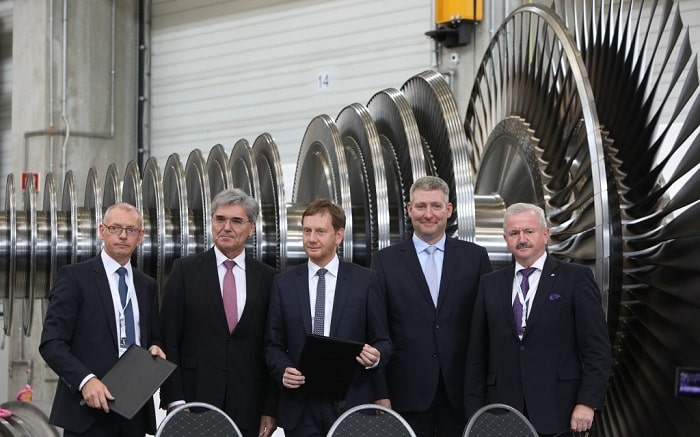

Siemens, the Free State of Saxony and the Fraunhofer-Gesellschaft signed a memorandum of understanding in Görlitz, Germany, to strengthen this location over the long term and support the structural transformation of Germany’s Lusatia region. Plans call for establishing an innovation campus and a startup accelerator on the site of Siemens’ plant in Görlitz. The aim is to encourage other technology and industrial companies as well as startups and research institutes to establish operations in this region. The focus of activity will be on digitalization, automation, energy technology and innovative material and production technologies.
On this campus, Siemens and the Fraunhofer-Gesellschaft will also establish a hydrogen research laboratory to study the production, storage and use of hydrogen. Görlitz is thus to be developed into a competence center for hydrogen technologies over the long term. In the first step, the partners intend to provide a total of around €30 million to expand the activities at this location. About 100 jobs for highly qualified employees are to be created there in the next five years.
“Today is a good day for Görlitz and Lusatia,” emphasized Saxony’s Minister President Michael Kretschmer. “The agreement with Siemens and Fraunhofer is a milestone for developing the Siemens location in Görlitz as well as enhancing the region of Lusatia’s role as an innovation hub in a way that strengthens viability for the future. Establishing an innovation campus as well as the research and development activities for climate-friendly and digital industrial processes creates new high-skill jobs. Together with Fraunhofer and our region’s universities and companies, we are also developing a research platform for innovative technologies for storage and for using hydrogen in the energy transition.
Siemens, as a company listed on the DAX stock index, and Fraunhofer-Gesellschaft are joining us in placing their trust in Görlitz and the people of Lusatia. I’m confident that this will lead to a long-term strengthening of Lusatia’s role as one of Germany’s hubs for research and industry – from developmental work to the construction of plants.”
“With this pact for the future, we’re fulfilling our promise to play an active role in shaping structural change in Lusatia,” said Joe Kaeser, President and CEO of Siemens AG. “That’s why – in addition to the worldwide headquarters for industrial steam turbines – we want to build an innovation campus here at our Görlitz location. On this campus, products and solutions based on hydrogen technology are to be developed in cooperation with partners and startups. In this way, we’re creating an ecosystem for what will be one of the most attractive future-oriented fields over the long term when it comes to measures for combatting climate change – and thus also when it comes to ensuring Germany’s competitiveness in industries of the future
“Phasing out coal-fired power generation has triggered transformation processes that are deeply impacting Saxony as a region that has an energy-based economy. Nevertheless, the Free State’s research and technology landscape features good relationships with players in this field. In addition, the region benefits from a well-established local industrial sector and a culture of innovation. These advantages offer excellent prerequisites for creating structures that will both strengthen the region and further enhance Germany’s position as an engineering powerhouse within the international competitive environment,” explained Prof.
Reimund Neugebauer, President of the Fraunhofer-Gesellschaft. “Setting up a joint platform for conducting hydrogen research and developing new hydrogen technologies together with Siemens and with the support of the Free State of Saxony puts us on track for the future. This cooperation provides a vital foundation for this region’s plant-engineering sector and brings industrial research together with the scientific community in a strategic partnership.”
In addition to the innovation campus, Siemens will further expand its research and development activities at the Görlitz site in the area of decarbonized industrial processes. There, Siemens researchers will be exploring how hydrogen technologies can reduce CO2 emissions in energy-intensive industries and will be developing new climate-friendly solutions such as storage technologies. As a contribution toward implementing Germany’s Climate Protection Plan 2050 and achieving the structural transformation of the Lusatia region, Siemens intends to convert its site into a carbon-neutral factory by 2025. To attain this goal, the process heat for operating the steam-turbine test facilities, for instance, is to be generated in a sustainable way, and overall energy consumption is to be reduced.
Siemens currently has about 800 employees at its industrial steam turbine plant in Görlitz – making the company one of the region’s largest industrial employers.