


















Close
Achema middle east
Horizon Clean Energy Expansion India Conference 2026

EUR 2.98bn German Green Heating Project Earns EU Support

Note* - All images used are for editorial and illustrative purposes only and may not originate from the original news provider or associated company.

Subscribe

- Never miss a story with notifications

- Gain full access to our premium content

- Browse free from any location or device.

Media Packs

Expand Your Reach With Our Customized Solutions Empowering Your Campaigns To Maximize Your Reach & Drive Real Results!

โ€“ Access the Media Pack Now

โ€“ Book a Conference Call

โ€“ Leave Message for Us to Get Back

Related stories

Breakthrough Energy Technologies Accelerating Net Zero

The global journey toward a zero-carbon world relies on more than just incremental improvements; it requires the deployment of frontier innovations. Accelerating net zero with breakthrough energy technologies involves integrating ultra-dense power sources like fusion and advanced geothermal with versatile molecular carriers such as hydrogen to create a truly resilient and sustainable industrial civilization.

How Renewable Infrastructure Drives Industrial Decarbonization

The heavy industry sector is often considered the "last mile" of the energy transition. Building renewable infrastructure for industrial decarbonization involves a fundamental redesign of industrial energy systems, moving away from high-carbon combustion toward a hybrid model of direct electrification and molecular green energy.

Integrating Renewable Energy for Enhanced Grid Stability

As the world transitions toward a cleaner power mix, the challenge of maintaining a steady electricity supply becomes paramount. Integrating renewable energy for grid stability involves leveraging cutting-edge technology and flexible infrastructure to turn variable resources into a reliable backbone for modern society.
- Advertisement -

The German government’s EUR-2.98 billion (USD 3.04 billion) funding initiative to assist green district heating received approval from the European Commission (EC) on August 2nd, clearing the way for the programme to begin in mid-September.

The assistance will be given to district heating network operators in the form of grants to cover the costs of feasibility studies, the development of district heating networks supplied by at least 75% renewable power or waste heat, and the decarbonization of current networks.

The programme will operate through the last day of August 2028.

Germany will be able to significantly reduce its emissions with this approach by increasing the proportion of renewable energy and waste heat in the heating sector. The German aid package that has been authorised would help Germany reach its environmental targets and contribute to attaining the goals of the EU Green Deal while eliminating potential competitive distortions, according to EU Competition Commissioner Margrethe Vestager.

German Economy Minister Robert Habeck commented on the plan, stating that green district heating networks are essential to a climate-neutral heat supply and to reducing the nation’s reliance on fossil fuel imports. The authorised programme, which is available to energy providers, local governments, municipal utilities, and registered cooperatives, will offer financial support and incentives for the long-term switch to green district heating, according to Habeck.

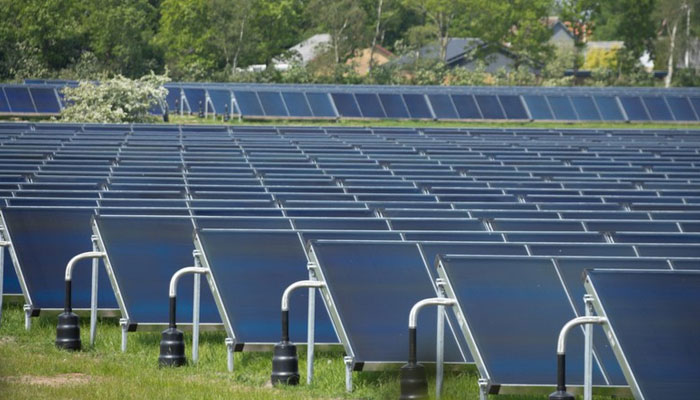
In accordance with the plan, subsidies would be given to pay up to 40% of the costs associated with building infrastructure and heating facilities that use waste heat, massive heat pumps, biomass, geothermal energy, solar thermal energy, and other renewable energy sources. Additionally, during a ten-year period, subsidies will be provided to cover the operating expenses of heat generation via solar thermal systems and electricity-based heat pumps.

Because fossil fuels still account for the majority of Germany’s heat supply; nearly half of German houses are still heated with natural gas; and another quarter with oil; the district heating industry must be decarbonized. According to early data, heat generation from heat pumps increased by 8% year over year, while the amount of heat supplied by solar thermal systems increased by 9% in Germany in the first half of 2022.

Power Info Today brings together the global energy industry โ€” from generation and transmission operators to utility executives and energy transition leaders โ€” through trusted editorial, market intelligence, and digital engagement.

Our 2026 Media Pack offers integrated solutions to reach your audience:

  • Magazine & Digital Editions Showcase your brand within premium energy industry coverage read by executives and decision - makers worldwide.
  • Industry Insights & Reports Align with data - driven analysis, trend reports, and regional roundups across the global power and energy value chain.
  • Brand Authority & Credibility Position your company as a thought leader through expert commentary, interviews, and special features.

Latest stories

Related stories

Breakthrough Energy Technologies Accelerating Net Zero

The global journey toward a zero-carbon world relies on more than just incremental improvements; it requires the deployment of frontier innovations. Accelerating net zero with breakthrough energy technologies involves integrating ultra-dense power sources like fusion and advanced geothermal with versatile molecular carriers such as hydrogen to create a truly resilient and sustainable industrial civilization.

How Renewable Infrastructure Drives Industrial Decarbonization

The heavy industry sector is often considered the "last mile" of the energy transition. Building renewable infrastructure for industrial decarbonization involves a fundamental redesign of industrial energy systems, moving away from high-carbon combustion toward a hybrid model of direct electrification and molecular green energy.

Integrating Renewable Energy for Enhanced Grid Stability

As the world transitions toward a cleaner power mix, the challenge of maintaining a steady electricity supply becomes paramount. Integrating renewable energy for grid stability involves leveraging cutting-edge technology and flexible infrastructure to turn variable resources into a reliable backbone for modern society.

Advancing Hydrogen Storage for Enhanced Energy Security

The global energy landscape is currently undergoing a transformation...

Subscribe

- Never miss a story with notifications

- Gain full access to our premium content

- Browse free from any location or device.

Media Packs

Expand Your Reach With Our Customized Solutions Empowering Your Campaigns To Maximize Your Reach & Drive Real Results!

โ€“ Access the Media Pack Now

โ€“ Book a Conference Call

โ€“ Leave Message for Us to Get Back

Translate ยป