
































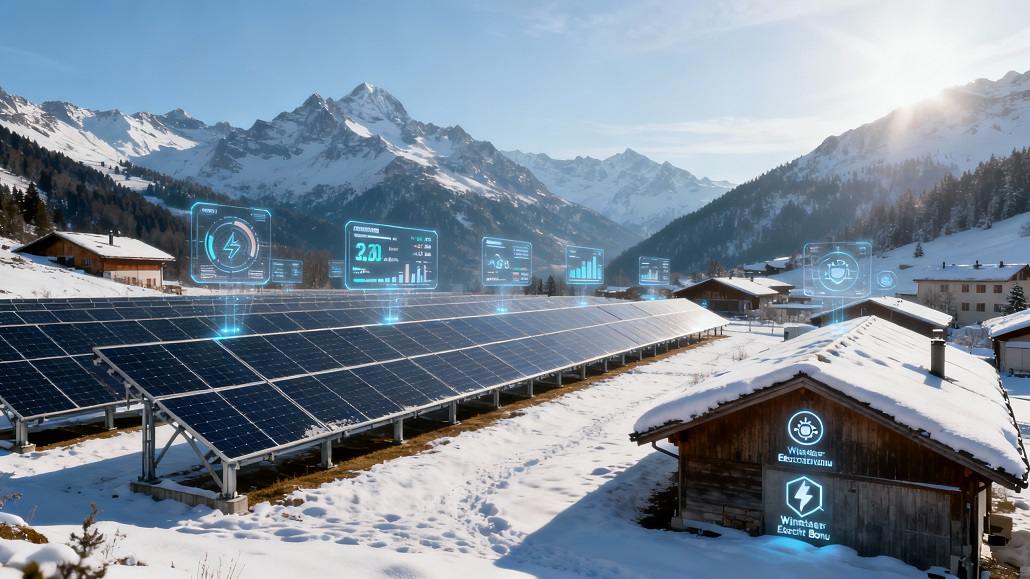

In a recent move, the Federal Council of Switzerland is introducing a winter electricity bonus when it comes to photovoltaic installations that would enter operations from January 1, 2026.
The mechanism is going to apply to photovoltaic systems that are 100 kW or more. An explanatory report in terms of the revision explains that the bonus is going to be performance-based and would be linked to the specific electricity output of the solar installation in the winter half-year, right from October 1 to March 31.
In order to be eligible, the installations have to go beyond the threshold of 500 kWh/kW generated during the winter half-year, since the bonus is going to be calculated by decreasing 500 kWh/kW off of the overall yield so as to make sure that the bonus is only granted to prominently higher winter electricity production when it gets compared to an average solar system.
According to the explanatory report, this calculation method is intended to make sure that only those installations having a significantly higher specific winter electricity output as compared to an average installation in the Swiss Plateau, which values anywhere between 250 and 300 kWh/kW, would get the benefit from the winter electricity bonus.
The report also goes on to add that the bonus is going to be calculated as a one-time payment that will be based on the specific winter electricity yield, which is averaged over three winter half-years, and is going to be granted to installations that come with and without the on-site consumption.
The report further explains that the specific winter electricity yield, which goes beyond the 500 kWh/kW of capacity, goes on to represent the specific winter electricity surplus of the system. For every kWh/kW of specific winter electricity surplus, there will be a bonus of CHF 3.50/kW of the installed capacity, which will be granted as a one-time payment for systems without any kind of on-site consumption.
The report also adds that for installations supported by way of a sliding market premium, the CHF 3.50/kW is going to be divided throughout the 20-year compensation period, thereby resulting in an amount of CHF 0.175/kW per year, which would be multiplied by the winter electricity surplus of the installation.
The new mechanism is going to replace the altitude bonus for photovoltaics by Switzerland, which has been in force since 2023. The altitude bonus went on to cover solar systems that were a minimum of 1,500 meters above sea level and that produced a minimum of 500 kWh/kW per year during the half-year between October 1 and March 31. It also covered almost 60% of the eligible investment costs when it comes to qualified projects.
Apparently, the Federal Council has also gone ahead and approved the new interim targets when it comes to renewable electricity production by the decade’s end since Switzerland works towards the objective of 35 TWh of renewables, excluding the hydropower, by 2035, and also 45 TWh by 2050, as outlined within a Federal Act on a Secure Electricity Supply Based on Renewable Energy Sources.
The new target set an aim of attaining 23 TWh of electricity production coming from renewables by the end of the decade, 18.7 TWh of which should be coming from photovoltaics.
As per PV Power Applications’ National Survey Report in Switzerland, which was published in October 2025 by the International Energy Agency Photovoltaic Power Systems Programme – IEA-PVPS, photovoltaics went on to produce 5.96 TWh of electricity in Switzerland by the end of 2024, comprising 10.36% of the electricity consumption in the country in 2024.
The report further added that the cumulative solar capacity of Switzerland stood at 8.17 GW at the end of 2024 after 1,799 MW were rolled out across that year.