














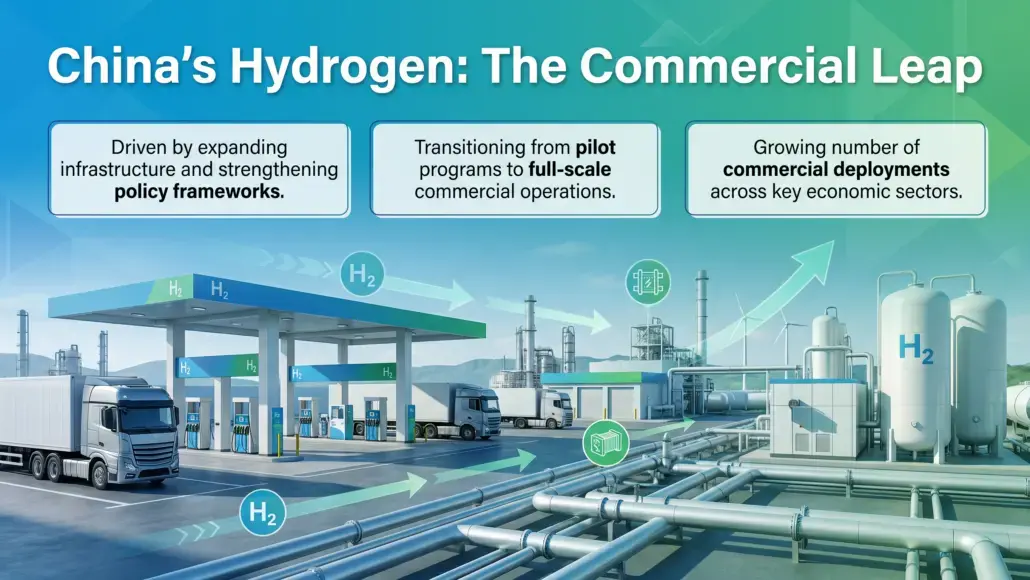

China’s hydrogen industry is moving from demonstration projects toward larger-scale commercial deployment, with renewable power increasingly becoming a key part of hydrogen production and application. Solar and wind resources are being linked with electrolyzers to produce green hydrogen, while hydrogen is also gaining applications across power generation, industrial processes and transportation. The shift is supported by national energy planning, expanding infrastructure and continued investment in hydrogen technologies.
One example is the Sinopec Xinjiang Kuqa Green Hydrogen Pilot Project in Kuqa, Xinjiang Uygur Autonomous Region. China’s first green hydrogen refining project has an annual capacity of 10,000 tonnes and began production on June 30, 2023. Solar electricity generated across the Gobi desert is transmitted more than 20 kilometers to the hydrogen production facility, where it powers water electrolysis. The resulting hydrogen is then transported by pipeline to Tahe Refining & Chemical Company for use in refining, replacing natural gas previously used in the process. According to Li Ruixia, manager of the hydrogen energy management department at Sinopec Star New Energy Co., Ltd., the project can reduce carbon dioxide emissions by about 485,000 tonnes annually when operating at full capacity. Li said the project has operated safely and steadily for more than three years, demonstrating the feasibility of large-scale industrial applications of green hydrogen. The China hydrogen industry is also extending the role of hydrogen beyond refining as renewable electricity becomes increasingly integrated with hydrogen production.
The potential applications include power generation, steelmaking and transportation. In Shandong province, a pure hydrogen shaft furnace demonstration line operated by China Iron & Steel Research Institute Group Co., Ltd. has achieved regular production of direct reduced iron with a metallization rate above 96 percent. The facility has also completed batch trial production of 3N-grade, or 99.9 percent, high-purity iron. In transportation, hydrogen fuel cell technology has expanded into buses, mining trucks, ships, drones and rail transit. During the Beijing 2022 Winter Olympic Games, 200 hydrogen-powered buses equipped with fuel cell systems developed by SPIC Hydrogen Energy under State Power Investment Corporation provided transportation services, covering more than 880,000 kilometers and reducing carbon dioxide emissions by more than 620 tonnes.
By the end of 2025, China had recorded nearly 40,000 cumulative sales of hydrogen fuel cell vehicles and built 574 hydrogen refueling stations with a combined daily refueling capacity of more than 360 tonnes. Annual green hydrogen production capacity had reached about 250,000 tonnes, while green hydrogen had begun replacing conventional fuels in some refining and coal chemical processes. National energy planning is also giving hydrogen a larger role in the country’s future energy system. The outline of the 15th Five-Year Plan (2026-2030) identifies hydrogen as a key area for future industries, while the plan for building a new energy system during the same period includes hydrogen within the non-fossil energy supply system and sets a target of producing 2 million tonnes of hydrogen from renewable energy sources. The China hydrogen industry nevertheless continues to face high production costs, limited economic viability and incomplete market and pricing mechanisms. Continued advances in solar and wind power, along with improvements in electrolyzers and fuel cells and reductions in technology costs, are expected to support wider commercial use of green hydrogen.