




















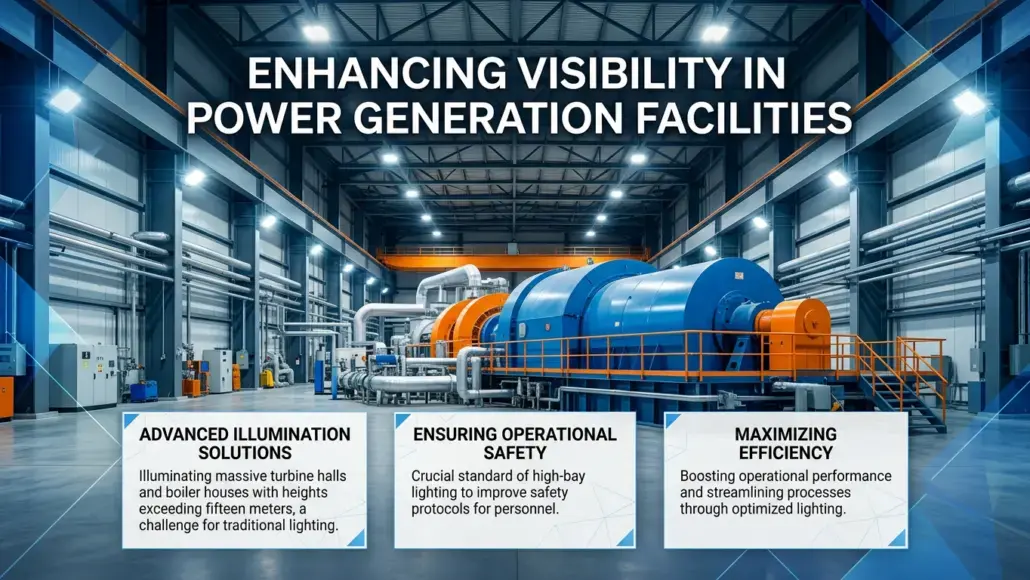

The architectural configuration of modern power generation facilities necessitates a sophisticated approach to internal illumination, particularly within the expansive volumes of turbine halls and boiler houses. In these environments, mounting heights often exceed fifteen meters, creating a challenging environment for traditional lighting solutions. The implementation of high-bay lighting systems has become a critical standard for ensuring operational safety and efficiency. These systems are designed to project high-intensity light over great distances, ensuring that the floor level receives the necessary lux levels for complex mechanical operations. The structural integration of these luminaires involves a detailed analysis of the building’s steel framework, as fixtures must be positioned to avoid shadowing from overhead cranes and heavy piping infrastructure.
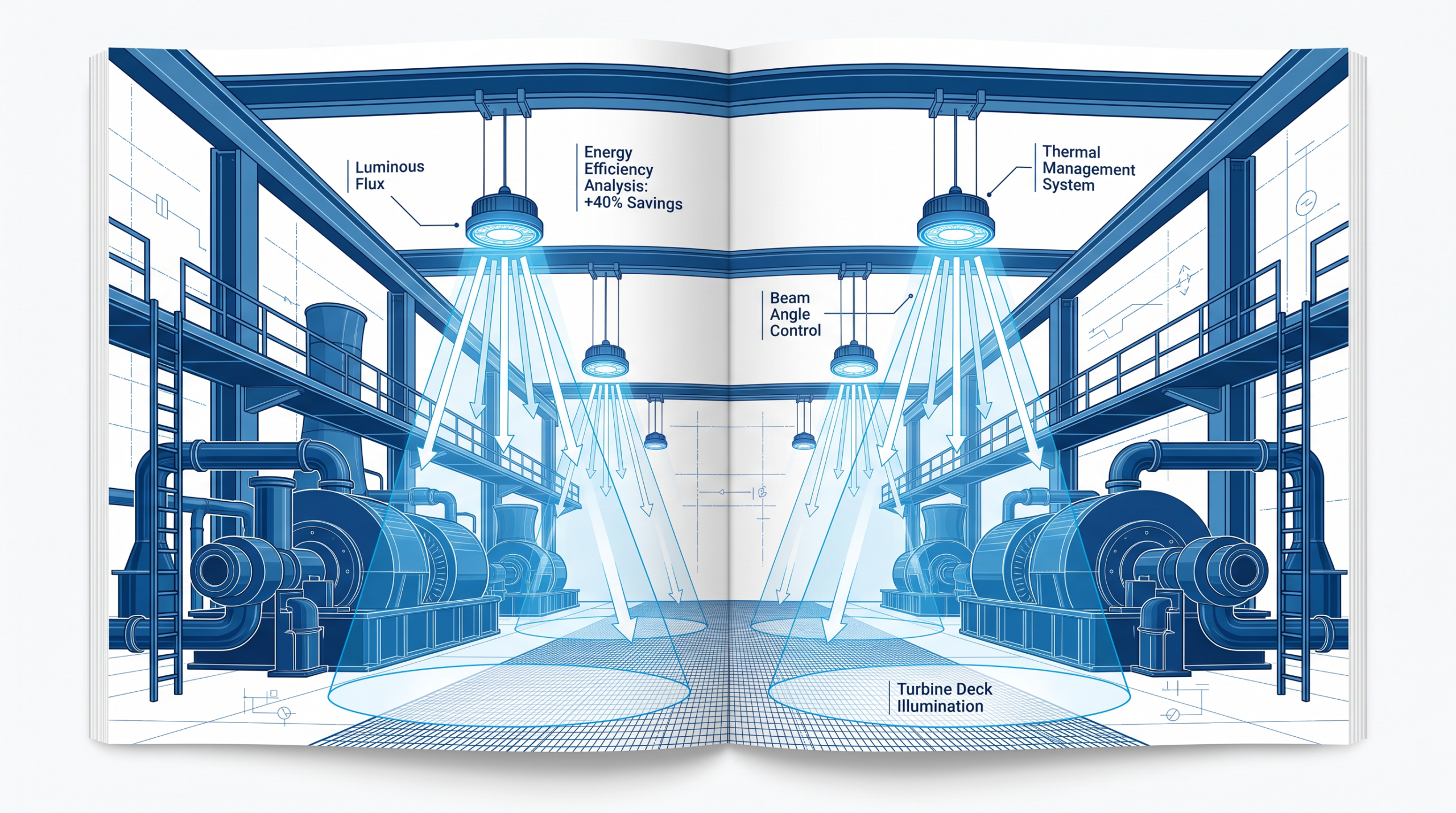
Visibility at the ground level is paramount for the safe operation of massive rotating equipment. Advanced overhead systems provide the consistent luminous flux required to monitor gauge panels and detect fluid leaks that might otherwise remain obscured in a dimly lit environment. The transition from legacy high-pressure sodium or metal halide fixtures to advanced light-emitting diode technology has allowed for better control over beam distribution. Modern optics allow for precise targeting of light, reducing the waste associated with stray light hitting the upper walls or ceiling. This targeted approach ensures that energy is focused where personnel are active, enhancing the overall safety profile of the facility.
The installation of these systems also considers the seismic and vibrational characteristics of power plants. Turbine operations generate constant mechanical resonance that can compromise the integrity of standard lighting mounts. Industrial fixtures utilized in the power sector are typically equipped with reinforced housing and vibration-resistant mounting brackets to ensure long-term stability. Additionally, the integration of glare-control optics improving operator visibility in power plants is a complementary strategy that works alongside high-bay installations to eliminate visual discomfort and fatigue. By addressing both the quantity and quality of light, facility managers can create a working environment that supports continuous, high-stakes monitoring.
Spectral Distribution and Visual Acuity in Large-Scale Generation
Color rendering and spectral quality are often overlooked in industrial lighting, yet they play a fundamental role in the identification of technical components within a power plant. Overhead fixtures with high color rendering indices enable technicians to distinguish between various color-coded wiring, piping, and safety markers. In high-voltage environments, the ability to correctly identify a phase-coded cable or a specific valve handle is a matter of life safety. Traditional lighting often cast a yellow or orange hue that distorted colors, leading to potential errors during critical switching operations. The shift toward broad-spectrum white light has significantly improved visual acuity, allowing for faster response times and more accurate diagnostic assessments.
The impact of spectral distribution extends to the circadian rhythms of operators working on rotating shifts. Power generation is a twenty-four-hour operation, and the lighting environment must support alertness during night shifts while preventing excessive eye strain. Advanced illumination systems can be calibrated to provide a cooler color temperature that mimics natural daylight, which has been shown to improve cognitive function and reduce the likelihood of human error. This is particularly vital in control room annexes and turbine decks where split-second decisions are made. The uniformity of the light also plays a role in preventing the “cave effect,” where the ceiling remains dark while the floor is bright, a phenomenon that can cause disorientation and psychological fatigue.
Visual acuity is further enhanced by the reduction of flicker and stroboscopic effects. In environments with fast-moving machinery, such as rotating shafts or fan blades, low-frequency flicker from older lighting can make moving parts appear stationary or moving in reverse. Modern overhead luminaires utilize high-frequency drivers that eliminate these dangerous optical illusions. This ensures that operators can accurately perceive the movement of equipment at all times. The combination of high CRI, appropriate color temperature, and flicker-free operation creates a visual environment that is conducive to the rigorous demands of power generation maintenance and operation.
Energy Efficiency and Operational Life in Harsh Thermal Environments
The economic viability of a power generation facility is closely tied to its internal energy consumption and maintenance overhead. Lighting accounts for a significant portion of a facility’s auxiliary power load. Overhead solutions that utilize LED technology offer substantial energy savings compared to traditional discharge lamps, often reducing consumption by fifty to seventy percent. These savings are not merely a result of the light source itself but also the result of advanced dimming and control capabilities. Integrated sensors can adjust light levels based on occupancy or available ambient light from skylights, ensuring that energy is not wasted in unoccupied zones of the plant.
Operational longevity is another critical factor, as replacing fixtures at extreme heights requires specialized equipment and creates potential safety risks. Industrial high-bay units are engineered for extended lifespans, often reaching 100,000 hours of operation before significant lumen depreciation occurs. In a power plant, where ambient temperatures near boilers or steam lines can reach fifty degrees Celsius, thermal management is essential. The use of high-bay lighting systems ensures that the facility remains adequately lit without the need for frequent, disruptive maintenance cycles. The luminaires are equipped with heavy-duty heat sinks and thermal throttling mechanisms that protect the electronic components from premature failure.
The reduction in maintenance requirements also translates to a lower risk profile for the facility. Every time a technician must ascend to a high-bay position to replace a lamp, there is a risk of falls or contact with energized equipment. By installing overhead fixtures with long-life components, a facility can minimize these high-risk interventions. The total cost of ownership is therefore significantly lower when accounting for energy savings, labor costs, and the avoidance of operational downtime. This makes the transition to high-performance lighting a prudent financial and safety decision for any large-scale generation site.
Safety Standards and Regulatory Compliance for Overhead Illumination
Compliance with international safety standards, such as those set by the Illuminating Engineering Society and various national health and safety boards, is a mandatory requirement for power generation operators. These standards dictate specific minimum lux levels for different areas of the plant, ranging from high-intensity lighting for maintenance zones to lower levels for general circulation. Technical lighting units are designed to meet these stringent requirements, providing documented performance data that can be used during safety audits. The ability to provide uniform illumination across large areas is a key metric in these audits, as dark spots can hide hazards like trip points or chemical spills.
- Minimum illumination levels for turbine decks: 200 to 300 lux.
- Required color rendering index for technical areas: 80 CRI or higher.
- Standard for emergency egress lighting: 10 lux minimum along the path of travel.
- IP rating for dust and moisture resistance: IP65 or higher for boiler areas.
- Vibration resistance certification for high-vibration zones near heavy machinery.
The regulatory environment also emphasizes the need for reliable emergency lighting. While the primary overhead systems provide the bulk of the illumination, they are often integrated into a broader emergency response strategy. This includes the use of battery backups and fail-safe mechanisms that ensure lighting is maintained during a total loss of station power. The durability of the high-bay fixtures themselves contributes to this compliance, as they are often the first line of defense in maintaining a safe environment during an industrial incident. Ensuring that all overhead lighting meets or exceeds these standards is a core responsibility of the facility’s engineering team.
Strategic Placement and Installation Challenges in Nuclear and Thermal Plants
The installation of lighting in nuclear or coal-fired power plants presents unique challenges that are not found in standard industrial settings. In nuclear facilities, specialized high-bay units must sometimes withstand radiation exposure without degradation of the lens material or the internal electronics. This requires the use of specialized polymers and shielding techniques. In coal-fired plants, the presence of fine combustible dust necessitates the use of explosion-proof or dust-ignition-proof housings. These specialized units are designed to contain any internal electrical spark, preventing the ignition of the surrounding atmosphere.
Strategic placement is also constrained by the density of the facility’s infrastructure. In a typical thermal plant, the overhead space is crowded with steam pipes, cable trays, and ventilation ducts. Technical high-bay lighting systems must be positioned with mathematical precision to ensure that the light reaches the intended targets without being blocked by these obstructions. This often involves the use of asymmetric optics or custom mounting angles to “throw” the light around structural obstacles. The use of 3D lighting modeling software has become an essential tool in the design phase, allowing engineers to simulate the light distribution before a single fixture is installed.
Finally, the commissioning process for these systems involves rigorous testing to verify that the predicted light levels have been achieved. Measurements are taken at various points across the turbine deck and at critical valve stations to ensure that there are no “blind spots.” High-bay lighting systems that fail to meet the design criteria must be adjusted or supplemented with secondary task lighting. The goal is always to achieve a seamless blanket of light that supports every aspect of the plant’s operation, from routine monitoring to emergency repairs. Through careful selection and strategic placement, these systems form the backbone of a power plant’s visual safety infrastructure.