
















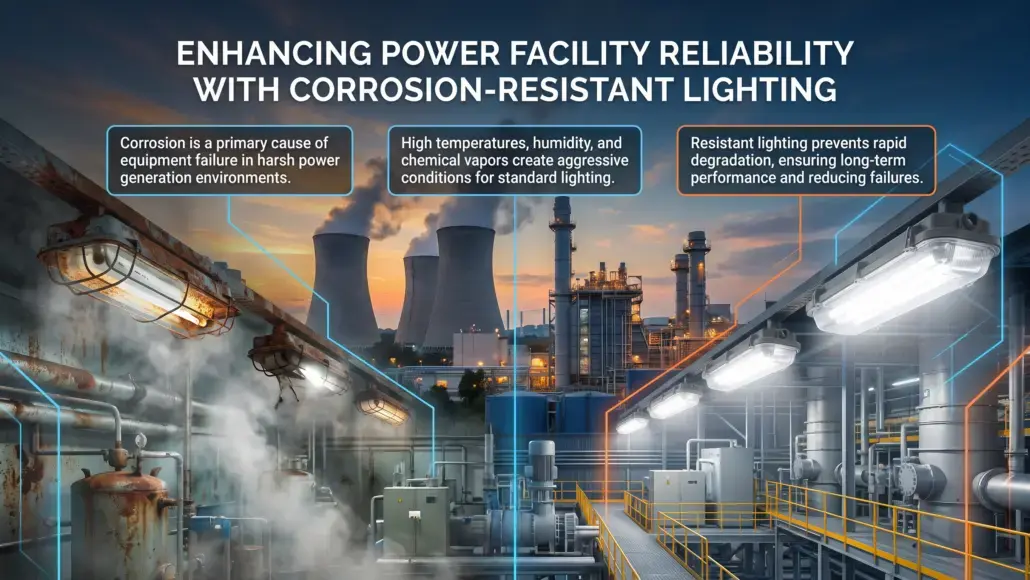

Corrosion is a primary cause of equipment failure in power generation facilities, where exposure to high temperatures, humidity, and chemical vapors creates a highly aggressive environment. In areas such as cooling towers, flue gas desulfurization units, and chemical treatment rooms, standard industrial lighting systems can fail within months due to the rapid degradation of their metallic components and seals. Corrosion resistant lighting solutions are specifically engineered to withstand these conditions, providing a reliable source of illumination that maintains the facility’s operational integrity. The use of these specialized systems is not merely a matter of maintenance convenience; it is a critical safety requirement, as lighting failures in hazardous areas can lead to accidents and hinder emergency response efforts. By implementing corrosion resistant materials and advanced sealing technologies, power plants can significantly reduce the total cost of ownership for their lighting infrastructure. The adoption of these systems is a strategic investment in the long-term resilience of the facility’s support utilities.
The impact of corrosion on lighting extends beyond physical degradation. As fixtures oxidize, their light output can decrease due to the clouding of lenses or the failure of internal reflective surfaces. This loss of illumination can compromise the accuracy of visual inspections and the safety of personnel moving through the site. Corrosion resistant lighting addresses these challenges through the use of non-metallic housings, such as fiberglass-reinforced polyester, or specialized metallic alloys that are inherently resistant to chemical attack. The integration of high-performance seals ensures that corrosive gases and moisture cannot reach the internal electronics, protecting the sensitive LED drivers and arrays. This holistic approach to environmental protection ensures that the lighting system remains functional even in the most severe operational zones, supporting a continuous culture of safety and reliability. The resulting improvements in visibility directly contribute to the reduction of operational risk across the entire site.
Material Engineering for Chemical and Thermal Resistance
The selection of materials for corrosion resistant lighting involves a careful evaluation of the specific chemical stresses present in different areas of a power plant. In sulfur-rich environments, such as those found near coal-fired boilers, the use of traditional aluminum can lead to rapid pitting and structural failure. In these zones, fixtures constructed from copper-free aluminum with specialized epoxy coatings provide the necessary protection. These coatings are applied through multi-stage processes to ensure a uniform and pinhole-free barrier that resists the penetration of acidic vapors. In even more extreme conditions, such as acid storage rooms or battery facilities, non-metallic housings provide the ultimate defense against chemical attack. These materials do not conduct electricity and are immune to the galvanic corrosion that often plagues metallic fixtures in high-moisture environments. The long-term stability of these materials is a foundational requirement for any illumination system deployed within a chemical-intensive power generation zone.
Thermal resistance is also a critical factor, as many corrosive environments in power generation are also characterized by high temperatures. Corrosion resistant lighting must be able to maintain its structural and chemical integrity at temperatures exceeding 60 degrees Celsius. This requires the use of specialized gaskets made from fluoroelastomers, which maintain their elasticity and sealing properties even after long-term exposure to heat and chemicals. The internal electronics must also be designed for high-temperature operation, utilizing industrial-grade capacitors and thermal management systems that prevent the buildup of heat within the fixture. By combining chemical and thermal resistance, these lighting systems provide a stable and predictable service life, allowing facility managers to synchronize lighting maintenance with other major equipment overhauls. This synchronization minimizes the downtime required for utility repairs and allows plant resources to be focused on core production assets.
Protecting Internal Electronics from Environmental Ingress
The vulnerability of modern LED lighting to environmental ingress is a significant concern in power generation facilities. Even small amounts of moisture or corrosive gas can lead to the failure of individual LEDs or the total collapse of the driver circuit. Corrosion resistant lighting utilizes hermetically sealed enclosures that prevent the entry of these contaminants. The use of vacuum-impregnated coatings on circuit boards provides an additional layer of protection, ensuring that even if the primary seal is compromised, the electronics remain functional. This level of redundancy is essential for maintaining illumination in critical areas where a sudden loss of light could have catastrophic consequences. The integration of pressure-equalizing vents allows the fixture to respond to changes in ambient pressure without drawing in contaminated air, further extending the life of the internal seals. The protection of these internal components is the primary driver for the increased reliability seen in specialized industrial fixtures.
The design of the electrical entry points is also a critical consideration for ingress protection. Corrosion resistant lighting systems utilize specialized cable glands and sealing hubs that provide a watertight and gas-tight connection to the conduit system. These components are often made from the same resistant materials as the fixture housing to prevent galvanic corrosion at the interface. By ensuring that the entire electrical path is protected, from the junction box to the LED array, facility engineers can eliminate one of the most common points of failure in industrial lighting. The resulting system is not only more reliable but also easier to maintain, as there is no need for frequent cleaning or the replacement of corroded wiring. This focus on long-term sealing is a key differentiator between standard industrial fixtures and true corrosion resistant solutions, providing a level of security that is unmatched by generic products.
Structural Integrity and Safety in High-Vibration Zones
Power generation facilities are characterized by constant mechanical vibration, which can accelerate the failure of corroded lighting fixtures. As the structural components of a fixture are weakened by oxidation, the vibration can cause mounting brackets to fail or lenses to become dislodged. Corrosion resistant lighting is designed with reinforced mounting systems and locking hardware that resist the combined effects of chemical attack and mechanical stress. This ensures that the fixtures remain securely attached to the structure, even in high-vibration areas like turbine decks or near large cooling fans. The use of safety cables and secondary retention systems is also common, providing an additional layer of protection for personnel working below. By maintaining their structural integrity, these systems prevent the risk of falling debris, which is a major safety hazard in industrial environments. The durability of these fixtures is a testament to the rigorous engineering standards required for power generation applications.
The lenses of corrosion resistant fixtures are also engineered for durability. In areas where chemical vapors could cloud traditional polycarbonate, tempered glass or specialized fluoropolymer lenses are used to maintain light transmission levels. These materials are resistant to scratching and chemical etching, ensuring that the light output remains consistent over the life of the fixture. The ability to clean these lenses with harsh chemical agents without causing damage is another significant advantage for maintenance teams. By ensuring that the light reaches the task area without being diffused or absorbed by a degraded lens, these systems support the high visual standards required for technical work. The combination of structural strength and optical clarity makes corrosion resistant lighting a vital asset for maintaining the reliability of the entire power generation facility, ensuring that every square meter remains safely illuminated regardless of the environmental conditions.
Reducing Lifecycle Costs through Proactive Environmental Design
While the initial investment in corrosion resistant lighting may be higher than for standard fixtures, the long-term savings are substantial. The reduction in maintenance labor, replacement parts, and the costs associated with unplanned outages quickly offsets the higher upfront price. In a typical power plant, the cost of replacing a single fixture in a hard-to-reach area can be several times the cost of the fixture itself when factoring in the need for specialized access equipment and safety personnel. By extending the replacement interval from two years to ten years or more, corrosion resistant systems provide a rapid return on investment. The ability to predict lighting lifecycle costs with greater accuracy also simplifies budget planning and resource allocation for facility managers, allowing for a more disciplined approach to utility management.
The environmental benefits of these systems should also not be overlooked. By reducing the frequency of fixture replacements, power plants decrease the amount of waste generated and the energy required for the manufacturing and transport of new components. The high efficiency of modern LED-based corrosion resistant lighting further reduces the facility’s carbon footprint, supporting corporate sustainability goals. As energy prices continue to rise, the energy savings provided by these systems become increasingly significant. The integration of smart controls, such as dimming and occupancy sensors, further enhances these savings by ensuring that light is only provided when and where it is needed. The adoption of corrosion resistant lighting represents a strategic move toward a more resilient, safe, and cost-effective power generation infrastructure, providing a foundation for sustainable energy production. The ongoing development of new materials and sealing techniques will continue to improve the performance of these systems, providing even greater protection for the world’s critical energy assets in the face of increasingly challenging operational environments.