
































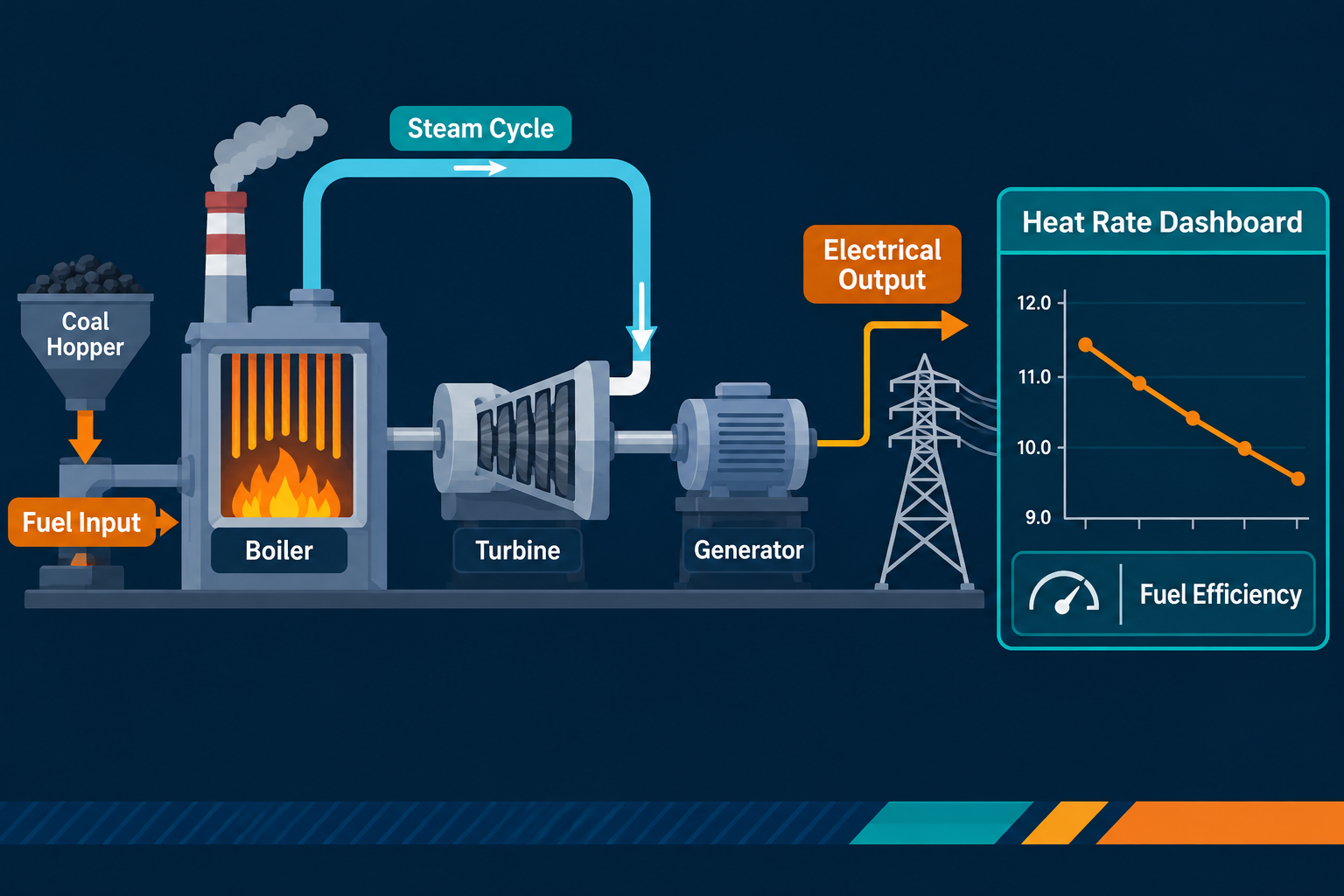
Fuel is the largest single cost in thermal power generation, commonly representing between sixty and seventy percent of the total cost of electricity from a coal fired station. Heat rate, the measure of how much thermal energy a plant consumes to produce each unit of electrical output, is therefore the number that governs competitiveness more than any other. A one percent deterioration in heat rate on a mid-sized coal unit can add millions to annual fuel spend, yet most plants still measure heat rate the way they did two decades ago: through periodic tests that capture a few hours of stable operation. AI-powered heat rate monitoring replaces that snapshot with a continuous, load-following estimate of efficiency, giving plant and fleet management an accurate picture of fuel performance across every hour of operation. The result is a shift from discovering efficiency losses after they have cost money to intercepting them while they can still be corrected cheaply.
Why Heat Rate Determines Thermal Plant Economics
In merit order dispatch markets, the units with the lowest short run marginal cost run first, and heat rate is the dominant component of that cost. Two nominally identical units in the same fleet can differ in heat rate by several percent because of age, maintenance history and operating patterns, and the market rewards the efficient one with hours of operation while the less efficient unit idles. Plant managers feel the same pressure internally: monthly fuel reconciliation meetings increasingly ask why specific consumption rose relative to the same month last year, and the answers are often inconclusive because the data needed to isolate the cause was never systematically captured.
The difficulty is that heat rate is not a fixed number. It varies with load, coal quality, ambient temperature, cooling water conditions, cycle configuration and the accumulated condition of the boiler and turbine. A single test campaign cannot describe behaviour across that space. Conventional performance calculation, done weekly or monthly from daily input-output figures, averages over these variations and smooths away precisely the information an operator needs. What looks like acceptable average performance can conceal days of poor operation that were never flagged. Understanding heat rate as a dynamic, condition-dependent quantity is the conceptual shift that makes continuous monitoring valuable.
The financial materiality explains why heat rate sits at the centre of plant governance. Fuel contracts, dispatch economics and carbon liabilities all flow through the same thermodynamic number. When fuel prices rise, the value of a heat rate point rises with them, and utilities in high fuel cost markets have historically been the most aggressive investors in efficiency instrumentation. Plants selling into competitive markets face the same logic from the demand side, since counterparties increasingly scrutinise the efficiency credentials of the generation they contract. In both settings, an accurate, continuously updated heat rate figure functions as commercial infrastructure, as fundamental to trading and contracting as the metering at the plant gate.
Continuous Heat Rate Estimation With AI Models
AI-based heat rate monitoring builds a statistical model of plant efficiency from the data historians already contain. Inputs typically include generator output, fuel flow or coal feeder rates with corresponding calorific values, air and flue gas measurements, steam conditions, condenser parameters and auxiliary power consumption. The model learns how each input combination maps to measured efficiency across the full operating history, including part load and cycling periods that conventional tests never cover. Once trained, it estimates heat rate continuously and, critically, estimates what heat rate should be under current conditions.
That expected-versus-actual comparison is the operational heart of the method. If the model predicts a gross heat rate of 2,410 kilocalories per kilowatt hour for the current load and coal quality, and the plant is actually achieving 2,465, the deviation is quantified immediately rather than surfacing in a monthly report. Because the model holds ambient and load effects constant, residual deviations point to genuine performance changes in the plant itself. Validation against formal test codes keeps the estimates honest: operators periodically run acceptance-grade tests and confirm that the model tracks them, which builds the confidence needed to use continuous estimates for commercial decisions.
Identifying and Prioritising Controllable Losses
Total heat rate decomposes into a chain of losses, and only some of them respond to operator action. Fixed or design-related losses, such as theoretical cycle limits and irrecoverable exhaust losses, set the floor. The actionable category includes excess combustion air, boiler exit gas temperature, unburnt carbon in ash, condenser backpressure, superheat and reheat attemperation flows, auxiliary power draw and cycle isolation losses such as leaking drain and bypass valves. Studies of utility fleets consistently find that a meaningful share of measured heat rate deviation is controllable, often between one and three percent of total fuel input.
AI-based loss attribution makes this decomposition routine rather than occasional. The system allocates the deviation between expected and actual performance across its probable contributors, ranks them by financial impact and tracks how each responds to corrective action. Operations teams receive a short, ranked list instead of a wall of trend curves: restore condenser vacuum by cleaning circulating water strainers, correct the air preheater leakage that is inflating exit gas temperature, rebalance mill performance driving unburnt carbon. Some of these fixes cost nothing but attention, which is why plants that adopt structured heat rate monitoring frequently capture their first measurable savings within weeks of going live.
Data and Infrastructure Requirements
The technical foundation for reliable heat rate analytics is well within reach of most plants, but several prerequisites deserve attention:
- Calibrated instrumentation on the primary energy flows, particularly coal weighing and sampling, since calorific value uncertainty propagates directly into heat rate uncertainty.
- A complete and validated historian archive covering representative operating periods, including cycling and low load regimes, for model training.
- Regular coal laboratory analysis feeding the model, because heat rate claims collapse quickly when fuel quality input is assumed rather than measured.
- Documented interfaces between the analytics platform and the plant control system, with clear data segregation for cybersecurity.
- Defined ownership, with a named engineer accountable for reviewing deviations and closing the loop on identified losses.
Benchmarking exercises by efficiency consultants suggest a further point often overlooked: instrument quality itself explains part of the apparent heat rate variation between comparable units. Two identical boilers can report different heat rates purely because one weighs coal more accurately or samples calorific value more frequently. Treating measurement quality as part of the performance programme, rather than as a maintenance cost centre, therefore produces returns that appear directly in reported efficiency. Utilities that audit their fuel flow, air and temperature instruments before deploying analytics consistently build models that validate against formal tests faster and hold their accuracy longer.
Plants that skip the instrumentation work tend to spend their first year arguing about data instead of saving fuel. Those that invest in measurement quality first report faster and more durable gains.
From Measurement to Action in Dispatch and Trading
Continuous heat rate data changes decisions well beyond the plant fence. Dispatchers and commercial teams can rank units by actual, current heat rate rather than annual average, sharpening merit order decisions in real time. Unit commitment can account for the heat rate penalty of operating a unit deep below its economic minimum, making the cost of renewable integration visible and negotiable. In markets that remunerate ancillary services, the analytics quantify what flexible operation genuinely costs in fuel terms, strengthening the commercial case for capacity payments. Some utilities now embed live heat rate estimates into their bidding models for day-ahead markets, where a two percent error in assumed efficiency can flip a profitable bid into a loss.
Measurement identifies where losses sit, but converting them into realised fuel savings requires control changes of the kind delivered through AI-based steam cycle optimisation, which adjusts operating setpoints continuously within equipment limits. The combination of monitoring and optimisation forms a closed economic loop: the model finds the deviation, the optimiser corrects it, and the monitoring system verifies the saving. Fleets that operate both report that verification step is what sustains executive support for the programme over multiple budget cycles.
Heat Rate Performance and Decarbonisation Commitments
Efficiency and emissions are two faces of the same fuel flow, which gives heat rate work a second life under climate policy. Every kilocalorie saved reduces carbon dioxide, sulphur dioxide, nitrogen oxides and ash generation in proportion, so efficiency programmes support compliance targets and carbon accounting simultaneously. Utilities reporting against ESG frameworks or preparing plants for repurposing decisions need credible, auditable efficiency baselines, and continuous monitoring provides exactly that. For assets with remaining operating lives measured in decades, disciplined heat rate management is the cheapest decarbonisation instrument available to a thermal fleet, delivering measurable emissions reductions today while the longer-term transition of the portfolio takes shape.