





























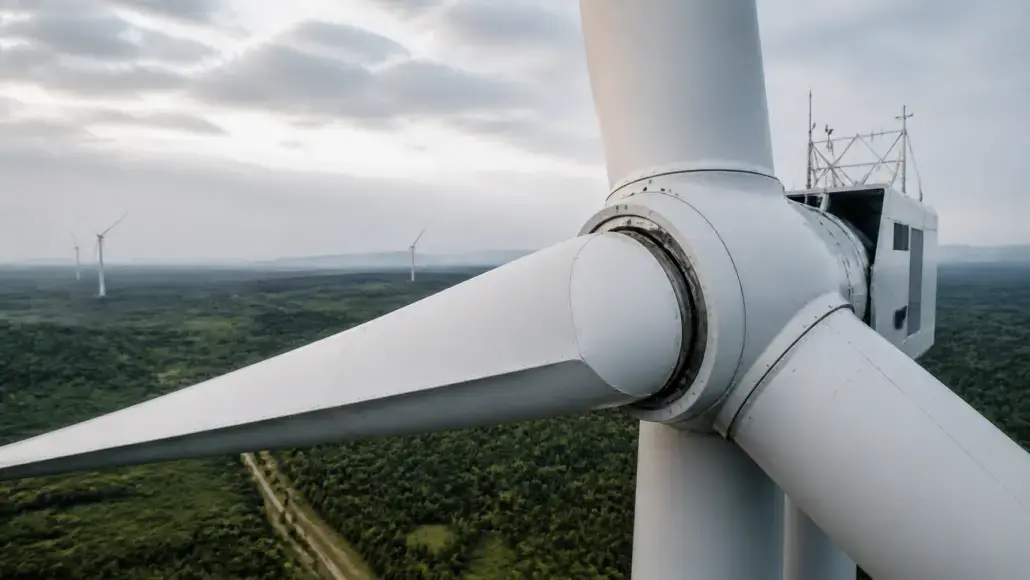

Every kilowatt-hour a wind turbine produces passes through its rotor, and the system that governs what that rotor does with the wind is the pitch mechanism. Pitch systems rotate each blade around its long axis to manage aerodynamic angle of attack, and they are the only means by which a turbine can shed power above rated wind speed, protect itself from storm loads and fine-tune output in the partial-load region where most operating hours are spent. As rotors have grown past 236 meters and ratings past 15 MW, the demands placed on pitch hardware and software have escalated dramatically, and blade pitch control has evolved from a simple safety actuator into one of the most sophisticated subsystems on the machine.
The performance stakes are considerable. Pitch dynamics shape the power curve, the fatigue life of blades and tower, the responsiveness of the turbine to grid instructions and the smoothness of power delivery through turbulent conditions. Operators who retrofit modern pitch strategies onto existing fleets have documented measurable gains in annual energy production alongside reductions in structural load cycles, which makes the pitch system one of the few upgrade paths that improves both revenue and asset longevity at once.
From Collective Pitch to Individual Blade Actuation
The earliest pitch systems treated the rotor as a single aerodynamic unit, commanding all three blades to the same angle in unison. Collective pitch remains adequate for power regulation above rated wind speed, but it ignores the fundamental reality that wind is never uniform across a 250-meter rotor. Each blade samples different wind speeds as it rotates, particularly under wind shear across the swept plane, wake turbulence from upstream machines or yaw misalignment, and those differences drive cyclic loads that shorten structural life.
Individual pitch control (IPC) responds to this asymmetry by commanding each blade separately, typically at a rate of one degree per second or faster, using azimuth-position-aware algorithms that anticipate the load each blade is about to experience. Research published through 2025 confirms the value of the approach: multivariable control designs that coordinate individual pitch with generator torque have demonstrated meaningful reductions in blade root and tower base fatigue loads. For large rotors the implications compound, because the load asymmetry scales with rotor diameter while the structural margin available for blades and tower does not. IPC has effectively become a standard expectation on machines above the 6 MW class rather than an optional refinement, and the newest offshore platforms treat pitch actuation speed and bandwidth as headline specification items alongside rated power.
Implementation at scale has proven the concept. Fleet-wide individual pitch retrofits have moved from research papers into commercial offerings, with suppliers packaging the control software as an upgrade compatible with machines already operating in the field. The retrofit market matters because installed capacity vastly exceeds new-build volume in many markets, and each percentage point of fatigue reduction or production improvement, multiplied across thousands of turbines, represents meaningful fleet-wide value.
Load Alleviation as a Design Currency
The business case for advanced pitch strategies rests on fatigue economics. Every load cycle removed from a blade root weld or pitch bearing race extends component life, defers replacement and lowers the levelized cost of energy. Modern pitch controllers therefore pursue two objectives simultaneously: maintaining power output and minimizing structural excitation. The most effective schemes blend measured load feedback from strain sensors on the blades with aerodynamic models that predict gust loading before it arrives, allowing actuation to begin ahead of the load peak rather than after it.
The principal techniques now deployed or under qualification include:
- Cyclical individual pitch, which commands a rotating offset to each blade that cancels the once-per-revolution loading caused by wind shear and gravity differences between upwind and downwind blade positions.
- Gust-mitigating pitch schedules that use lidar or nacelle anemometry to detect incoming gusts and feather blades proactively, shaving peak loads during extreme events rather than absorbing them structurally.
- Frequency-separated control layers that assign power regulation, load damping and tower clearance management to distinct control bands, preventing the objectives from fighting each other within a single actuator command.
- Damping-focused pitch actions that target specific structural modes, such as blade edgewise or tower fore-aft oscillations, adding active damping where passive structural solutions would add mass.
- Actuator-aware scheduling that modulates pitch activity to conserve bearing and actuator life during periods when load reduction value is lowest.
Pitch Hardware Under Extreme Duty
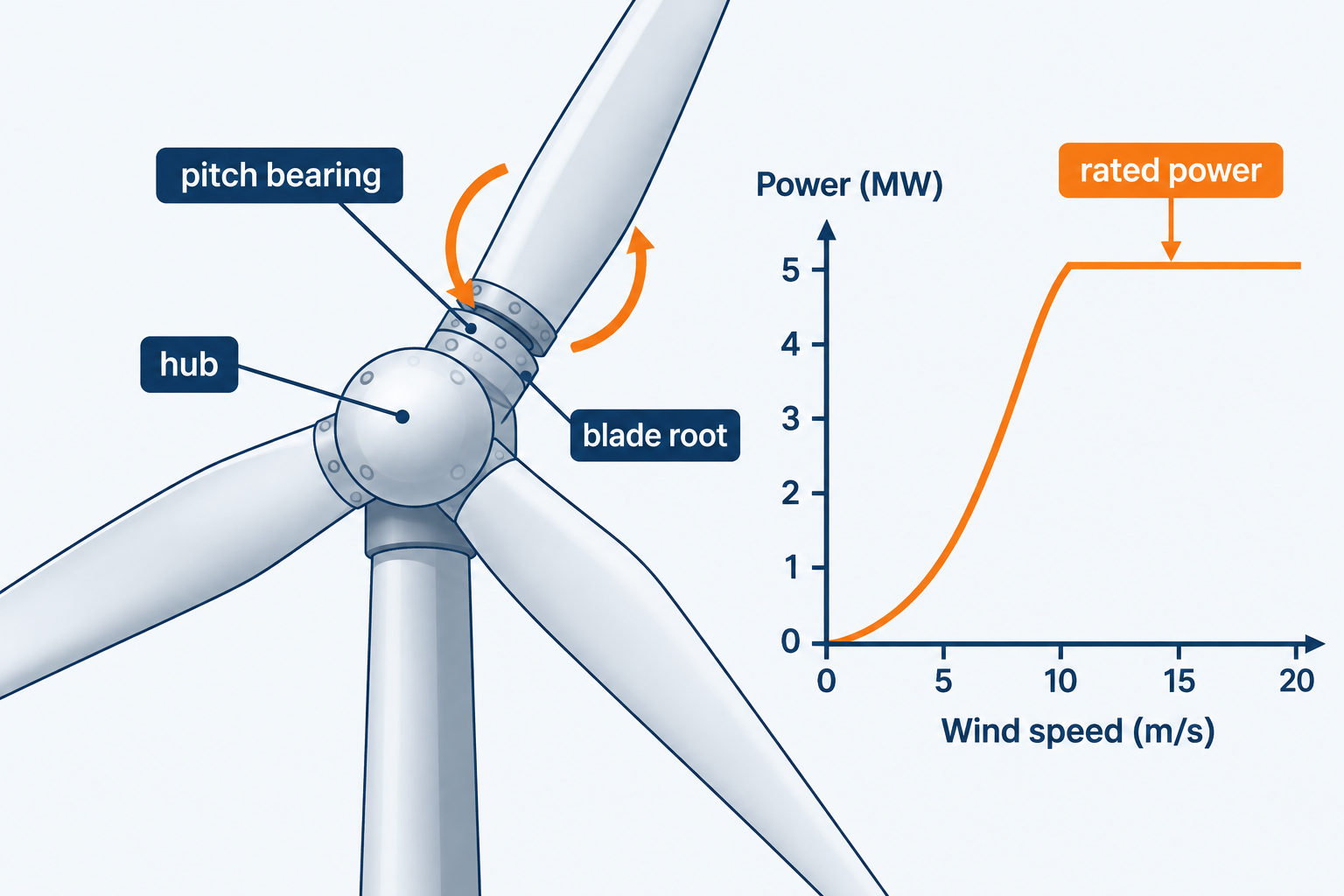
Software sophistication means little if the hardware beneath it cannot keep pace. On a 15 MW machine, each blade weighs as much as 50 tonnes, and the pitch system must rotate it precisely against full aerodynamic torque in conditions ranging from typhoon gusts to icing events. Electric pitch drives dominate new installations, valued for their control precision and diagnostic transparency, while hydraulic systems retain advantages in torque density and cold-climate performance. Both architectures have converged on triplex redundancy, in which each blade carries independent actuators, energy storage and communication paths so that a single failure never leaves a blade uncontrollable, a non-negotiable safety requirement for machines of this scale.
Pitch bearings rank among the most fatigue-critical components on modern turbines. The rolling elements carry blade weight, aerodynamic moments and pitch actuation forces simultaneously, and their duty cycle intensifies as individual pitch commands multiply bearing movement frequency. Manufacturers have responded with larger race diameters, redesigned roller profiles and, notably, a shift in lubrication strategy toward frequent automated greasing that maintains protective film under high-cycle conditions. Component-level monitoring, tracking bearing temperature, vibration signatures and lubricant condition, has become standard equipment, feeding reliability data back into the design loop for successive rotor generations.
Cold climate and offshore duty add further engineering layers. Pitch systems in arctic-grade machines incorporate heating circuits and low-temperature lubricants so that actuation remains responsive through icing events, while offshore variants are sealed against salt intrusion and specified for corrosion classes appropriate to marine atmospheres. Slip rings, the rotating interfaces that carry power and signals into the spinning hub, remain a classic failure point, and contactless power transfer designs are replacing them on the newest platforms to remove that vulnerability entirely.
Smart Pitch in the Wind Farm Context
The newest chapter in pitch evolution extends its scope beyond the individual machine. Pitch systems now participate in wind farm level control strategies, adjusting rotor behavior in response to conditions that no single turbine can observe. In wake steering trials led by research institutions including the National Renewable Energy Laboratory, upstream turbines deliberately pitch or yaw to deflect turbulent wakes away from downstream neighbors, trading a small production loss at the steering turbine for larger gains across the array. Grid operators, meanwhile, increasingly expect pitch systems to support ancillary services, ramping power output and providing inertia response on command.
Artificial intelligence has accelerated this trajectory. Machine learning models trained on fleet-wide SCADA and load data identify pitch schedule refinements that classical control engineering would never surface, and adaptive controllers adjust their strategies to the aging behavior of each specific machine. The same data streams support predictive maintenance of pitch hardware, converting what was once a failure-prone electromechanical subsystem into a monitored, self-reporting asset. As these capabilities mature, coordination between pitch actuation and broader turbine load control frameworks is deepening, positioning pitch control as the executing layer of that wider intelligent control architecture.
The distinction between pitch as a machine function and pitch as a grid asset is also blurring. System operators in markets with high wind penetration increasingly value the fast, precise response that blade pitch control provides for frequency support and ramp management, capabilities that turn turbines into controllable generation rather than intermittent output. That grid-facing role gives pitch engineering a revenue dimension beyond energy capture, and it strengthens the case for investing in actuation quality across every new platform.
Where Pitch Technology Goes Next
The roadmap points toward faster, lighter and more integrated systems. Designs under development include distributed pitch actuation with multiple smaller drives per blade, blade-integrated sensors that eliminate the slip ring communication bottleneck, and aerodynamic trailing edge devices that work in concert with pitch to shape loads at spanwise resolution no hub-mounted system can match. Certification frameworks are adapting as well, recognizing control software as a safety-critical element subject to formal verification.
None of these advances stand alone. Faster actuation is useful only with better load prediction, better prediction only pays off with reliable sensing, and reliable sensing depends on communication architectures that survive decades in the hub environment. The integrated nature of modern pitch engineering explains why manufacturers treat their control software stacks as strategic intellectual property, defended as carefully as blade molds or generator designs.
For the power industry, the significance extends beyond turbine engineering. Blade pitch control has become a decisive factor in procurement scoring, warranty negotiations and reliability engineering, and the machines that dominate the next decade of wind deployment will be those whose pitch systems were designed as first-class contributors to performance rather than as accessories to the rotor. Each refinement in actuation bandwidth, load awareness and farm coordination translates directly into cheaper, more dependable wind electricity.