



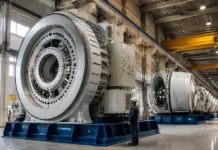






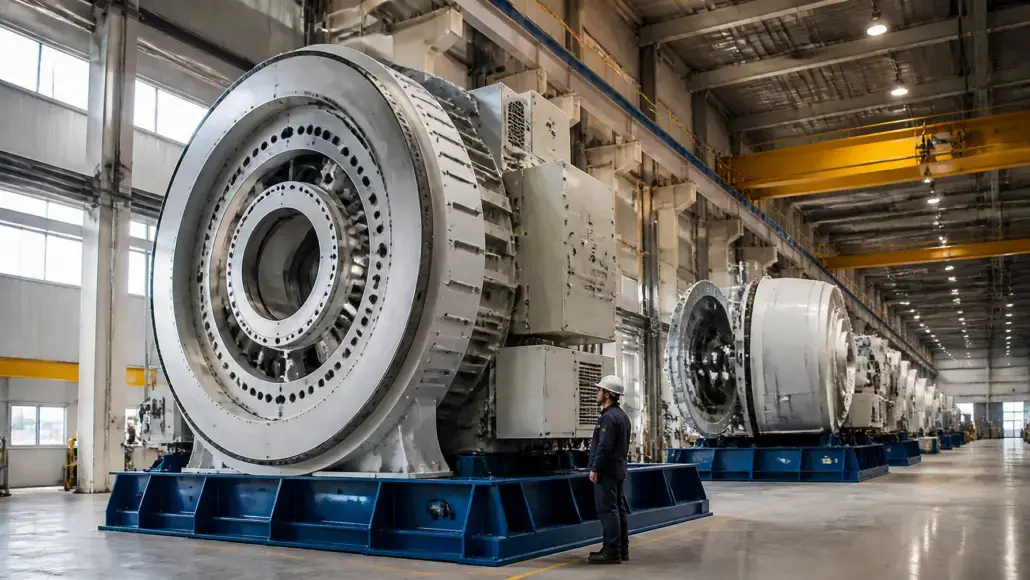

The generator converts mechanical rotation into electricity, and at multi-megawatt scale it has become one of the most demanding components in the entire wind supply chain. Direct-drive machines for large offshore rotors must handle torque measured in the hundreds of meganewton-meters, weigh tens of tonnes and fit within nacelle dimensions that shipping and installation constraints dictate. As ratings have climbed past 15 MW and toward 26 MW, the conventional approach of building ever-larger monolithic generators has collided with casting capacity limits, transport restrictions and factory crane loads. Modular generator architecture has emerged as the industry’s answer, breaking the machine into standardized segments that individual factories can produce, verify and ship before final integration.
The shift matters far beyond component design. Wind turbine manufacturing is scaling worldwide, with nacelle assembly plants multiplying across Europe, Asia and the Americas, and the modularity of the generator determines how easily that geographic expansion can actually happen. A drivetrain that arrives as a few verified modules can be assembled close to the project site by a broader range of suppliers, whereas a monolithic unit concentrates production in a handful of specialized facilities and lengthens every logistics chain that depends on them.
The Drivetrain Context: Direct Drive Versus Geared Systems
Generator architecture decisions begin with the drivetrain. Direct-drive designs couple the generator rotor directly to the hub, eliminating the gearbox and its maintenance profile while accepting large generator diameters, heavy permanent magnet requirements and structural demands at the tower top. Geared systems use a gearbox to step rotor speed up, allowing a smaller, lighter generator, but reintroducing a high-maintenance component that has historically driven a significant share of turbine downtime.
The industry has increasingly settled on the middle path. Medium-speed drivetrains, sometimes called hybrid designs, use a compact one or two-stage planetary gearbox to raise rotational speed to a few hundred revolutions per minute, producing a generator that is dramatically smaller and lighter than a direct-drive equivalent while avoiding the complexity of traditional three-stage gearboxes. Market analysis of offshore drivetrain trends in 2026 notes that medium-speed geared systems, stepping rotor speed to roughly 300 to 600 rpm, are emerging as the balanced choice for many new offshore platforms, with the global wind turbine gearbox market valued at about 27.85 billion dollars in 2025 and projected toward 43.19 billion dollars by 2034. That growth trajectory reflects the drivetrain’s central role in the industry’s capacity race.
Each architecture assigns modularity a different role. Direct-drive designs benefit most from segmentation because their sheer size is what makes them difficult to build and ship, while medium-speed systems achieve transportable dimensions more easily and invest their modularity instead in production volume and service standardization. Manufacturers generally match architecture to product strategy: platforms aimed at extreme offshore ratings lean toward segmented direct-drive machines, while high-volume onshore lines favor compact hybrid drivetrains that maximize factory throughput.
Modular Generator Architecture in Practice
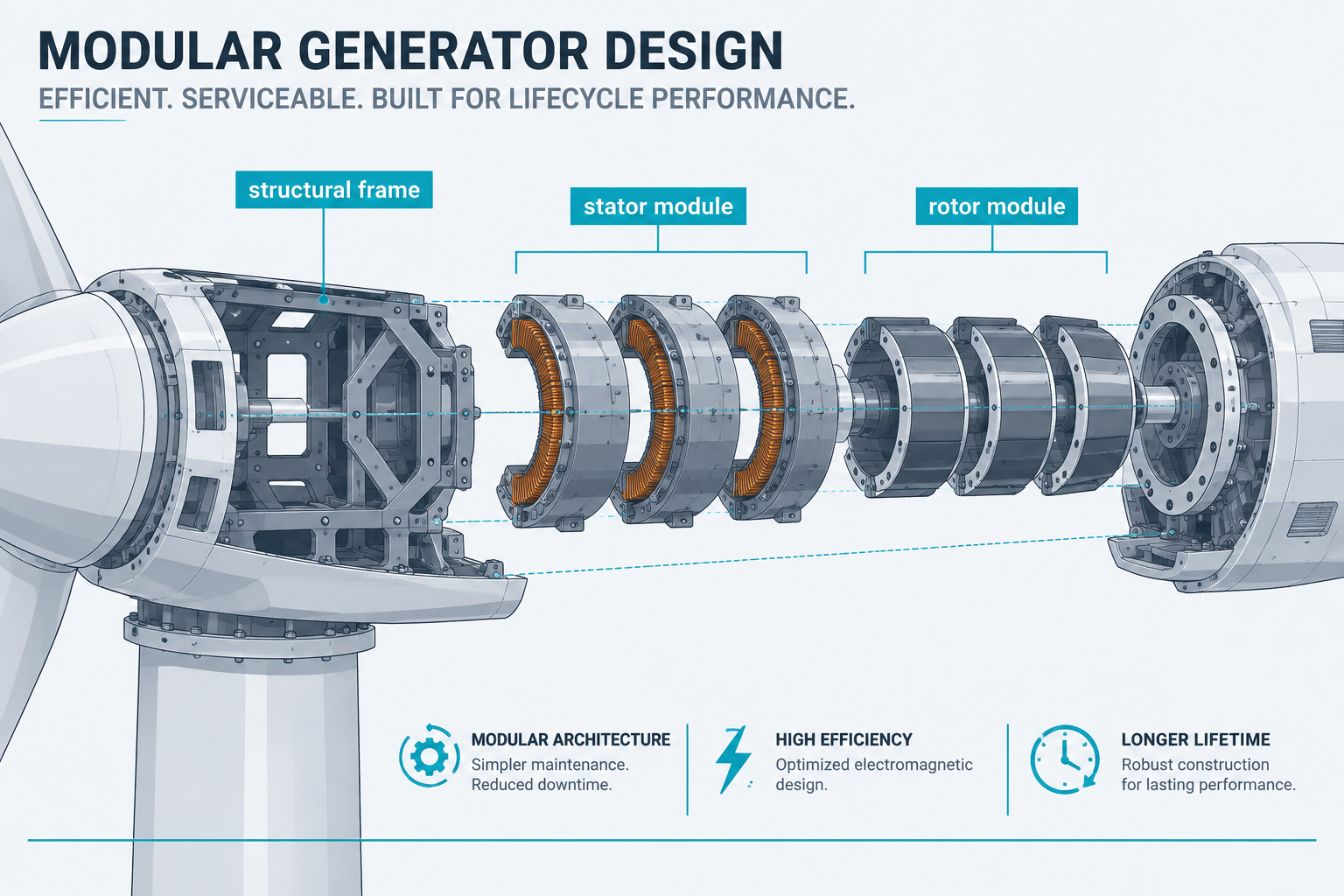
Modularity redesigns the generator as an assembly of functional building blocks rather than a single welded and wound machine. The stator divides into segments that are wound and tested independently before being joined on a structural frame, and in some designs the rotor splits into arc sections as well. Power electronics, cooling circuits and structural supports follow the same logic, each engineered to interface through standardized connections so that modules can be produced by different facilities or even different suppliers and integrated wherever the nacelle assembly occurs.
The engineering rationale rests on several practical benefits:
- Segment manufacturing keeps individual components within the casting, winding and crane capacity of a much wider pool of factories, expanding qualified supplier options for every rating class.
- Parallel production compresses lead times, since stator modules and rotor sections can be built simultaneously rather than sequentially on a single large machine tool.
- Standardized interfaces allow one generator platform to serve multiple turbine ratings by adding or removing module counts, amortizing design and certification investment across product lines.
- Partial replacement becomes possible in service, as a damaged stator segment can be exchanged without scrapping the entire machine, reducing warranty exposure and repair downtime.
- Transport dimensions shrink, since modules fit within standard shipping envelopes that a complete large-diameter generator cannot, enabling assembly locations distant from specialized fabrication hubs.
What makes modular generator architecture more than a design preference is how it changes failure economics across a fleet. Warranty provisions structured around replaceable modules let manufacturers cap their exposure per unit, while owners gain repair paths that avoid the months of downtime a damaged monolithic generator would imply. Those incentives, more than any single technical advantage, explain why the architecture keeps expanding across rating classes.
Early engineering work on modular direct-drive permanent magnet designs demonstrated that the approach can reduce size, weight and manufacturing cost simultaneously without compromising efficiency, a conclusion the industry has since validated as module counts have grown on commercial platforms.
Manufacturing Scale-Up and Supply Chain Effects
The supply chain consequences of modularity extend deep into the industry. Nacelle manufacturing has historically concentrated near specialized drivetrain suppliers, and that concentration constrained where turbine factories could economically operate. Modular generators relax the constraint: final assembly plants in Brazil, India, the United States or Taiwan can receive verified modules from regional suppliers and integrate them locally, multiplying production capacity without replicating the most capital-intensive fabrication steps. This distributed model aligns with local content requirements that now shape procurement in many markets, where turbines increasingly must demonstrate domestic manufacturing participation to qualify for tenders and tax incentives.
Quality assurance adapts to the same logic. Each module undergoes factory acceptance testing against defined electrical, mechanical and dimensional criteria before shipment, so integration at the nacelle plant becomes verification rather than discovery. Traceability requirements strengthen accordingly, since a fleet of segmented generators must track material batches and test records at module resolution rather than machine resolution. For manufacturers, these disciplines carry upfront cost, but they pay back in warranty predictability, because field failures can be isolated to specific module populations and corrected without fleet-wide grounding.
Policy frameworks reinforce the shift. Local content rules in several markets now score turbines on where value is added rather than where final assembly occurs, and modular generator architecture rewards exactly that definition, since module production can localize progressively, beginning with structural frames and ending with windings and magnets as domestic capability matures. Suppliers in emerging manufacturing regions have used this staged pathway to build credentials that eventually qualify them for global supply.
Cost, Reliability and Service Implications
Economics ultimately decide architectural debates, and modular generators score well across the metrics that matter. Material use falls because segment geometry can be optimized individually rather than compromised to suit one monolithic casting, and windings produced in dedicated cells achieve higher slot fill factors than large-machine manual winding typically reaches. Assembly tolerances improve when joints are machined under factory conditions rather than negotiated in a nacelle shell. Reliability benefits accrue through redundancy and serviceability: cooling circuits, converter modules and bearing assemblies designed as replaceable units shorten mean time to repair, which directly raises turbine availability, the metric offshore operators watch most closely.
The service model also changes shape. Technicians can be trained and certified per module type, spare parts inventories rationalize around standard units, and upgrades such as enhanced cooling or higher-rated power electronics can be introduced at module level across a fleet progressively. As fleets age and rating classes diversify, this maintainability becomes a procurement criterion in its own right, and operators increasingly weigh the long-term service economics of drivetrain architecture alongside purchase price.
Field experience is accumulating in parallel. Fleets built on segmented generators have now operated long enough for reliability data to inform the next design cycle, and early concerns about joint integrity have largely given way to standardized qualification procedures for module interfaces. As the installed base grows, the architecture is shifting from a differentiator claimed in marketing material to an expected baseline of large-machine design.
Scaling Toward the Next Capacity Threshold
The ratings ahead, from 20 MW platforms now operating to 26 MW designs under development, will test generator engineering further. Torque densities rise, cooling demands intensify and every additional tonne at the tower top consumes structural margin that rotor and tower designers want for their own purposes. Modular approaches provide the path through: superconducting and advanced permanent magnet concepts under research are explicitly being designed as segmented machines, high-voltage generator outputs that reduce converter mass are being packaged as replaceable electrical modules, and the integration of drivetrain architecture with ultra-large wind turbines has become a co-design exercise rather than a sequential handoff between disciplines.
For the manufacturing sector, the significance is structural. Modular generator architecture determines where in the world high-capacity turbines can be built, how fast production lines can scale and how resilient supply chains remain under disruption. It converts the generator from a bottleneck into a distributable capability, and in an industry racing to multiply annual installed capacity, the ability to produce drivetrains wherever demand appears may prove as valuable as any engineering specification on the datasheet.