




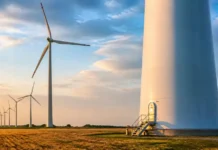













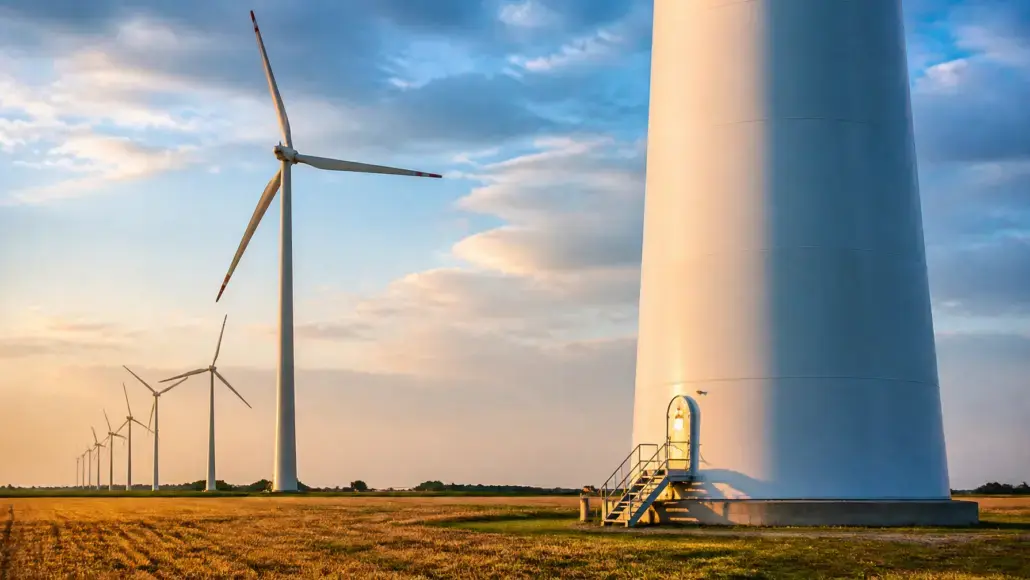

Turbine towers rarely receive the attention that rotors and generators command, yet they decide where wind farms can be built and how much energy each machine will harvest. Hub heights on utility-scale onshore turbines have risen roughly 83 percent since the late 1990s, reaching an average of about 103 meters in the United States by 2023, and the newest machines in China now connect to the grid at 204 meters, the tallest steel-concrete hybrid support structure in operation anywhere. The rationale is simple wind physics: wind speed increases with height above ground, and because available power scales with the cube of wind speed, even modest elevation gains produce outsized energy returns. Studies across multiple sites estimate that raising hub height by 20 meters can lift annual energy production by roughly 10 percent, a margin that frequently determines whether marginal sites are viable at all.
Advanced tower engineering has become the discipline that translates this physics into buildable, transportable and financeable structures. Every additional meter of height increases the loads the tower must carry, the steel or concrete it must contain and the logistics challenge of moving it to site, and modern designs respond to all three constraints simultaneously. For developers evaluating low-wind or forested terrain, the tower is no longer a commodity component but a differentiator that expands the addressable project pipeline.
The Economics of Height in Modern Wind Projects
The commercial case for taller towers rests on the shape of the wind resource. Wind shear means that surface roughness from forests, buildings and terrain features suppresses wind speeds near the ground, so a rotor sitting above the shear layer accesses stronger, steadier and less turbulent flow. Higher rotors also experience less pronounced diurnal wind variation, smoothing production profiles and improving alignment with electricity demand patterns, an increasingly valuable trait as power markets penalize volatile output.
Height also permits larger rotors on constrained sites. A longer blade sweeping close to forest canopies loses usable wind range to turbulence and vegetation-induced shear, so developers pairing 150-meter rotors with 160-meter towers capture the full aerodynamic value of their machines. The cost calculus has shifted as well: steel prices and fabrication capacity fluctuate, but the energy gain from height is permanent over a 30-year design life, and financing models increasingly credit the production uplift directly. In markets such as Germany, India and the central United States, where mid-hub-height sites are saturating, tower height has effectively become the primary variable left for developers to optimize.
The cost drivers that determine whether a tall tower pays back are specific and quantifiable:
- Foundation loads: taller structures raise overturning moments, so foundation design must grow with height even as the rotor harvests stronger winds.
- Structural mass: wall thickness and segment counts rise roughly in proportion to height, making steel and concrete markets a direct input to tower economics.
- Installation logistics: crane capacity, assembly days and weather windows scale with tower height and dominate construction budgets on remote sites.
- Frequency management: taller and more flexible towers raise tower-top acceleration concerns that must be engineered out through added stiffness or damping.
- Production uplift: the energy gain from height, roughly 10 percent per 20 meters in many wind regimes, anchors every other calculation.
Hybrid Concrete-Steel Designs Reaching 200 Meters
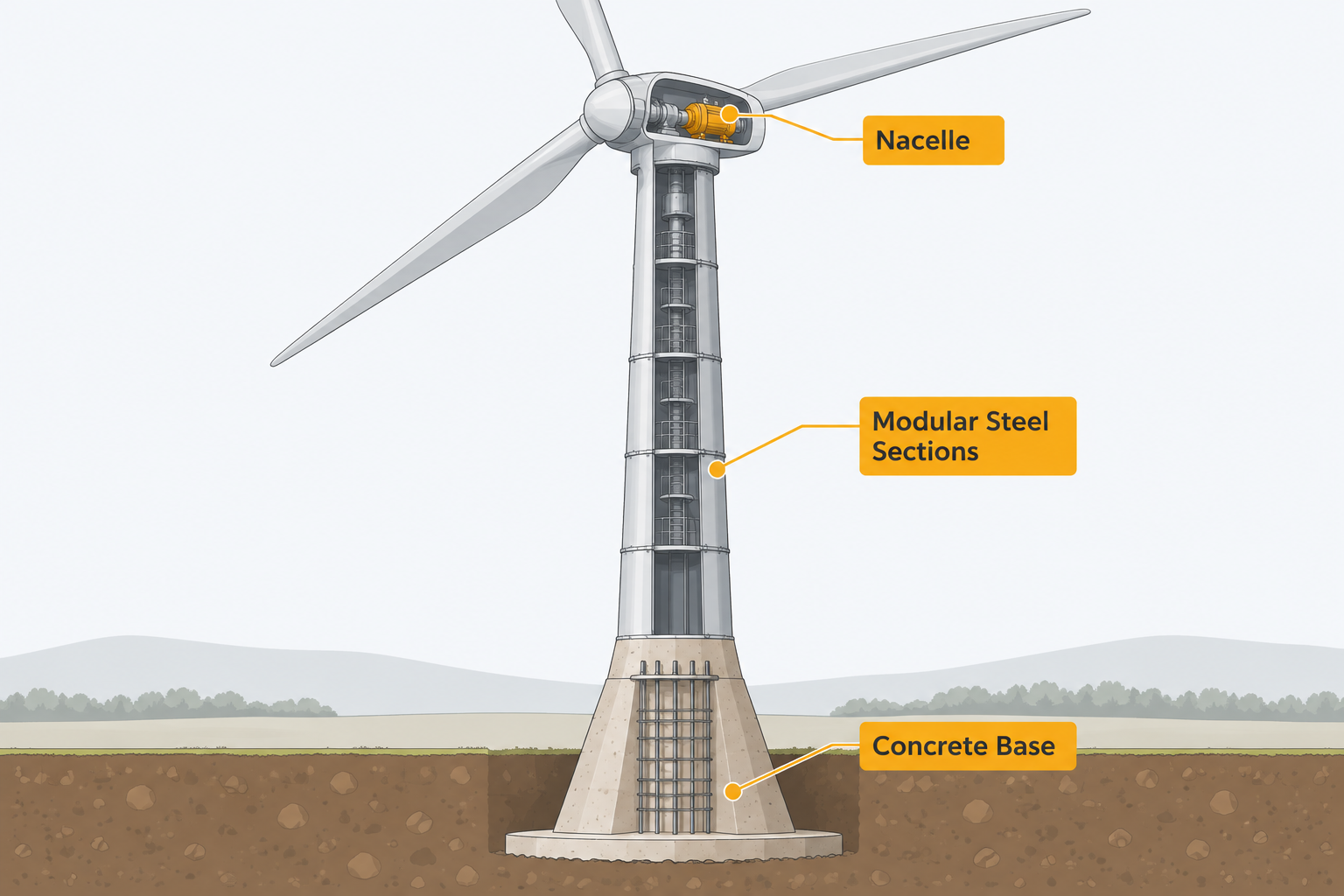
The structural problem with very tall steel towers is geometric: diameter grows faster than height, and a fully steel 200-meter tower would need base sections so wide that they cannot travel by road. Hybrid designs resolve this by shifting the lower, wide sections to concrete. Precast concrete segments are manufactured regionally, hauled as manageable elements and assembled on site, where their mass and stiffness anchor the tower against the overturning moments of a large rotor. The upper sections remain steel, produced in conventional diameters and joined to the concrete shaft through a transition segment that manages the stiffness mismatch.
China has demonstrated the concept at record scale. The world’s tallest steel-concrete hybrid tower, connected to the grid in 2026, reaches a hub height of 204 meters with a 199-meter structural height, and it was engineered for a low-wind inland site where annual average speeds sit near 4.5 meters per second. Earlier, in October 2025, CSSC unveiled a 200-meter-class hybrid tower matched with its H220-6.25 MW turbine, producing an overall machine height beyond 310 meters. These projects show that the hybrid approach handles the fatigue environment of large rotors while remaining manufacturable with domestic materials, an advantage in markets where ultra-wide steel transport is impractical.
Site logistics ultimately decide between tower technologies. Hybrid concrete suits markets with strong regional precast industries and poor road access for wide steel sections, while all-steel modular designs win where fabrication capacity outpaces concrete supply or where erection schedules must compress into short seasons. Manufacturers now offer both options on the same turbine platforms, letting developers select tower technology per site the way they once selected foundation types, and that flexibility itself reflects how far the discipline has advanced.
Modular and Segmented Steel Construction
Where hybrid concrete does not suit the site, steel itself has been re-engineered for transportability. Modular steel towers split conventional shell sections into flanged, bolted sub-panels that pass under bridges and through standard gauge clearances, then reassemble on site into a structurally continuous column. Research programs across Europe and North America have matured several connection technologies for these joints, including internal flange systems, prestressed bolted seams and welded field splices, each validated against the fatigue spectra that tall towers accumulate over decades of cyclic loading.
The modular approach carries consequences beyond transport. Factory-controlled fabrication of identical sub-panels improves weld quality consistency, while on-site assembly reduces the crane time and weather exposure that traditionally inflate tall-tower construction budgets. The design choices ripple through the whole machine package, since taller towers change natural frequencies, tower-top accelerations and the load cases transmitted into the nacelle. Turbine OEMs increasingly co-develop towers with rotor platforms so that aerodynamic and structural performance advance together rather than in sequence, and the integration of structural considerations with ultra-large wind turbines has become a defining feature of new offshore and onshore platforms alike.
The maturity of advanced tower engineering also shows in how contracts are written. Tower supply agreements increasingly specify fatigue test evidence, weld procedure qualifications and monitoring provisions rather than relying on generic standards, and independent engineers verify designs against site-specific wind conditions before banks commit financing. This professionalization reflects hard-won lessons from earlier generations of tall towers, whose early fatigue problems taught the industry that height amplifies every design shortcut.
Monitoring, Fatigue Management and Lifetime Extension
A tower that must survive 30 years of millions of load cycles at 200 meters demands more than conservative steel thickness. Modern structures ship with integrated instrumentation from day one: strain gauges at critical welds, accelerometers that track natural frequency drift, and corrosion sensors inside the base sections where inspection access is hardest. This telemetry feeds condition-based maintenance programs that catch coating failures, bolt relaxation and fatigue crack initiation long before they threaten structural integrity, converting the tower from a passive asset into a monitored one.
Fatigue management also shapes the design code evolution underway across the industry. Certification frameworks now incorporate taller-tower load spectra, simplified aeroelastic assumptions are giving way to site-specific modeling, and owners of operating fleets use measured load data to justify lifetime extensions beyond original design assumptions. For the growing population of aging wind farms, tower structural assessments have become a commercial service line in their own right, since a validated 10-year extension on a tall-tower machine is worth several million dollars in deferred repowering capital.
Insurance and financing markets reinforce the monitoring infrastructure. Lenders increasingly condition debt on structural monitoring programs for tall-tower projects, and insurers price premiums against the availability of load and condition data, effectively converting instrumentation spending into a measurable reduction in the cost of capital across a 30-year asset life.
What Taller Towers Mean for the Next Project Cycle
The trajectory ahead points toward hub heights of 250 meters onshore and tower-top masses that offshore foundations must also accommodate. Techniques under active development include self-erecting tower systems that climb themselves into place, high-strength steel grades that cut wall thickness without sacrificing stiffness, and concrete technologies that cure faster in cold climates, shortening construction seasons. Each addresses a different constraint, but they share a goal: removing height as a limiting factor in turbine siting.
For developers, the practical implication is that site selection maps are expanding. Land once dismissed for marginal wind resource or excessive vegetation now supports competitive projects when paired with the appropriate tower technology, and the production uplift from height flows directly through power purchase agreement economics. Quietly, advanced tower engineering has become one of the most consequential enablers of wind capacity growth, proving that in the race for higher output, what stands beneath the rotor matters as much as the rotor itself.