



























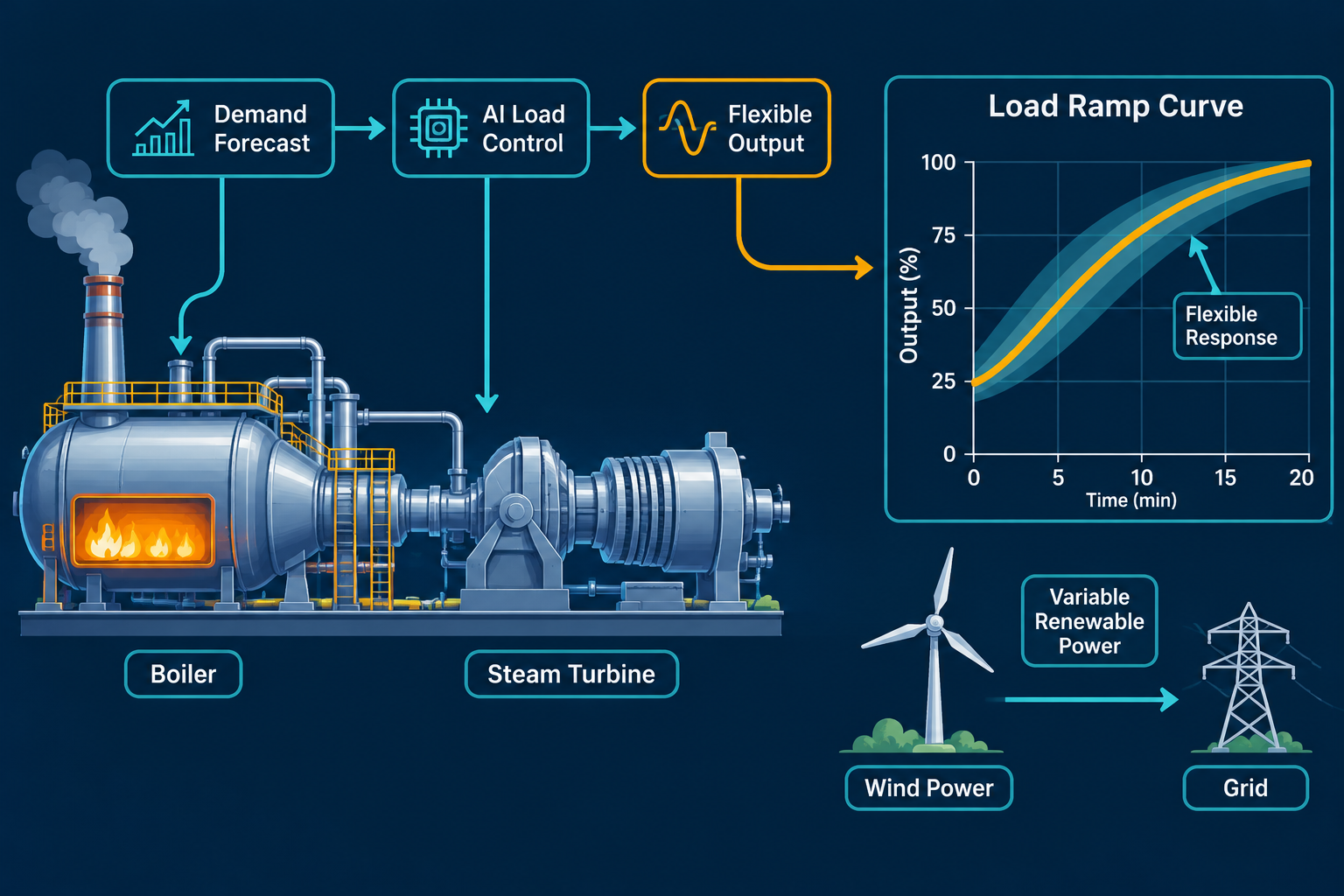
Thermal power boilers were engineered for a world of steady baseload demand. Most units in service today were designed to run near full load for thousands of hours between starts, and their control systems were tuned accordingly. The operating reality has changed. As solar and wind capacity grows across major grids, thermal plants are increasingly called on to ramp up and down daily, run for extended periods at part load, and start and stop far more often than their designers anticipated. Each of these duties stresses the boiler and its control loops in ways the original control philosophy never addressed. AI-enabled boiler load management has emerged as the practical response, using predictive models to anticipate demand changes and coordinate the boiler’s many control subsystems so that the unit ramps quickly without tripping, without excessive thermal stress and without the combustion instability that older control strategies produce during load changes.
Flexibility Pressure on Thermal Fleets
The scale of the flexibility challenge is easiest to see in systems with high renewable penetration, where the net load curve, the demand remaining after solar and wind output is subtracted, swings steeply within hours. Grid operators in India, Germany, China and parts of the United States now expect coal and gas units to track those swings. A unit that once changed load a few times a week may now ramp every day, with ramp requirements that push against the design capabilities of its firing system. Regulators and system operators have responded by paying for flexibility: minimum generation norms, ramping capability requirements and ancillary service markets all convert the ability to move load quickly into revenue.
The problem is that boiler capability degrades along this path. Mill systems tuned for steady pulverised fuel delivery struggle to maintain coal-air balance through rapid load changes. Drum boilers face shrink-and-swell transients that challenge drum level control at precisely the moments operators can least afford a trip. Thermal cycling of headers, drums and thick-walled components accumulates fatigue damage with every ramp. Plants find that their true constraint is not nameplate capacity but the reliability envelope within which they can change load without unplanned outages, and that envelope is narrower than the grid would like.
What Boiler Load Management Involves
At plant level, the discipline coordinates everything that governs how quickly and how safely a boiler can change its steam output. It spans the sequencing and loading of pulverisers or burners, control of primary and secondary air, furnace draft, drum water level, steam pressure and superheat and reheat temperature control during transients. In a conventional implementation, these loops run largely independently, tuned for steady state and handed over to the operator during load changes. Operators become the coordination layer, watching trends and intervening with changes to master demand rate, mill loading order and setpoints from experience.
That human coordination layer breaks down under modern duty cycles. Ramps are too frequent, margins are too tight and the interactions between loops are too fast. AI-based boiler load management replaces ad hoc operator coordination with model-based anticipation. Instead of reacting to a demand change after it arrives, the system sees the dispatch schedule ahead of time, predicts how drum level, steam pressure, furnace pressure and metal temperatures will evolve for any candidate ramp profile, and coordinates the individual loops to execute the fastest ramp that stays inside validated limits. The plant still respects every protective interlock; what changes is that the transitions between stable operating states are planned rather than improvised.
How AI Improves Ramp and Stability Control
The core capability is prediction. Machine learning models trained on historical ramp data capture relationships that linear control tuning cannot express, such as how drum level responds to a combined change in feedwater demand and steam flow during a ten percent load swing, or how mill outlet temperature behaves when a spare pulveriser is started under low load. Model predictive control built on these models computes control moves several minutes ahead, shaping the ramp to avoid the instability signatures that historically caused trips: drum level excursions, furnace pressure transients and steam temperature deviations during mill starts and stops.
The gains appear in several concrete forms. Ramp rates improve because the control system is no longer limited by conservative fixed rates set to avoid worst-case behaviour; plants commonly report meaningful increases in sustainable ramp rate after AI-based coordination is commissioned. Minimum stable load falls, because the models find combustion and water level strategies that keep the unit steady at loads where conventional control required oil support or accepted wide oscillation. Trip rates during load changes decline, which matters commercially since a trip during an evening ramp can cost the plant its position in the dispatch stack for days. Operators also report reduced workload during ramps, freeing attention for supervision rather than continuous manual intervention.
Operational Gains From AI-Supported Load Control
Utilities operating AI-supported load control on cycling units report a consistent pattern of benefits:
- Faster sustainable ramp rates, frequently in the range of three to five percent of capacity per minute on units that previously managed little more than half that figure reliably.
- Lower minimum stable load, extending the operating window between renewable output peaks and reducing the need for costly overnight shutdowns.
- Fewer load-change trips and boiler master instability events, protecting both availability and the unit’s standing with the system operator.
- Reduced thermal stress during transients, because coordinated control sequences distribute load changes across mills and attemperators rather than concentrating stress in one subsystem.
- Lower support fuel consumption, as stable combustion at reduced minimum load cuts the auxiliary oil previously burned during low load and ramping periods.
- Improved steam temperature control during ramps, which protects superheater and reheater metallurgy and supports turbine life.
Each of these gains is individually modest, but on a unit cycling daily the compounding effect on availability, fuel cost and component life is substantial, and the revenue uplift from qualifying for flexibility markets frequently dwarfs the efficiency component of the business case.
Protecting Equipment During Cycling Duty
Flexibility has a price paid in fatigue, and credible AI-based load management accounts for it explicitly. Online life consumption monitoring tracks pressure-part temperatures and differential expansions through every ramp, converting operating history into accumulated fatigue and creep usage fractions. The AI layer then uses that information as a constraint: it selects ramp profiles that meet the dispatch requirement while minimising incremental damage, rather than simply moving load as fast as possible. Over years of two-shift operation, the difference between damage-aware and damage-blind ramping translates into visibly different inspection findings and overhaul costs.
Start-stop duty raises the stakes further. Each start consumes support fuel, stresses components through the light-off and synchronisation transients and carries elevated trip risk during early loading. Analyses of cycling costs typically find that a hot start absorbs a meaningful fraction of a day’s fixed cost once support fuel, maintenance accrual and lost availability are counted, so reducing failed starts carries direct commercial value. AI-supported control shortens and standardises the start sequence, holding drum level and steam temperature on target through the most fragile phases, and the same predictive coordination carries through into the loading ramp that follows. Units that once needed hours of operator attention to return to stable operation complete the sequence in a fraction of the time, with a repeatable, documented profile.
Combustion-side protection follows the same logic. Rapid load changes disturb fuel-air balance, and the emissions signature of a poorly coordinated ramp reveals it: nitrogen oxide spikes when air control lags, carbon monoxide rises when combustion is starved, unburnt carbon climbs when mills are unbalanced. AI-based emissions monitoring provides the continuous feedback that keeps these combustion tradeoffs visible during every ramp, ensuring that flexibility is not purchased at the cost of compliance excursions. Together, life tracking and emissions feedback define the boundaries inside which aggressive flexibility is responsible engineering rather than asset mining.
Grid Services and Revenue Stacking
The commercial end state of capable boiler load management is a portfolio of grid services layered on top of energy sales. Units with demonstrated ramp capability bid into frequency response and ramping products, provide balancing energy in real time and earn premiums for reliable minimum load operation during renewable surges. Each service demands fast, predictable, repeatable load response, which is exactly what AI-coordinated control delivers and what manual operation cannot guarantee under continuous cycling. Utilities preparing thermal fleets for that role are investing in load management capability ahead of the grid requirements being formalised, because qualification historically favours units with auditable response records. For plants with limited remaining life, disciplined AI-based boiler load management offers a way to convert flexibility capability into revenue that justifies the asset’s operation through the transition, while for younger units it establishes the operating record on which long-term dispatch contracts are built.