



























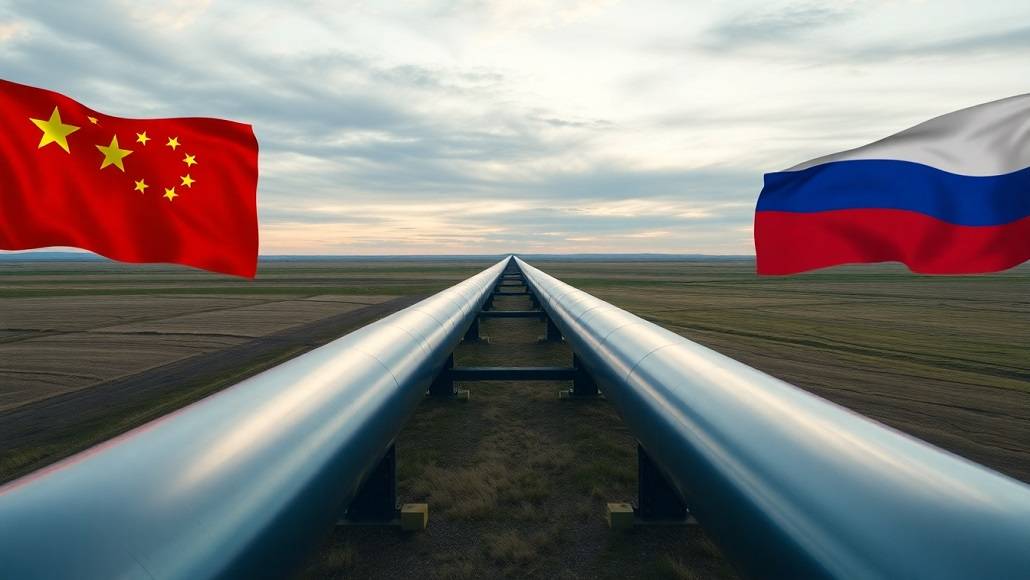

Russia and China signed a legally binding agreement to advance the long-delayed Power of Siberia 2 gas pipeline, strengthening their commercial partnership in a development likely to be interpreted as a significant message to Western powers.
Alexei Miller, chief executive of Gazprom, confirmed to Russian news outlets that a memorandum of understanding had been concluded on the project’s construction, following discussions between Russian President Vladimir Putin and China’s Xi Jinping in Beijing.
According to reports, the Power of Siberia 2 gas pipeline will carry gas reserves from Russia’s West Siberia through eastern Mongolia to northern China, enabling deliveries of up to 50 billion cubic meters annually. Supplies secured under this agreement are expected to continue for a period of 30 years.
Miller added that pricing arrangements for the new gas pipeline would be determined separately. In addition to this development, the two nations also concluded another agreement for increased deliveries to China via the existing Power of Siberia pipeline.
While Beijing has yet to officially confirm Miller’s statement, state news agency Xinhua reported that the two countries signed more than 20 cooperation agreements, including several focused on energy.
The European Union has plans to stop importing all Russian gas by 2027, while in March 2022, the United States placed restrictions on Russian exports of fossil fuels. These moves have hastened Moscow’s plans to intensify cooperation with Beijing and make China a leading buyer of Russian gas via new infrastructure projects.
At the Shanghai Cooperation Organization summit, both Russia and China highlighted their intent to reshape the global economic and security framework. During the event, Chinese President Xi Jinping remarked that the world had entered “a new phase of turbulence” with governance at a “new crossroads.”
Timothy Ash, an associate fellow at Chatham House, observed that China had played a firm negotiating role in the Power of Siberia 2 gas pipeline deal. “But now I think likely the Chinese got a better deal, in terms of the pricing, and perhaps are now more willing to fund the construction,” Ash commented in a note. He added that recent moves underscore Beijing’s willingness to present a stronger, more coordinated stance with Moscow in the face of U.S. pressure.