
































A utility’s contact center is the only department that feels a rate case twice: once when the filing makes the news, and again, harder, when the first higher bill lands. What follows comes in a fixed order: the confused call, the angry call, the missed payment, and the request for more time.
There is more of all four coming. US utilities asked regulators for a record $31 billion in rate increases in 2025, according to the nonprofit PowerLines, and for another $18.6 billion in the first half of 2026. The federal forecast has residential electricity prices still climbing in 2027.
This article sets out what that does to customer service workloads, what the added work costs, and where utilities outsourcing to the Philippines for billing, payment, and assistance support fits, including the places where it does not.
Why Will Energy Bills Drive More Customer Contacts in 2027?
Because prices are still rising, and households are already stretched. The federal forecast puts the average residential electricity price at 18.7 cents per kilowatt-hour in 2027, up from 17.2 in 2025. One household in six is behind on its power bill. Each new increase lands on customers with no room left.
The Energy Information Administration’s November 2026 outlook projects 18.2 cents this year and 18.7 cents in 2027 (Figure 1). That is a slower rise than this year’s, but it is a rise on top of a rise. J.D. Power’s tracker put the average household’s combined electric, gas, and water bills at $428 a month in the second quarter of 2026.
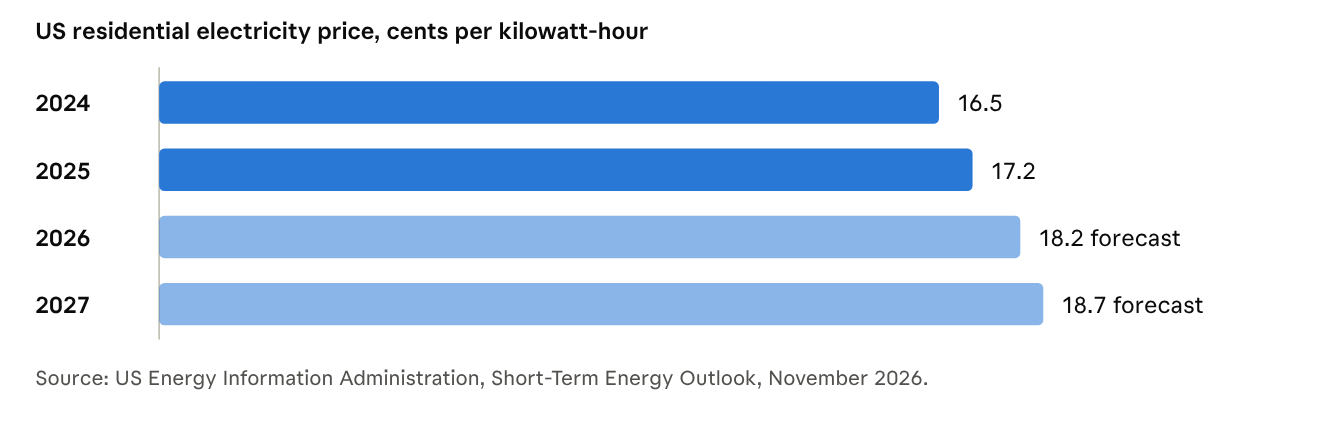
Figure 1. US residential electricity price, cents per kilowatt-hour. Four years, one direction. The 2026 and 2027 bars are forecasts.
The strain is measurable. The National Energy Assistance Directors Association estimates that 16 percent of US households are behind on their electricity bills, owing $23 billion between them, and expects shut-offs to rise from about 3.5 million to 4 million. Customers are also telling regulators. California’s utilities commission logged 4,708 energy contacts in the first quarter of 2026, up 24 percent on the quarter before, with “High Bill” the largest category.
A regulator’s complaint line is the last resort. For every customer who reaches it, many more called the utility first. Utilities rarely publish those volumes, but anyone who has sat on a utility floor in the month after a rate change knows the pattern.
What Contacts Does a Rate Increase Create, and When?
Four, in a predictable sequence. The high-bill inquiry arrives within days of the first new bill. The missed payment follows about a month later, then the request for a payment arrangement, and finally the disconnection notice and the application for assistance. The further along the sequence, the more a mistake costs.
Figure 2 shows the chain. What matters operationally is that the peaks are staggered. The high-bill wave is short and can be met with trained overflow. The payment and assistance waves are slower, heavier on paperwork, and regulated: the terms of a payment arrangement, the notice before disconnection, and the protections for medically vulnerable customers are set by each state’s commission.
“The three waves never peak together, and that is the one piece of good news in a rate case,” said John Maczynski, the PITON-Global CEO and a 40-year outsourcing veteran who ran worldwide business development on behalf of the world’s largest contact center outsourcer as Executive Vice President. “A utility that knows the sequence can staff each wave in turn. One that does not is surprised three times by the same rate increase.”
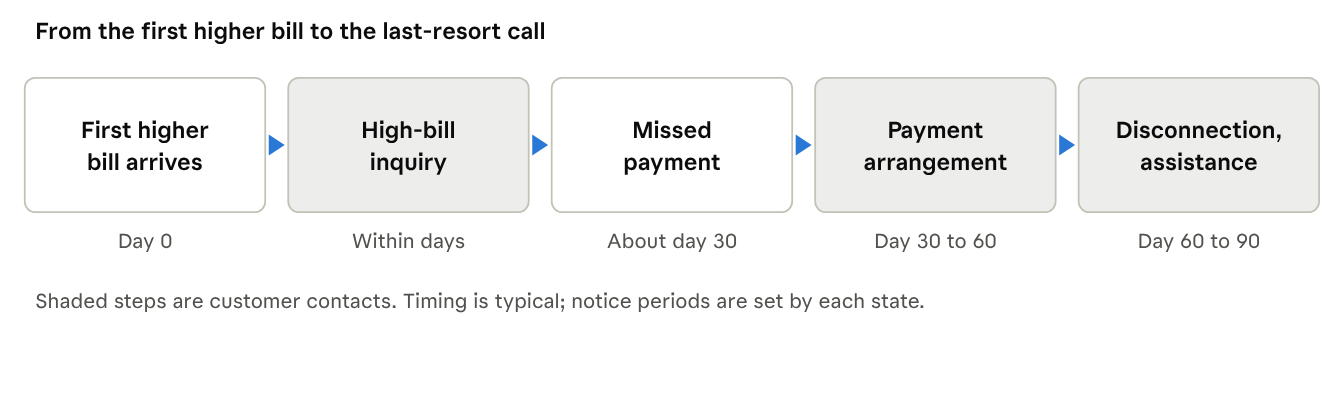
Figure 2. From the first higher bill to the last-resort call. One rate increase, three waves of contact over about 90 days.
The other thing that matters is silence. The same J.D. Power research found that only 41 percent of electric customers recall receiving any communication from their utility. A customer who was not told the bill would rise calls to ask why it did. A notice sent before the first new bill is the cheapest contact a utility will ever handle, because the customer never has to make it.
Which Utility Work Can Be Outsourced to the Philippines?
Most of the billing and payment workload: high-bill inquiries by chat, email, and overflow voice, payment arrangement setup, assistance application processing, and billing exceptions. Outage, gas emergency, and disconnection decisions should stay onshore. For regulated utilities, each state commission’s rules on call center location decide how far the voice work can go.
“A utility should hear about this constraint from its adviser before it hears about it from its commission,” Maczynski added. Customer service at an investor-owned utility is a regulated activity, and some states attach conditions to where it is performed. New Jersey’s rules, for example, permit a call center outside the state only after the utility demonstrates to Board staff that every representative there is trained in the required subjects. Other states have their own conditions, and unions and local politics can be stricter than any rule.
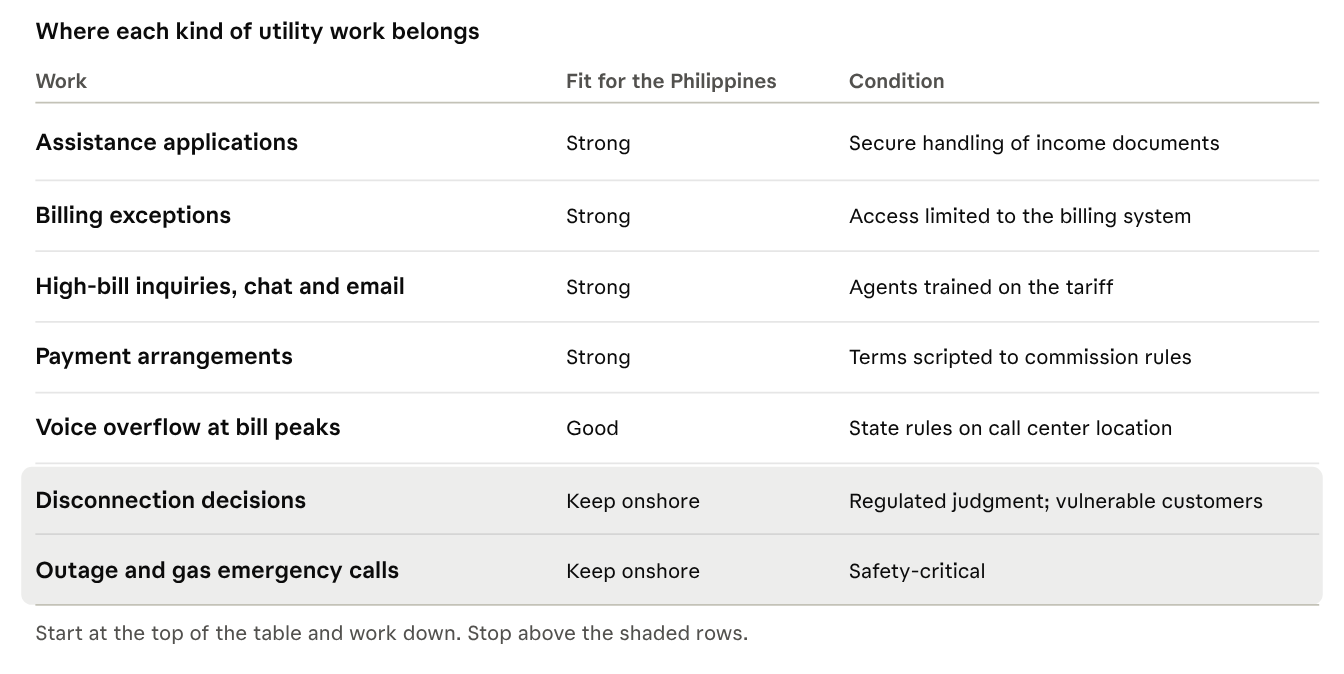
Table 1. Where each kind of utility work belongs. A sequence, not a menu. Back office and digital work first, voice overflow second, safety-critical contacts never.
That is why the order in Table 1 matters. The top four rows carry the least sensitivity and the most paperwork, which is where Philippine teams with billing and collections experience are strongest. Competitive retail energy suppliers, which are not bound by the distribution utility’s service rules, have more room to move voice as well.
Data location is the other question a commission will ask. Keep customer records in the utility’s own systems, give offshore agents access through a secure virtual desktop, and nothing leaves the country except keystrokes.
What Does the Affordability Workload Cost per Million Customers?
On PITON-Global’s planning assumptions, about 270,000 contacts and 45,000 handling hours a year for every million residential customers. Staffed onshore, that costs roughly $2.0 million. Staffed from the Philippines, it costs about $675,000. The larger benefit is elastic capacity: the work arrives in waves, and offshore teams scale for each one.
The inputs are in Table 2, and a finance team should replace them with its own. Twelve percent of customers make one high-bill contact in the year after an increase. Half of the 16 percent who are behind ask for a payment arrangement. Three percent face disconnection, roughly the national rate implied by the association’s shut-off estimate. Four percent apply for assistance. Agents are productive for 80 percent of paid time.
For the onshore rate, the model assumes a $26 wage plus 40 percent overhead, or $36.40 an hour. As a reference point, the Bureau of Labor Statistics puts the average utility meter reader at $32.50 an hour. A managed Philippine team costs about $12 an hour.
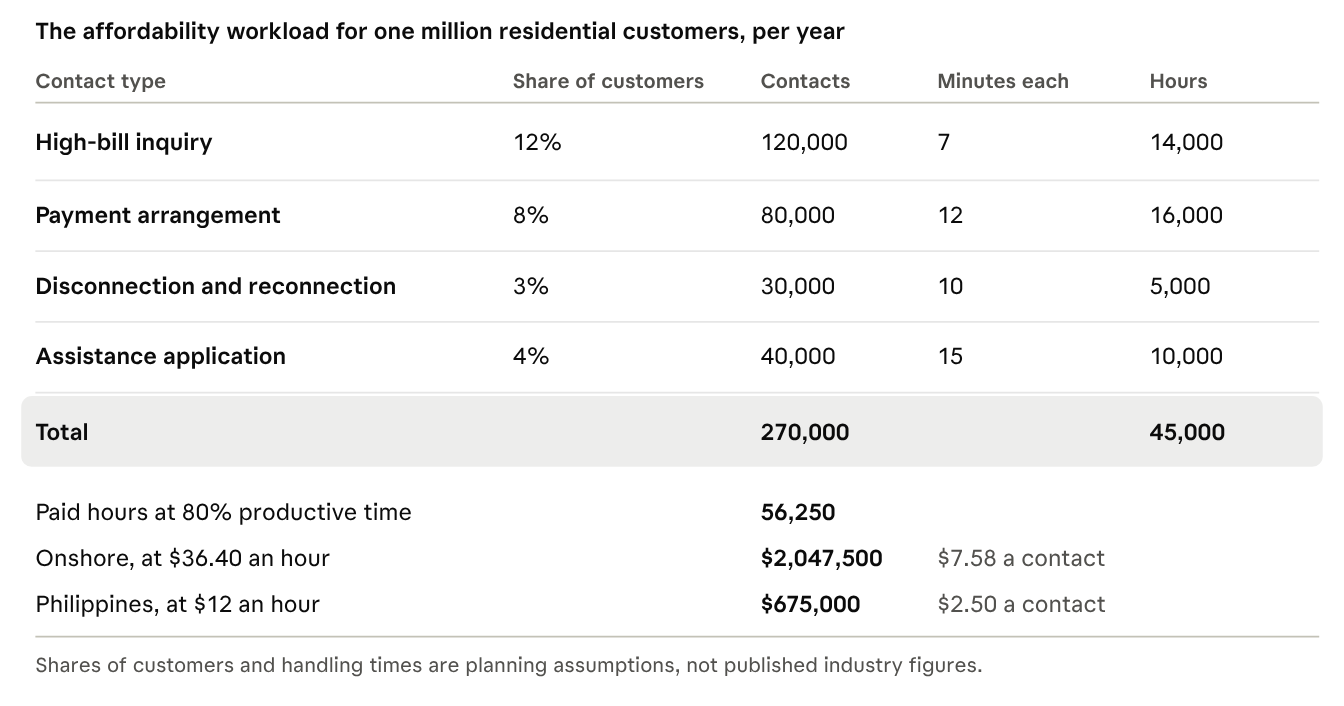
Table 2. The affordability workload for one million residential customers per year. A planning model. Change any input, and the totals move in proportion.
The savings are about $1.4 million a year per million customers. For a utility of that size, that is welcome but not decisive. The decisive part is the shape of the work. A utility staffed for the average month is overwhelmed for the six weeks after a rate change and overstaffed for the rest of the year. A provider that can add 30 trained agents for a wave and release them afterward solves a problem a fixed onshore team cannot.
Scale the model to the national picture. PowerLines counts more than 56 million customers covered by the rate requests filed in the second quarter of 2026 alone. On the same assumptions, that is roughly 15 million affordability contacts and 2.5 million handling hours in the year that follows, before a single request from any other quarter is counted.
How Should an Energy Provider Source and Launch Before the Next Bill Cycle?
Start four to six months before new rates take effect. Begin with back office and digital work, train agents on the tariff and the commission’s payment rules, and brief the regulator early. Contract for a base team plus surge capacity, and measure the provider on resolved contacts and kept payment arrangements.
The lead time is not negotiable. An agent who cannot explain why a bill rose, line by line, makes the high-bill call longer and the customer angrier. Tariff training, system access, and a supervised pilot on live back office work take about three months if nothing slips. Add time to walk the commission’s consumer staff through the plan, whether or not a rule requires it. Regulators forgive most things more readily than surprises.
Write two measures into the contract that a wage comparison never captures. The first is resolution on first contact for high-bill inquiries, because a second call costs as much as the first. The second is the share of payment arrangements still being kept after 90 days. An arrangement the customer cannot afford is a disconnection postponed, and a provider paid per call has no reason to care.
Provider selection decides whether those measures are met. “We look for three things when we shortlist Philippine providers for an energy client,” said Ralf Ellspermann, CSO at PITON-Global. “Prior work on regulated billing or collections scripts, proof that they have doubled a team inside 30 days, and willingness to report kept-arrangement rates. The first narrows the field most.”
Utilities and energy suppliers pay nothing for PITON-Global’s advice or provider sourcing, which are free of charge, and they take on no obligation by asking for a shortlist.
Frequently Asked Questions
What is utilities outsourcing to the Philippines?
It is the use of managed Philippine teams for a utility’s or energy supplier’s customer work: billing inquiries, payment arrangements, assistance applications, move-in and move-out requests and back office exceptions. The teams work in the client’s billing system under its policies. Safety-critical calls stay with the utility.
Can a regulated US utility move its call center offshore?
It depends on the state. Some commissions attach conditions to where customer service is performed, and New Jersey requires a training demonstration before a call center leaves the state. Most utilities begin with back office and digital work, which draws less regulatory and political attention than voice.
How much can an energy provider save?
In the model above, the affordability workload for one million customers costs about $2.0 million a year onshore and $675,000 from the Philippines, or $7.58 against $2.50 a contact. The inputs are planning assumptions, so run it with your own volumes and rates.
Which contacts should never be outsourced?
Outage reports, gas leak and other emergency calls, and the decision to disconnect a customer, especially one who is medically vulnerable. These carry safety or regulatory consequences that belong with the utility’s own trained staff, close to field operations.