

















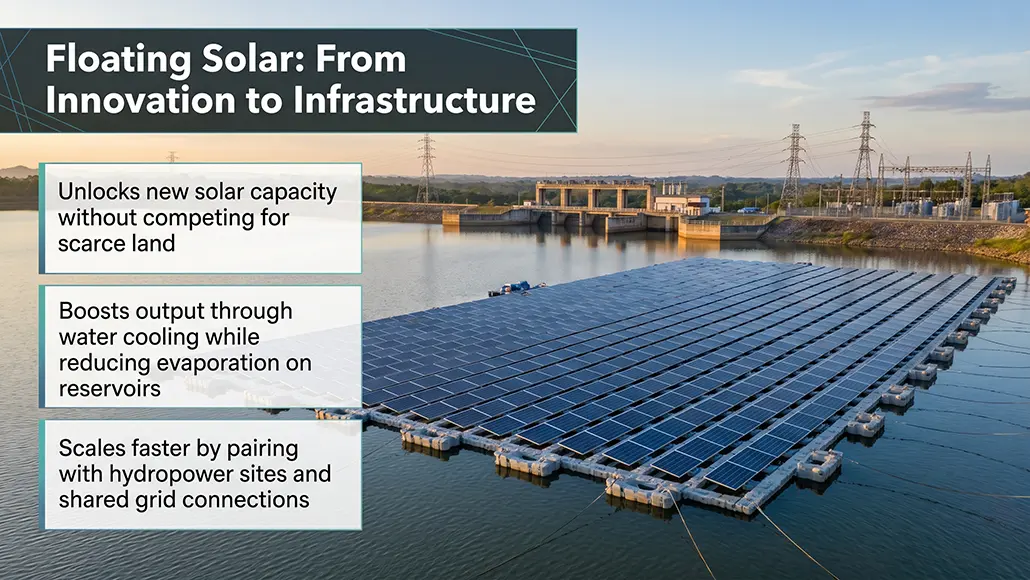

The global clean energy narrative is undergoing a subtle but significant shift. While land-based solar has dominated capacity additions over the past decade, a quieter transformation is unfolding across reservoirs, lakes, and industrial water bodies. Floating solar, often referred to as floating photovoltaic (FPV), is no longer a niche experiment it is increasingly being positioned as a strategic asset in large-scale energy planning.
From a market standpoint, the segment is moving with steady momentum, backed by consistent investment flows and a widening project pipeline. Yet, the real story lies beyond growth rates. What is emerging is a structural evolution in how energy developers, utilities, and policymakers are thinking about space, efficiency, and system integration.
Why Floating Solar Is Gaining Strategic Relevance
At its core, floating solar addresses one of the most persistent constraints in renewable energy deployment: land availability. In densely populated or industrially active regions, acquiring land for large solar parks is often both expensive and politically complex. Water bodies, by contrast, present an underutilized and often readily available alternative.
More importantly, floating solar systems introduce performance advantages that are increasingly hard to ignore. The natural cooling effect of water can improve panel efficiency, particularly in high-temperature geographies where thermal losses typically reduce output.
Key drivers shaping the market today include:
- Optimized land use by shifting solar installations to reservoirs and lakes
- Improved generation efficiency due to lower operating temperatures
- Reduced water evaporation, especially in arid and semi-arid regions
- Algae growth control, benefiting water quality management
- Growing alignment with national decarbonization and net-zero targets
This combination of operational and environmental benefits is positioning floating solar as more than just an alternative it is becoming a complementary pillar within broader renewable portfolios.
Technology Evolution: From Pilot to Scalable Infrastructure
Early floating solar installations were largely pilot projects, designed to test feasibility and durability. That phase is now firmly behind the industry. Today’s systems are engineered for scalability, resilience, and long-term performance.
Advancements in modular floating structures, anchoring systems, and corrosion-resistant materials have significantly improved reliability in diverse water conditions. Meanwhile, tracking technologies once limited to land-based solar are now being adapted for floating environments, enabling better energy yield optimization.
Another defining trend is integration. Floating solar is increasingly being deployed alongside existing infrastructure, particularly hydropower plants. This hybrid model allows operators to leverage shared transmission assets while stabilizing power output through complementary generation profiles.
In parallel, the integration of battery storage is beginning to reshape project economics. By addressing intermittency and enhancing grid reliability, storage-linked floating solar projects are moving closer to dispatchable renewable energy solutions, an important milestone for utility-scale adoption.
Regional Momentum and Industry Participation
Geographically, adoption patterns reflect both necessity and opportunity. Countries with limited land availability or high population density such as those in parts of Asia have emerged as early adopters. Japan, for instance, has consistently expanded floating solar deployments across reservoirs, driven by land constraints and strong policy support.
In the United States, the approach has been more experimental but increasingly strategic. Utilities are testing floating solar on reservoirs not only to generate power but also to improve overall asset efficiency. These pilot projects are now transitioning toward more structured deployment frameworks.
The industry ecosystem itself is also evolving. Established solar manufacturers, infrastructure developers, and specialized floating platform providers are converging within this segment. This convergence is accelerating innovation, particularly in areas such as:
- High-durability module design for water-based environments
- Flexible floating platforms that simplify installation
- Smart grid integration for real-time energy management
- Hybrid project models combining solar, storage, and hydropower
Such developments indicate a maturing market where competition is no longer limited to capacity but extends to engineering sophistication and lifecycle performance.
Investment Outlook: Stability Over Speculation
Unlike some emerging clean technologies that rely heavily on future projections, floating solar presents a more grounded investment case. The technology builds on the proven fundamentals of photovoltaic systems while adding incremental advantages through its deployment model.
Investors are increasingly viewing floating solar as a risk-mitigated extension of traditional solar portfolios rather than a speculative bet. The relatively moderate growth trajectory reflects this maturity it is not a hype-driven surge, but a steady, infrastructure-led expansion.
Government incentives, renewable energy targets, and climate commitments continue to play a catalytic role. However, what is notable is the growing participation of private capital, particularly in hybrid and utility-scale projects. This shift suggests rising confidence in both the technology and its long-term returns.
Challenges That Will Define the Next Phase
Despite its advantages, floating solar is not without challenges. Installation complexity, higher upfront costs compared to land-based systems, and long-term maintenance considerations remain key concerns for developers.
Environmental assessments also require careful handling. While floating solar can reduce water evaporation and algae growth, large-scale deployments must be designed to avoid disrupting aquatic ecosystems.
Grid integration is another critical factor. As projects scale, ensuring seamless connectivity and managing variable output will require more advanced energy management systems.
These challenges, however, are not structural barriers. They represent engineering and regulatory frontiers that the industry is already working to address.
The Road Ahead: From Innovation to Infrastructure
Floating solar is transitioning from an innovation-led segment to an infrastructure-driven market. This distinction is important. It signals a move away from experimentation toward standardization, scalability, and integration into national energy systems.
For stakeholders across the value chain utilities, EPC contractors, technology providers, and investors the opportunity lies in understanding where floating solar fits within broader energy strategies. It is not a replacement for land-based solar, but a strategic extension that unlocks new capacity without competing for scarce land resources.
From the editorial lens of Power Info Today, the trajectory is clear: floating solar is set to become a defining component of next-generation renewable infrastructure. Not because it disrupts the system entirely, but because it enhances it quietly, efficiently, and at scale.
As global energy systems continue to decarbonize, the surfaces once considered passive reservoirs, lakes, and industrial water bodies are being reimagined as active contributors to power generation. That shift, more than any single metric, captures the true significance of floating solar today.