







































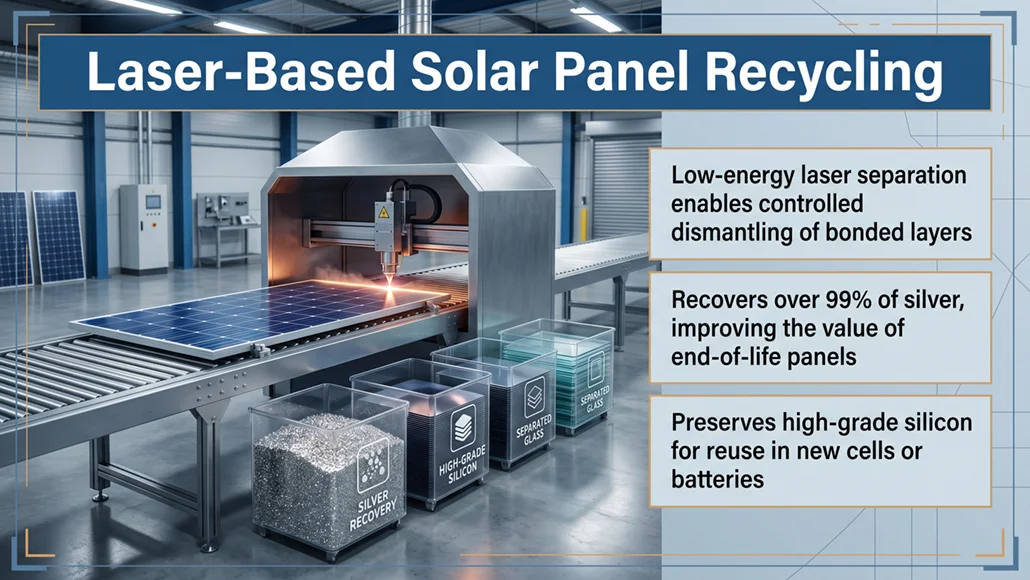

TNO in the Netherlands has developed a laser-based method for Laser solar panel recycling that enables efficient, low-energy dismantling while recovering over 99 percent of the silver content and high-grade silicon. Following three years of research, the laser technology has advanced beyond the experimental phase in laboratory settings across almost all panel types. The current focus is on scaling for industrial applications and exploring integration into existing and future recycling systems.
Conventional recycling struggles because glass, solar cells, and other layers are strongly bonded, making disassembly rough and inefficient. TNO’s approach applies laser technology to weaken the adhesive bond between layers. This allows the panel to be taken apart in a controlled way, improving material recovery and enabling the separation of individual components for reuse, including pathways that support silver recovery and preservation of high-grade silicon.
Solar panels typically last at least 25 years, but they are difficult to break down at end of life. According to TNO, roughly a quarter of all silver extracted worldwide is used in solar panels, and demand for the metal continues to increase. Panels also contain silicon, which can be reused in batteries or made into new solar cells. Mirjam Theelen, a research lead at TNO, said the technology addresses both recycling needs and pressure on raw material supplies, calling it a potential “goldmine of resources.” She added that by 2030, Europe is expected to face a substantial wave of discarded solar panels. The high quality and value of recovered materials could help shift recycling from a cost-heavy process to one that is potentially profitable, supported by high-grade silicon reuse and strong silver recovery outcomes.
After three years of development, TNO reports successful dismantling of almost all types of solar panels in lab trials. The work now turns to industrial scale-up and to determining how the method can be integrated within current and future solar panel recycling systems. As the approach advances, the emphasis remains on material recovery, replicable laser technology processes, and consistent silver recovery alongside the capture of high-grade silicon. In this context, Laser solar panel recycling is positioned to support lower-energy processing while maintaining the integrity of valuable materials needed for subsequent manufacturing steps.