







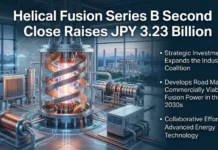


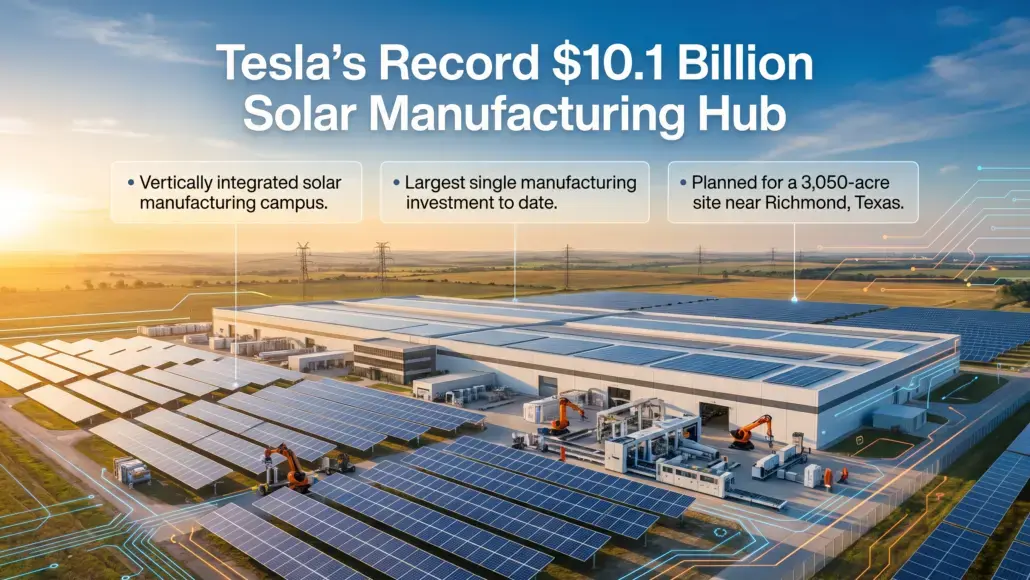

US EV, battery, AI and robotics company Tesla has submitted formal application documents to the Texas Comptroller proposing a US$10.1 billion vertically integrated solar manufacturing campus in Fort Bend County, Texas. Known as ‘Project Crystal Sun,’ the development is planned for a 3,050-acre site near Richmond and represents the largest single manufacturing investment proposed by Tesla to date, if approved and developed as planned.
Comprehensive Equipment Scope and Vertical Integration
The proposed financial commitment comprises US$1.5 billion in real property alongside US$8.6 billion in manufacturing equipment and other personal property. Filing documents submitted under the Chapter 312 tax application outline an operation spanning the entire silicon-to-module value chain to achieve full vertical integration. Equipment detailed in the filing covers ingot manufacturing, wafer slicing, chemical coating, metallisation and printing, cell testing and quality control, automated material handling, and cleanroom systems. This equipment scale supports high-volume automated wafer and cell manufacturing rather than solely a downstream module assembly facility. The campus plans also incorporate chemical storage and delivery systems, utility infrastructure, and environmental and safety systems.
Employment Projections and Tax Limitation Framework
To support the development, Tesla is seeking a 10-year property tax limitation under the Texas Jobs, Energy, Technology and Innovation Act. Once fully operational, the solar manufacturing campus is projected to create 9,712 permanent full-time jobs alongside 1,147 local construction jobs. Construction is scheduled to run from 2026 through 2028, with commercial production targeted to begin in the first quarter of 2029.
Although the filing does not disclose an annual nameplate manufacturing capacity, industry analysts note the massive scale of the facility. Commenting on the investment, Joe Hennessy, market research analyst at PV Tech Research, said, “This is a massive investment in US manufacturing, as big as we’ve ever seen for one site. Qcells’s facility at Cartersville cost around US$2.5 billion for 3.3GW of integrated PERC capacity, suggesting this facility could have a capacity of more than 10GW on a single site.”
Evolving Trade Landscape and Supply Chain Dynamics
The proposed development aligns with broader trends across the domestic solar market. Hennessy added: “This year, many suppliers have aimed for vertical integration in the US. This is due to the many barriers imports must go through the antidumping and countervailing duty (AD/CVD) and the new Section 232 regulations, starting in December. This will likely start a trend of even more upstream investment, now that those have been announced.”
US solar manufacturers currently navigate a complex trade environment, with the US Department of Commerce pursuing AD/CVD cases covering imports from India, Indonesia, and Laos. Regulators have also been asked to investigate alleged circumvention involving Ethiopian solar cells produced by Toyo Solar and Origin Solar using Chinese-origin components, as well as cell imports from South Korea involving Hanwha and other producers. Furthermore, US President Donald Trump introduced a 15% tariff on imports of products using polysilicon and set minimum prices for polysilicon and its derivatives under Section 232 of the Trade Expansion Act of 1962, effective 4 December 2026. Moustafa Ramadan, head of market research at PV Tech Research, described the move as “one of the biggest events in the US solar landscape.” This major manufacturing investment addresses these evolving conditions by establishing domestic end-to-end production.