



















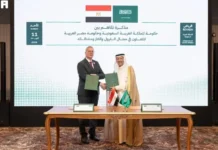

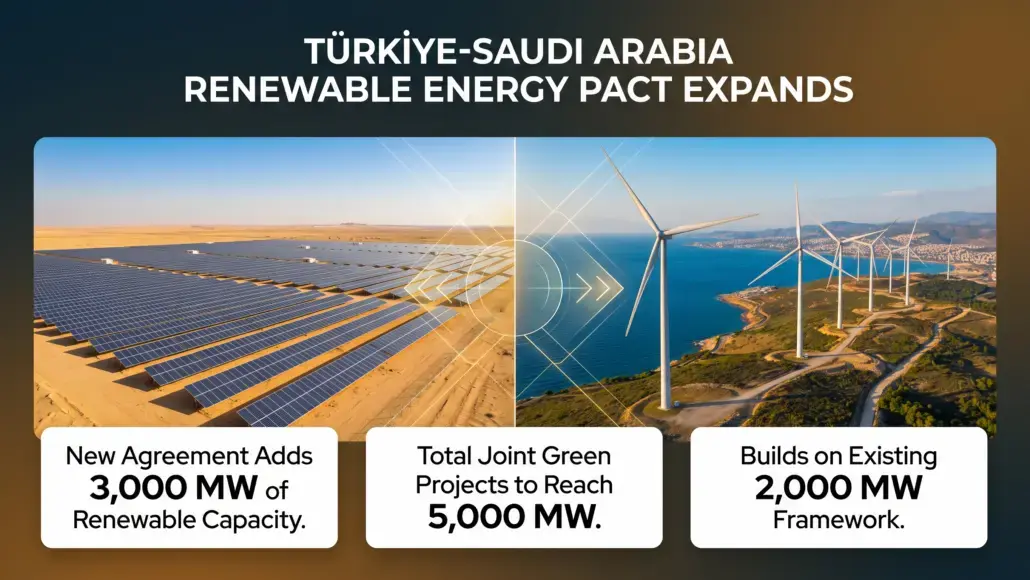

Türkiye and Saudi Arabia are set to broaden their bilateral energy cooperation through a new 3,000-megawatt renewable energy agreement, raising the total planned green capacity under their joint renewable energy partnership to 5,000 MW.
Turkish Minister of Energy and Natural Resources Alparslan Bayraktar announced that the new renewable energy agreement builds directly upon an earlier 2,000-MW framework established between the two countries. The additional accord is scheduled for formal execution on the sidelines of the COP31 United Nations Climate Change Conference, which will convene in Antalya, Türkiye, in November.
Expansion of National Generation Capacity
The strengthened renewable energy partnership aligns with ongoing efforts to reinforce national power infrastructure and decrease dependence on imported resources under the “Century of Türkiye” framework. Alparslan Bayraktar noted that the nation’s installed electricity capacity has increased nearly fourfold over the last 24 years, scaling from approximately 32,000 MW to 126,000 MW.
As a result of this development, Türkiye now ranks third in Europe for installed electricity capacity, overall power generation, and electricity consumption, positioned behind France and Germany. Over the same 24-year timeframe, domestic crude oil extraction has tripled, mineral exports have grown tenfold, and natural gas production has expanded ninefold.
Hydrocarbon Production and Regional Transit Initiatives
Domestic natural gas production from the Black Sea is projected to double this year and reach four times its current volume by 2028, providing enough fuel to supply an estimated 17 million households. Concurrently, daily crude extraction at the Gabar field in southeastern Türkiye has exceeded 83,000 barrels per day, supporting regional employment and economic progress. Ongoing exploration in Diyarbakır is evaluating unconventional oil formations that hold the potential to produce two to three times the output of the Gabar field.
Regional Hub Integration
Alongside domestic resource development, Türkiye is progressing discussions concerning the transit of Iraqi crude via the Ceyhan terminal, as well as transit options for Qatari natural gas and Kuwaiti crude. The country is also engaging in joint onshore and offshore exploration initiatives in Pakistan. Combined with broad energy cooperation, these projects support the country’s strategic objective to diversify supplies and function as an energy bridge between resource-producing nations, Europe, and global markets.