

















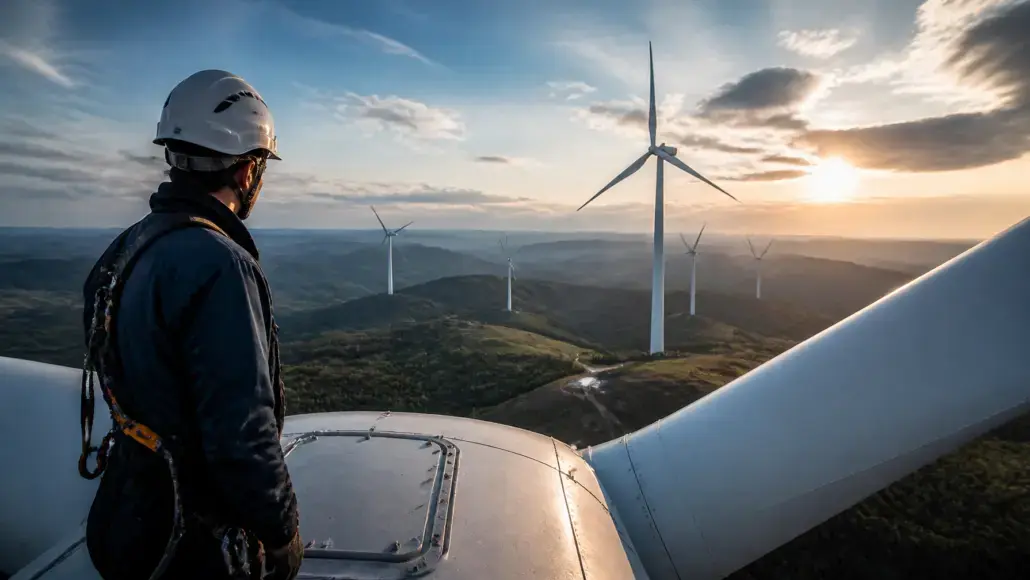

Wind turbines live and die by loads. The forces acting on a rotor, tower and drivetrain accumulate over roughly a billion load cycles in a 25-year design life, and how well those forces are managed determines whether a machine reaches its rated life, exceeds it or fails early. Ratings have climbed from 3 MW to 20 MW in under two decades while blade lengths have nearly tripled, and every increment of scale amplifies the load environment faster than conventional structural design alone can absorb. Intelligent turbine load control has therefore moved from a research interest to an operational necessity, combining sensing, modeling and coordinated actuation to keep next-generation machines inside their structural envelopes while extracting the maximum energy the wind offers.
The commercial logic is direct. Fatigue and extreme loads drive the sizing of almost every expensive component in a turbine, from blade laminates to tower base welds to main bearings. A load control capability that trims even a five percent margin off design loads allows engineers to specify lighter structures, longer blades or taller towers for the same reliability target, and each of those savings flows into the levelized cost of energy. Conversely, machines that operate without load intelligence accumulate damage invisibly and surrender their remaining useful life to chance.
Sensing the Structural State in Real Time
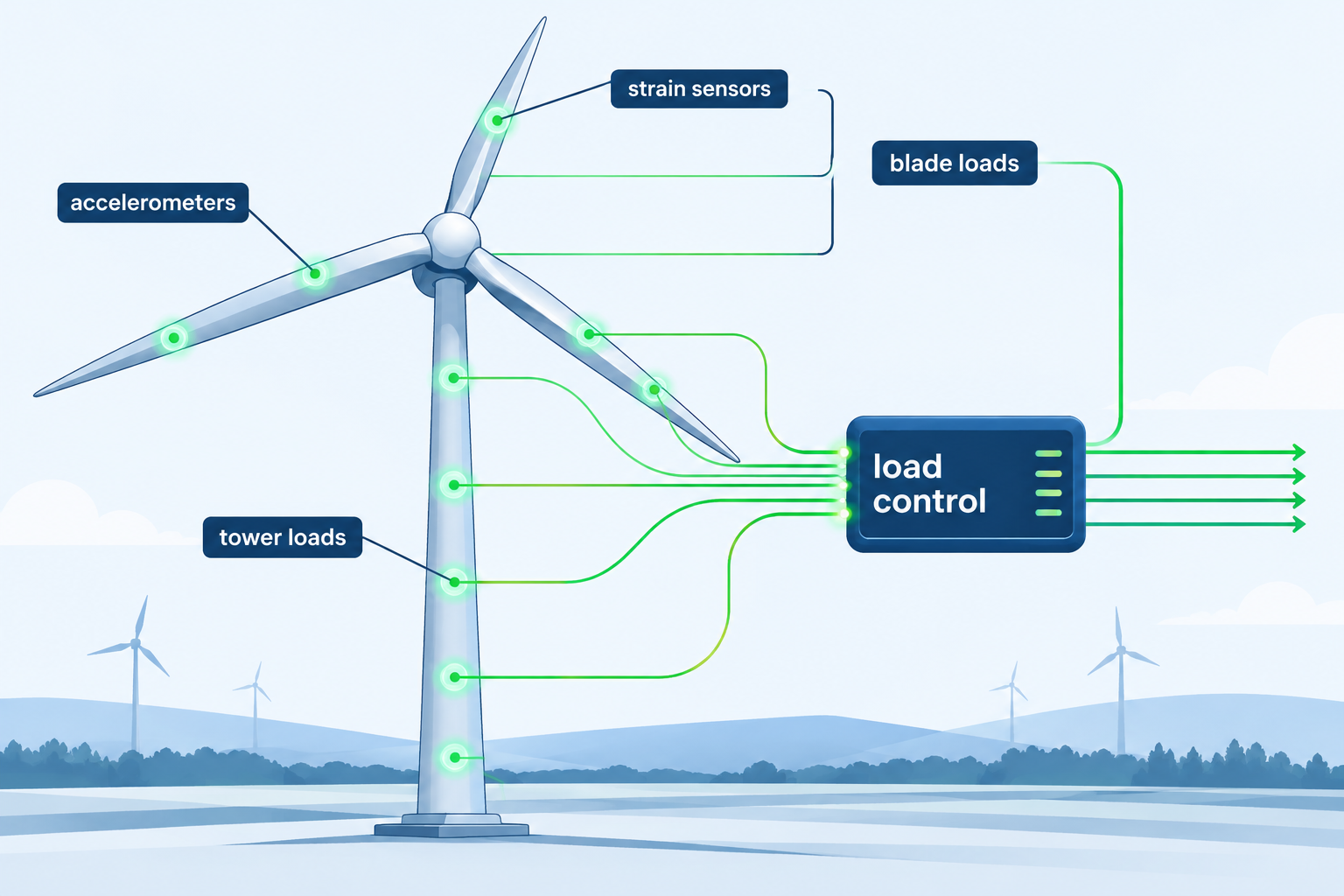
Load control begins with measurement, and modern turbines have become dense networks of instrumentation. Strain gauges bonded into blade roots and tower sections track actual structural response, accelerometers capture vibration signatures across the frequency spectrum, and pressure sensors document the aerodynamic forces arriving at the rotor in each gust. Fiber optic sensing now extends this capability along entire blade spans, delivering distributed strain profiles rather than readings from a handful of discrete points, which is essential on blades approaching 150 meters where localized overloads can hide between sensor locations.
The data these networks generate feeds two distinct purposes. In the short loop, real-time load estimates flow into control algorithms that adjust blade pitch, torque and damping within milliseconds of a measured or predicted load excursion. In the long loop, accumulated load histories populate structural health models that track fatigue consumption over months and years, converting raw signals into remaining useful life estimates for every major component. The combination turns the turbine into a machine that not only responds to loads but remembers them, a capability that reshapes maintenance economics for owners operating large fleets.
Installation practice has matured alongside the technology. Sensor networks are now specified during turbine design rather than retrofitted, with wiring routes, data bandwidth and power supplies allocated at the platform level. Standardization efforts across the industry are pushing toward common data formats so that signals from different sensor vendors feed the same analytics stack, a small detail with large consequences for owners who operate fleets assembled from multiple turbine suppliers.
Digital Twins and Predictive Load Modeling
The modeling layer above the sensors has matured rapidly. A digital twin of a modern turbine couples aeroelastic simulation, structural finite element models and measured operating data into a virtual machine that mirrors its physical counterpart continuously. Reviews published through 2025 document the technology’s growing role in turbine components, from real-time load estimation to predictive maintenance planning, and the offshore segment in particular has embraced twins as a way to manage the consequences of concentrating enormous capacity in single positions.
Predictive load modeling delivers value across several workflows. Controllers use short-horizon predictions to act before gusts strike, feathering blades or stiffening damping ahead of measured load peaks rather than reacting afterward. Operations teams use long-horizon load trend analysis to schedule maintenance during low-wind windows, deferring interventions when fatigue consumption is tracking below expectations and accelerating it when anomalies appear. Design engineers close the loop by comparing predicted and observed loads on operating fleets, calibrating the models that will size the next generation of machines.
Cost trajectories support wider adoption as well. Computing that once required dedicated simulation clusters now runs on cloud infrastructure priced per use, and analytics platforms have packaged twin technology as a subscription service accessible to mid-sized owners rather than only the largest utilities. The democratization of load modeling means that asset management quality increasingly separates competitors in operations and maintenance markets, an important shift for a sector where service contracts span decades.
The result is a continuous improvement cycle in which every operating hour strengthens the engineering basis for future platforms.
Coordinated Control from Machine to Farm
Load intelligence also operates at a scale above the single turbine, where wake interactions dominate. Every turbine in an array sits downstream of turbulent, energy-depleted air left by its neighbors, and these wake conditions impose load environments far more punishing than free-stream wind. Farm-level control strategies manage that reality by coordinating the behavior of multiple machines simultaneously, and the toolset now being commercialized includes several complementary approaches:
- Wake steering, in which selected upstream turbines deliberately misalign a few degrees to deflect their turbulent wakes away from downstream neighbors, reducing both fatigue exposure and production losses across the array.
- Coordinated pitch and torque schedules that respond to farm-wide wind conditions rather than local measurements alone, smoothing collective power output and limiting synchronized load excursions.
- Sector management, in which turbines curtail or reconfigure during specific wind directions known to drive harmful wake loading, protecting structural life during the highest-risk operating conditions.
- Dynamic wake mixing, an emerging technique that uses controlled rotor behavior to accelerate wake recovery and raise the energy content of air reaching downstream machines.
- Farm-aware siting and controller tuning, where load models developed during operation feed back into layout optimization for expansion phases of the same project.
Field campaigns led by institutions such as the National Renewable Energy Laboratory have demonstrated that wake steering alone can raise annual farm output by one to two percent in favorable layouts while reducing downstream fatigue exposure, gains achieved purely through intelligent coordination of existing hardware.
Implementation discipline determines whether these strategies deliver their modeled value. Wake steering requires accurate wind direction measurement at farm scale, and errors of a few degrees can turn intended gains into losses, so commercial deployments pair the control strategy with dedicated met masts, scanning lidar or nacelle-mounted direction sensors. Operators typically enable farm-level control gradually, validating performance per sector before extending coverage across the full array.
Loads as the Constraint on Capacity Growth
The connection between load management and turbine rating growth is now explicit in platform design. As rotors expand toward and beyond 300 meters, aeroelastic behavior becomes the limiting factor on blade length before material strength does, because long flexible blades interact dynamically with the aerodynamic forces they generate. Designers of ultra-large wind turbines therefore specify load control capabilities as headline requirements rather than options, integrating active damping, individual pitch coordination and real-time structural awareness into the baseline architecture. Without those capabilities, the fatigue budget of a 20 MW rotor cannot close; with them, blade designs that would otherwise be infeasible become certifiable.
The same logic extends offshore, where single-position failures carry outsized consequences. A 20 MW machine concentrates roughly the annual revenue of a small wind farm from the early 2010s in one structure, so owners instrument and monitor accordingly, using load-based condition assessment to justify warranty terms and insurance premiums. Certification frameworks are evolving in parallel, with load measurement and validated aeroelastic models increasingly expected as evidence in the approval pathway for extreme-scale machines.
The scale of that dependency becomes visible in procurement data. Technical scoring criteria in recent offshore tenders assign substantial weight to load measurement coverage, validated aeroelastic models and documented control capabilities, signals that intelligent turbine load control is now evaluated as core turbine technology rather than an enhancement.
The Operational Payoff
Fleet operators report the payoff in concrete terms. Load-informed maintenance converts unplanned downtime into scheduled interventions, and remaining useful life estimates built from measured loads allow owners to extend asset lives where the data supports it, deferring repowering capital while production continues. Retrofits that add load sensing and adaptive control to existing turbines have demonstrated measurable fatigue reductions and energy gains, providing a return pathway for fleets installed before intelligent control became standard.
Talent follows the same pattern. Load engineering, once a niche within turbine design, now supports dedicated career tracks at manufacturers, service companies and independent engineering firms, and universities have expanded aeroelastic and structural dynamics curricula to feed the demand. An industry that once hired primarily mechanical engineers for turbine work now recruits control theorists, data scientists and reliability engineers in equal measure.
For the industry as a whole, turbine load control has become the quiet infrastructure beneath every headline capacity figure, the discipline that allows rotors to grow larger, towers taller and lifetimes longer without structural consequences catching up. The next generation of wind power capacity will be built on machines that know precisely how hard the wind pushes them, and that respond intelligently every time it does.