





















Close
MCE 2026
World Hydrogen & Carbon Americas

World’™s Largest Tidal Farm to be Launched in Scotland

Note* - All images used are for editorial and illustrative purposes only and may not originate from the original news provider or associated company.

Subscribe

- Never miss a story with notifications

- Gain full access to our premium content

- Browse free from any location or device.

Media Packs

Expand Your Reach With Our Customized Solutions Empowering Your Campaigns To Maximize Your Reach & Drive Real Results!

– Access the Media Pack Now

– Book a Conference Call

Leave Message for Us to Get Back

Related stories

Industrial Decarbonisation and Power Sector Synergy

The path to a net-zero economy requires the deep integration of heavy industry with the electrical grid. By exploring the concept of sector coupling and the role of hydrogen in difficult-to-abate sectors, this analysis details how industrial decarbonisation and power sector synergy can create a more resilient, flexible, and efficient energy system through shared infrastructure and coordinated strategy.

Hydrogen Trade Corridors Reshape Global Energy Supply

The emergence of international hydrogen trade is fundamentally redrawing the world's energy maps. By establishing dedicated corridors that connect resource-rich exporters with high-demand industrial centers, the global energy transition is moving toward a more diversified and resilient supply chain underpinned by advanced maritime logistics and rigorous certification standards.

Largest Solar-Plus-Storage Project Hits Initial Grid Sync

The first phase of the MTerra Solar project in...
- Advertisement -
Ten underwater turbines will generate 30GW a year from the seafloor in the Sound of Islay, following government approval. A £40 million tidal array harnessing electricity from one of the UK’s most reliable and strongest tidal streams has been granted approval by the Scottish Government.

The 10MW tidal turbine project in the Sound of Islay, between the islands of Islay and Jura, will be the largest scheme of its kind in the world and will generate approximately 30GW per year, enough to power all the homes on Islay andJura – and, crucially, their whisky distilleries. Scotland has been described as the Saudi Arabia of offshore renewables by First Minister Alex Salmond. The Scottish Government offers higher subsidies for wave and tidal energy through Renewables Obligation Certificates (ROCs) than the rest of the UK. (That’s five ROCs for wave and three for tidal in Scotland, compared to two ROCs for both in the UK.)

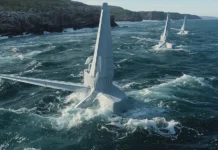
The ten turbines will sit 50m deep on the seabed in a 1km-wide underwater canyon where the peak tidal flow is a (more than sufficient) 3m per second. Each turbine will have an installed effect in excess of 1MW, and the first will be in place in 2013, with the full project running from 2015.

Unlike their wind-powered cousins, tidalturbines can’t be accused of any visible or audible pollution. Vessels will be able to operate on the surface without restrictions, and marine life will not be at risk from the turbines’ slow-turning arms. The tripod design also means the turbines will have a minimal ‘footprint’ on the ocean floor.

For Andrew Macdonald, Tidal Energy Project Manager of theIslay Energy Trust, the “real significance of this site” will be the lessons learnt for future, even larger, developments – including a 400MW installation proposed for the Pentland Firth. “It gives us a chance to show the systematic interaction between the turbines before hundreds are placed in the Pentland Firth.” Maintenance of multiple turbines in such a high-pressure and hard to reach environment will also be thoroughly tested.

The project is being built by ScottishPower Renewables using ten HS1000 turbines developed by Hammerfest Strom AS, and local contractors, ornithologists and divers. The Islay Energy Trust will get a (yet to be decided) cut of the profits to fund community projects in Islay, Jura and Colonsay, which all share the same grid.

Other significant tidal projects in the pipeline includeSouth Korea’s Incheon Bay power station which, with a capacity of 1,320MW, will be the largest in the world when it opens in 2017.

Latest stories

Related stories

Industrial Decarbonisation and Power Sector Synergy

The path to a net-zero economy requires the deep integration of heavy industry with the electrical grid. By exploring the concept of sector coupling and the role of hydrogen in difficult-to-abate sectors, this analysis details how industrial decarbonisation and power sector synergy can create a more resilient, flexible, and efficient energy system through shared infrastructure and coordinated strategy.

Hydrogen Trade Corridors Reshape Global Energy Supply

The emergence of international hydrogen trade is fundamentally redrawing the world's energy maps. By establishing dedicated corridors that connect resource-rich exporters with high-demand industrial centers, the global energy transition is moving toward a more diversified and resilient supply chain underpinned by advanced maritime logistics and rigorous certification standards.

Largest Solar-Plus-Storage Project Hits Initial Grid Sync

The first phase of the MTerra Solar project in...

F4OR Scotland Launches Offshore Wind Supply Chain Programme

Applications have opened for the first Scotland-wide Fit For...

Subscribe

- Never miss a story with notifications

- Gain full access to our premium content

- Browse free from any location or device.

Media Packs

Expand Your Reach With Our Customized Solutions Empowering Your Campaigns To Maximize Your Reach & Drive Real Results!

– Access the Media Pack Now

– Book a Conference Call

Leave Message for Us to Get Back

Translate »